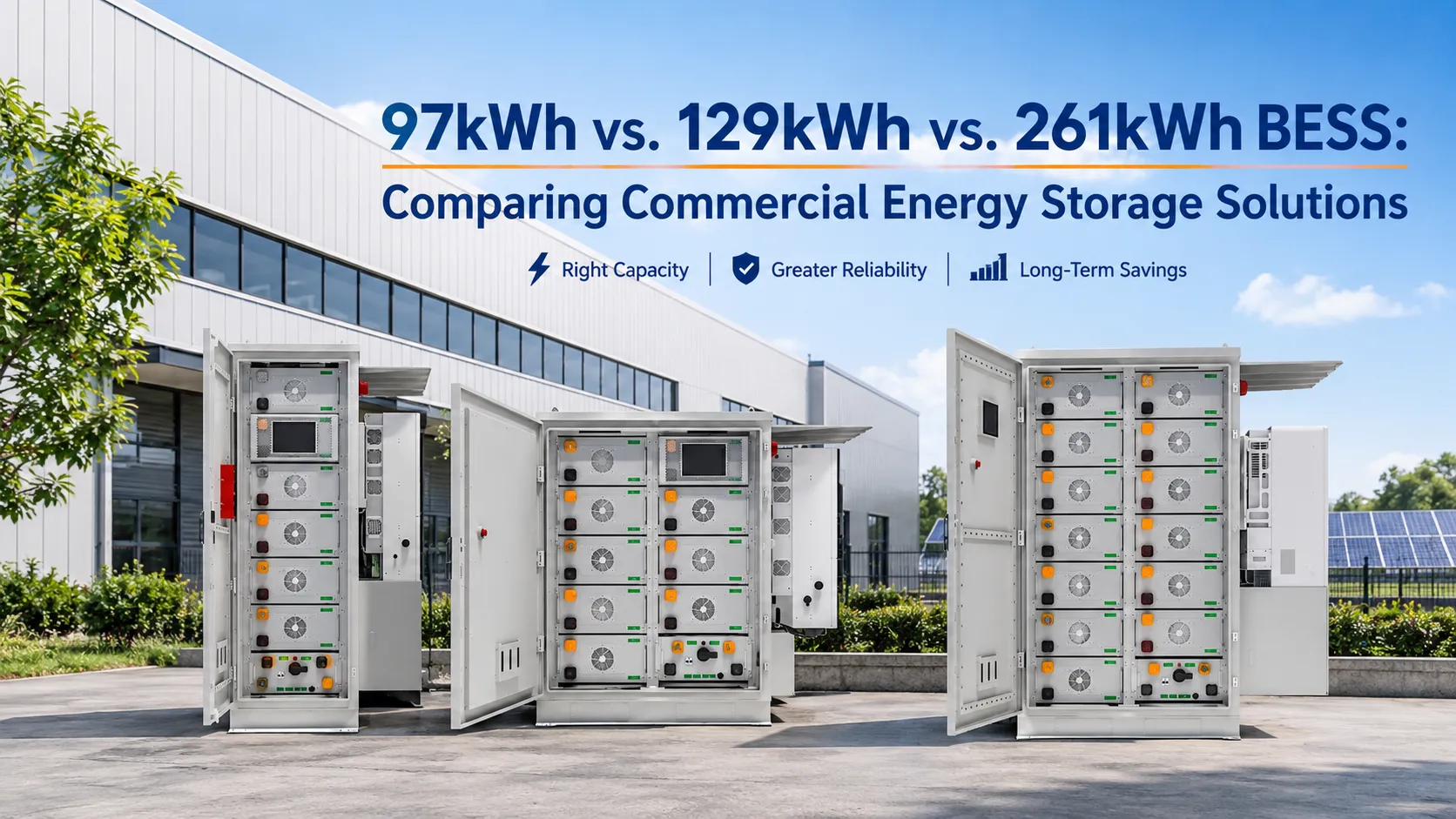
97kWh vs. 129kWh vs. 261kWh BESS: Comparing Commercial Energy Storage Solutions
Most C&I storage projects go wrong for one of two reasons. The battery is too small to cut the peak or carry the critical load through an outage, or it is so oversized that the extra kilowatt-hours never earn back what they cost.
Three capacities come up most often in commercial work: 97kWh, 129kWh and 261kWh battery energy storage systems. Between them they cover a wide range of sites, from a small retail unit and a commercial building through to a plant with several production lines.
Capacity is where the conversation usually starts, and it should not be where it ends. Rated power, discharge duration, chemistry, inverter compatibility, cooling and the facility's own consumption pattern decide whether a box that looks right on paper will actually perform.
Understanding Commercial Battery Energy Storage Systems (BESS)
What Is a Commercial BESS and How Does It Work?
A commercial battery energy storage system stores electricity and gives it back when the facility needs more power than the grid is supplying. Strip the marketing off and the working parts are always the same. Lithium modules hold the charge, a battery management system (BMS) watches the cells, and a power conversion system (PCS) moves energy between DC and AC. An energy management system (EMS) decides when charging and discharging should happen, and the safety and thermal hardware wraps around all of it.
A UPS sits idle until something breaks. A modern C&I BESS earns its keep daily, shifting energy between the utility grid, on-site solar and the loads.
The cycle itself is simple enough:
- Charging: The battery takes power from the grid, a solar PV system, or whatever source the site has available.
- Energy management: The EMS reads demand, state of charge, tariff windows and operating limits, then decides whether the next half hour is a charge hour or a discharge hour.
- Discharging: The PCS pushes stored DC back out as AC to the connected loads when demand climbs or the grid drops away.
- Monitoring and protection: The BMS tracks cell voltage, temperature and current, and opens protection paths before anything drifts out of range.
On a site with heavy consumption, those four functions show up as four line items: lower demand charges, more solar kWh used on site instead of exported, fewer production stops, less diesel.
Key Components of Modern C&I Energy Storage Systems
Layouts differ from one manufacturer to the next. The parts list rarely does.
Battery Modules
The energy sits here, usually in LiFePO4 cells. Module count is what sets the kWh figure on the datasheet.
Battery Management System (BMS)
Cell-level watchdog. It reads voltage, temperature and current across the pack, balances cells, and opens protection paths when a limit is crossed.
Power Conversion System (PCS)
The bidirectional gate between the DC bus and the AC side. Charge flows one way, discharge the other, and most conversion losses land right here.
Energy Management System (EMS)
The part that actually runs the asset: charge and discharge schedules, tariff logic, load limits, and the signals an operator can act on.
Thermal Management System
Air or liquid cooling holds cells inside their temperature window. In hot climates this is the component that most often decides how long the pack lasts.
Fire Protection System
Detection, suppression and the separation details local codes ask for. What gets installed depends on the system design, the site, and the authority having jurisdiction.
For EPC contractors and project developers, this parts list matters as much as the kWh number. Our breakdown of 129kWh BESS cabinet components goes through what is actually inside an integrated unit. Two systems rated at the same nominal energy can still differ on usable capacity, discharge power, efficiency and what they cost to run over ten years.
Understanding the Difference Between Battery Capacity (kWh) and Power Output (kW)
kWh and kW get used as if they were the same number in a lot of early-stage conversations, and that is usually where a sizing error starts. They measure different things:
- kWh (kilowatt-hours): how much energy the battery holds.
- kW (kilowatts): how fast it can give that energy back, or take it in.
Pair a 129kWh battery with a 65kW PCS and the arithmetic says 65kW for roughly two hours, assuming every kWh in the pack is usable and conversion losses are set to zero. They never are.
Real runtime comes off usable capacity, the depth of discharge (DoD) you allow, PCS efficiency, auxiliary loads (cooling fans do not run on nothing) and the operating limits written into the firmware.
Discharge Duration Calculation
Discharge Duration (hours) = Usable Battery Capacity (kWh) ÷ Output Power (kW)
Get this backwards and the project fails in a predictable way. A site that needs 200kW for twenty minutes buys 261kWh of energy it cannot move fast enough, or a site that needs six hours of light load buys power it never uses.
Overview of 97kWh, 129kWh, and 261kWh BESS Solutions
The three capacities below are reference points, not product tiers. Where a project actually lands depends on the load profile and how the system is configured.
97kWh BESS: A Practical Solution for Small Commercial Facilities & Retail
A 97kWh energy storage cabinet is the entry point for a business that needs real storage but has neither the load nor the space for an industrial-scale system.
Retail units, restaurants, offices, small workshops, and other sites whose consumption follows a fairly predictable daily pattern sit inside its range.
What it typically does:
- Trims short demand spikes instead of reshaping an entire day.
- Soaks up rooftop solar that would otherwise be exported at a low feed-in rate.
- Keeps selected critical loads alive long enough to shut equipment down in order.
- Backs a small commercial microgrid.
- Moves grid purchases out of the expensive tariff window.
A retail facility with a 30kW critical load would get around three hours of nominal energy out of 97kWh, again with full capacity available and losses ignored. Usable energy and system efficiency pull that number down, so treat three hours as the ceiling rather than the plan.
Two things sell this size: footprint and the size of the cheque. It also happens to be a workable building block for EPC contractors putting together standard commercial solar-plus-storage packages.
It is not enough for a site with large refrigeration equipment, several production lines or heavy machinery. There, discharge power and required backup duration have to be worked out load by load, because the kWh figure alone will not settle it.
129kWh BESS: Flexible Storage for Medium-Sized Commercial & Light Industrial Facilities
A 129kWh high-voltage rack energy storage battery carries about 33% more nominal energy than the 97kWh unit. That extra third is usually what buys a schedule some slack on a site with heavier consumption or a longer backup requirement.
Where it fits:
- Mid-sized commercial buildings and shopping facilities.
- Hotels, resorts and hospitality properties, where the load curve is anything but flat.
- Light manufacturing facilities and workshops.
- Commercial solar-plus-storage installations.
- Sites that keep getting hit with recurring peak demand charges.
Hotels are the clearest case. Air conditioning, lifts, kitchen equipment, water heating and room occupancy stack on top of each other at breakfast and again at dinner, and the load swings hard between those two peaks.
Midday PV can be parked in the battery and released into the evening peak, provided the battery and PCS are sized for this site rather than for a generic building.
Against a 97kWh system, the extra capacity leaves more room for energy scheduling and load management, and less pressure to run the pack down to its floor every day.
For EPC contractors it is the convenient middle: more than a small commercial unit, short of an industrial installation, and usually the number that keeps a hotel or light industrial project inside budget.
261kWh BESS: High-Capacity Storage for Factories & Large C&I Applications
A 261kWh commercial energy storage system is for sites whose energy demand sits in a different order of magnitude.
That works out to about 2.69 times the 97kWh unit and a little over twice the 129kWh one.
It tends to show up at:
- Manufacturing plants and industrial facilities.
- Factories running multiple production lines.
- Large commercial buildings and logistics centres.
- Industrial solar-plus-storage projects.
- Commercial microgrids, particularly where the grid connection is weak.
- EV charging stations with real charging throughput.
A plant running heavy machinery through the day, with a handful of machines that must keep running if the grid drops, is the shape this capacity was built for: more reserve, more headroom for demand management than smaller configurations offer.
It also makes sense where there is a substantial rooftop or ground-mount PV array. Surplus midday generation gets stored rather than exported, within whatever the charging limits and operating strategy allow.
Bigger does not automatically mean better returns. Tariff structure, demand charge basis, how many cycles the site can genuinely use, and the real energy requirement decide that.
97kWh vs. 129kWh vs. 261kWh BESS: Key Differences Compared
Energy Capacity, Rated Power, C-Rate, and Discharge Duration
Nominal capacity is the obvious difference between the three configurations. Rated power and discharge duration are what decide whether the stored energy can be moved fast enough to be useful.
The PCS ratings below are illustrative, chosen to keep the discharge durations in a similar range. Actual ratings have to be confirmed against the selected product configuration before anything is quoted.
97kWh BESS
97 kWh
Relative capacity: 100%
Illustrative PCS rating: 50kW
Illustrative C-rate: 0.52C
Ideal full-capacity discharge time: 1.94 hours
129kWh BESS
129 kWh
Relative capacity: 133%
Illustrative PCS rating: 65kW
Illustrative C-rate: 0.50C
Ideal full-capacity discharge time: 1.98 hours
261kWh BESS
261 kWh
Relative capacity: 269%
Illustrative PCS rating: 125kW
Illustrative C-rate: 0.48C
Ideal full-capacity discharge time: 2.09 hours
What those three cards show is that quite different energy capacities can be configured to land at roughly the same discharge duration. None of the pairings is an industry standard, and none is a guaranteed product specification.
C-rate is charge or discharge speed divided by nominal capacity. At 0.5C, a full battery is nominally empty in about two hours.
For project planning, EPC contractors should verify:
- Nominal and usable battery capacity.
- Maximum continuous charge and discharge power.
- Peak power, and how long the peak is permitted to last.
- Operating DoD and minimum state of charge.
- PCS conversion efficiency and auxiliary consumption.
- How the pack behaves across the ambient temperature range on site.
Battery Chemistry, Cycle Life, and Round-Trip Efficiency
Most modern commercial and industrial BESS products run on lithium iron phosphate (LiFePO4 or LFP) cells. LFP became the default in this segment for two reasons: thermal stability, and a cycle life that suits daily charge and discharge. Stationary storage cycles far more often than a vehicle pack ever does.
Capacity says nothing about lifespan. A 261kWh cabinet does not outlast a 97kWh cabinet just because it holds more energy.
What actually moves that number:
- Cell quality, and how consistent the manufacturing run was.
- How deep the pack is discharged, and how many times a day.
- Charge and discharge rates.
- Operating temperature, and how well the cooling holds it.
- BMS protection and cell balancing.
- Warranty terms, especially any annual throughput cap.
Round-trip efficiency is worth asking about early. It is output energy divided by input energy over a full cycle.
At 90% efficiency, every 90kWh taken out costs around 100kWh to put in, under the test conditions that produced the figure.
Ask suppliers for those test conditions and the third-party support behind the efficiency and cycle-life numbers. A headline figure with no conditions attached is not a specification.
System Configuration, Scalability, and Expansion Options
Internal layout decides three things nobody thinks about until commissioning: how much wiring happens on site, what maintenance looks like afterwards, and whether the system can grow.
Some designs put battery modules, BMS, PCS, EMS and safety equipment in a single cabinet. Others split the battery cabinets away from the power conversion equipment.
An integrated cabinet buys you:
- Less on-site wiring and commissioning work.
- A more standardised system integration.
- Easier transport and lifting on site.
- One place to monitor and maintain.
If the site is likely to grow, modularity matters more than anything else on the datasheet. Plenty of projects start at 97kWh and come back two years later asking for more storage as consumption climbs.
Check four things before buying on the promise of expansion: parallel operation, add-on battery cabinets, a PCS upgrade path, and whether the EMS actually speaks the protocol the new hardware needs.
Old and new modules also age differently. Bolting another cabinet onto a three-year-old pack does not produce a balanced system, and nobody should pretend it does.
Installation Space, Air/Liquid Cooling, and Thermal Management
Site work scales with capacity, and it is the part of the project that surprises people.
A 97kWh unit can usually be squeezed into a compact installation area. A 261kWh installation needs equipment layout, access clearance, ventilation and emergency access thought through before the concrete goes down.
Cooling choice feeds straight back into that layout.
Air cooling moves heat out with fans and controlled airflow. Simple, serviceable, and fine for smaller or lighter-duty applications.
Liquid cooling circulates coolant through a thermal management circuit and holds pack temperature more evenly. It is the usual choice in higher-capacity commercial storage cabinets.
Neither technology should be judged on its own merits. Cabinet design, ambient temperature, battery configuration, duty cycle and maintenance requirements all decide what the cooling achieves in practice.
In Southeast Asia, the Middle East and much of Africa, thermal design is not a detail. Sustained ambient heat speeds up cell degradation, and a cabinet that behaved well in a temperate climate can run its cooling system ragged at 45°C.
Before the site layout is fixed, check enclosure protection rating, installation clearances, drainage, ventilation, fire detection and whatever the local authority requires. Retrofitting any of it later is expensive.
Core Commercial Applications: How BESS Delivers Value
Peak Shaving and Demand Charge Reduction
Demand charges are where a lot of commercial bills actually go wrong. On many tariffs the utility bills the highest recorded demand in the billing period, not just the total kWh.
Discharge into the spike and the recorded peak drops.
Picture a factory where several production machines, the air compressors and the cooling systems all start inside the same interval. The battery covers part of that load and the meter never sees the full number.
Whether that turns into money depends on:
- The gap between peak and off-peak demand.
- How the utility calculates the demand charge.
- How long the peaks last and how often they recur.
- The BESS power rating, and the energy behind it.
- Battery degradation and what charging costs.
A 97kWh unit can carry a fairly modest demand reduction target. Larger or longer peaks usually point to 129kWh or 261kWh.
Size it off interval data rather than monthly bills. A bill tells you what you paid, not what caused it.
Backup Power and Microgrid Resilience
An outage costs a plant three ways: lost output, equipment stopped mid-process, and material that has to be scrapped.
A commercial BESS can carry critical loads through a grid failure, but only if the system has the islanding and grid-forming capability to run on its own. Without those, it is a battery that cannot be switched on.
What usually goes on the critical list:
- Industrial control systems and automation equipment.
- Server rooms and communication infrastructure.
- Security systems and emergency lighting.
- Refrigeration and essential HVAC equipment.
- Selected production machinery.
Where the grid is weak, the battery can also sit alongside solar PV and diesel generators in a hybrid microgrid.
PV carries the daytime base, the battery absorbs surplus generation and covers the selected loads, and the generator fills the gap when the other two run out of headroom.
Energy capacity and backup capability are different things, and the space between them is where optimistic proposals fall apart. A cabinet does not back up an entire factory by itself. The PCS, transfer equipment, protection settings, load priority and islanding design all have to support that mode of operation, or the mode does not exist.
Solar PV Integration and EV Charging Support
PV plus storage is mostly about using your own generation instead of giving it away.
Without a battery, midday surplus goes out the gate at a feed-in rate and comes back in the evening at retail price. The spread between those two numbers is what the battery is competing for.
It pays best at:
- Factories with large rooftop solar installations.
- Hotels with substantial evening consumption.
- Commercial buildings with variable daily load profiles.
- Sites operating under time-of-use tariffs.
Then there is EV charging.
A row of high-power chargers spikes the demand reading the moment two or three vehicles plug in together. The battery can supplement a limited grid connection and keep that peak where it is.
At a commercial charging station with limited grid capacity, stored energy covers the short high-power windows. What that is worth depends on charger output, how sessions are scheduled, battery power capability, and how much reserve is left at the end of the day.
How to Choose the Right BESS Capacity for Your Project
Analyzing Historical Electricity Consumption and Load Profiles
Sizing starts with the site's own history, not with a capacity table. Our 129kWh BESS cabinet sizing guide walks through one configuration in detail.
Monthly bills are a starting point and nothing more. They say how much, never when.
For an assessment worth acting on, EPC contractors should request:
- At least 12 months of electricity bills, where they exist.
- 15-minute or 30-minute interval load data.
- Daily and seasonal consumption patterns.
- Historical maximum demand, and when it occurred.
- PV generation data, if an array is already installed.
- Details of planned equipment upgrades or load expansion.
The load profile identifies which windows are worth charging and discharging in. It also stops you buying capacity the facility has no way to use.
Evaluating Peak Demand, Required Backup Duration, and Power Output
With consumption data in hand, power and energy get worked out separately.
Step 1: Determine the required power output.
Identify the maximum load the BESS must support during peak shaving or backup operation. Motor starting currents, power factor and equipment running at the same time all belong in that figure.
Step 2: Estimate the required energy capacity.
Multiply that load by the discharge period the site genuinely needs, not the period that looks good in a proposal.
Step 3: Account for usable battery energy.
The simplified sizing relationship is:
Required Nominal Battery Capacity
= Critical Load (kW) × Backup Duration (hours) ÷ (Usable DoD × Discharge Efficiency)
Take a facility that needs to support a 40kW critical load for two hours, on a design using 80% usable DoD and 95% discharge efficiency:
40 × 2 ÷ (0.80 × 0.95) = 105.3kWh
On those assumptions 97kWh is short, and 129kWh is the sensible starting point, subject to PCS output, reserve margin and other design constraints.
Which is the whole argument for not selecting on nominal capacity alone.
Considering Installation Space, Grid Conditions, and Permitting Requirements
A system can meet every energy and power requirement and still not be installable.
Before the configuration is finalised, project developers should assess:
- Available installation space: cabinet dimensions, access routes, maintenance clearance, equipment foundations.
- Grid connection: voltage level, transformer capacity, protection coordination, interconnection requirements.
- Environmental conditions: ambient temperature, humidity, dust, rainfall and flood risk.
- Fire safety: detection, suppression, separation distances, emergency access and local codes.
- Permits and approvals: electrical, building, fire and utility sign-off before installation.
Projects outside your home market usually bring standards into play: IEC 62619, UN 38.3, UL 9540 and UL 9540A, depending on the equipment, the market and the project specification. They cover different ground, from cell safety and transport through to system evaluation, and they are not interchangeable certifications.
For EPC contractors working across several countries, checking local regulations at design stage is cheaper than finding out during commissioning.
Calculating Total Cost of Ownership (TCO), ROI, and Long-Term Savings
The cheapest cabinet is rarely the cheapest project.
Total cost of ownership, not purchase price, is the comparison that holds up over an operating life.
What goes into it:
- Battery cabinets and battery modules.
- PCS, EMS and electrical equipment.
- Installation, wiring and commissioning.
- Cooling and auxiliary electricity consumption.
- Maintenance and monitoring.
- Battery replacement or capacity augmentation later in life.
- Transportation, taxes and permitting.
On the savings side, add up peak shaving, energy arbitrage, increased solar self-consumption, reduced diesel consumption and avoided operational interruptions, but only the ones that can be reliably quantified. Anything without a number should stay out of the payback line rather than be guessed into it.
The simple version of the calculation:
Simple Payback Period
= Total Initial Investment ÷ Annual Net Financial Savings
A commercial BESS project costing $100,000 and returning $25,000 a year in net savings lands at four years. Rough, and useful as a first filter.
Treat it as a filter rather than a forecast. A model that means anything has to carry battery degradation, electricity price movement, financing cost, replacement spend, system availability and the expected project operating life.
When three capacities are on the table, compare them on the same six questions:
Initial Investment
Does the capacity match the project's actual requirement, and do the savings justify the spend?
Energy Savings
How much grid electricity can the battery realistically offset?
Demand Reduction
Does it move the facility's monthly peak demand charge?
Battery Degradation
What happens to usable capacity over the project lifecycle?
Operating Costs
What does maintenance and auxiliary energy actually cost?
Expansion Potential
Can it take a future increase in demand without a rebuild?
Sometimes 97kWh wins outright, because its capacity matches the demand reduction the site can actually produce. Sometimes 261kWh earns more over the project life by carrying bigger loads and catching more surplus solar.
The target is the best balance of investment, operating performance and return, which is rarely the largest unit on the price list.
Conclusion: Selecting the Right Commercial BESS for Your Business
97kWh, 129kWh and 261kWh cover three different bands of C&I demand. Each exists because some group of sites needs that much storage and no more.
97kWh BESS
A practical option for smaller commercial facilities, retail stores, offices and projects with moderate storage requirements.
129kWh BESS
The flexible middle: mid-sized commercial buildings, hotels and light industrial applications that need more capacity than a small cabinet offers.
261kWh BESS
For factories, manufacturing facilities and larger commercial projects where the energy requirement, not the power rating, is the binding constraint.
These are indications rather than strict application boundaries. The configuration that holds up comes out of the load profile, the discharge power required, backup duration, the electricity tariff, available installation space and the project economics.
Choosing the supplier matters as much as choosing the capacity. What you want from a manufacturer is technical documentation you can check, performance data with test conditions attached, integration support, customisation that is actually available, and after-sales that answers. Our commercial and industrial energy storage products are listed here for comparison.
Frequently Asked Questions About Commercial BESS Solutions
1. How do I choose between a 97kWh, 129kWh, and 261kWh commercial BESS?
Pick by load, not by capacity number. 97kWh suits smaller commercial and retail sites. 129kWh covers hotels, commercial buildings and light industrial facilities, with more room to schedule. 261kWh is for factories and larger C&I projects where energy demand rather than power output is the binding constraint. Work from interval load data and the required power output first, then compare capacities.
2. Can a commercial BESS significantly reduce factory electricity bills?
It can, through three main mechanisms: peak shaving, time-of-use shifting and more solar kWh consumed on site. Discharging into a demand spike is the one that moves the bill hardest. The size of the saving depends on the local tariff, how demand charges are calculated, the daily load pattern, round-trip efficiency and how the system is scheduled. Get an interval-data analysis before anyone puts a payback figure in a proposal.
3. Can a 261kWh BESS power an entire factory during a grid outage?
Usually not. Runtime is set by consumption, usable capacity and PCS output: a 100kW critical load drains the same pack several times faster than a 30kW one. Motor starting currents, peak load, islanding capability and protection all add to that. Most projects back up essential production equipment and critical loads rather than the whole facility.
4. What is the difference between nominal battery capacity and usable battery capacity?
Nominal capacity is the total rated energy in the pack. Usable capacity is what can be taken out inside the permitted operating window. A 129kWh battery at 80% depth of discharge gives about 103.2kWh of usable DC energy, before conversion losses and auxiliary consumption. Ask suppliers for both figures, the recommended DoD, discharge efficiency and the capacity retention written into the warranty.
5. How long does it take for a commercial BESS investment to pay for itself?
It depends on capacity, installed cost, tariff and how hard the system is cycled. High demand charges, wide peak-to-off-peak spreads and substantial surplus PV shorten the period. Build the number from annual savings in peak shaving, energy shifting and self-consumption against total installed cost, then stress it for degradation, maintenance and long-run operating cost. A four-year payback on paper can become six once those are in the model.
Looking for the Right Commercial BESS Solution?
Still deciding between 97kWh, 129kWh and 261kWh? Talk directly with Bonada’s engineering team. EPC contractors and project developers usually come to us with interval data, a tariff schedule and a site plan, and that is enough to start sizing a site-specific C&I storage solution around the actual load profile.
Discuss Your BESS Project with Bonada
What Should EPC Contractors Look for in a Commercial BESS Supplier
Related Article