What Should EPC Contractors Look for in a Commercial BESS Supplier
Choosing the right commercial Battery Energy Storage System (BESS) supplier is one of the most important decisions an Engineering, Procurement, and Construction (EPC) contractor makes when delivering an energy storage project. Beyond equipment pricing, the supplier's technical capabilities, manufacturing reliability, safety standards, engineering support, and long-term service commitments can directly affect project costs, delivery schedules, and overall system performance.
As commercial and industrial (C&I) energy storage becomes increasingly important for applications such as peak shaving, load shifting, renewable energy integration, and backup power, EPC contractors need suppliers capable of delivering complete, project-ready solutions rather than simply supplying battery cabinets. Explore Bonada’s rack-mounted high-voltage energy storage systems for commercial and industrial applications.
However, not every BESS manufacturer has the same level of technical expertise or project experience. Some suppliers specialize in battery manufacturing, while others provide integrated systems involving battery management systems (BMS), energy management systems (EMS), power conversion systems (PCS), thermal management, and fire protection.
For EPC companies evaluating potential commercial BESS suppliers, understanding these differences is essential. EPC teams planning solar-plus-storage projects may also find our BESS solutions guide for solar EPC contractors useful.
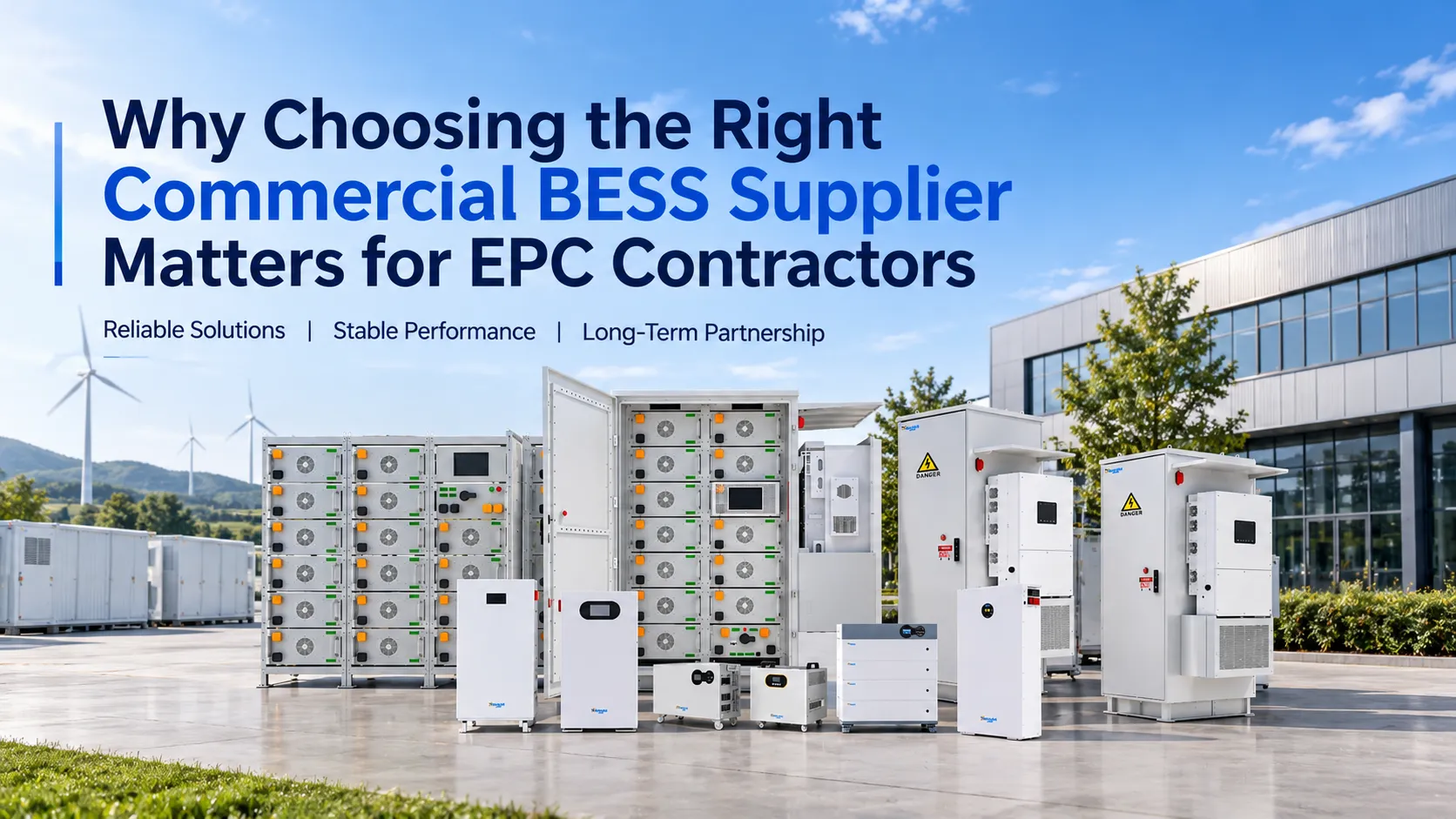
Why Choosing the Right Commercial BESS Supplier Matters for EPC Contractors
An EPC contractor is responsible for coordinating multiple aspects of an energy storage project, including system design, equipment procurement, installation, commissioning, and project delivery. A supplier that cannot meet technical or commercial requirements can create problems throughout the entire project lifecycle.
Protecting Project Timelines and EPC Profit Margins
Commercial BESS projects often involve multiple equipment packages, including battery energy storage cabinets, PCS units, transformers, switchgear, control systems, and monitoring equipment. Delays in any critical component can affect the entire installation schedule.
For example, if a battery supplier provides an estimated delivery date but cannot maintain its production schedule, an EPC contractor may face installation delays, additional labor expenses, postponed project acceptance, and potential contractual penalties.
Equipment pricing also needs to be evaluated carefully. A lower initial quotation does not necessarily mean a lower project cost. Incomplete configurations, additional integration requirements, expensive replacement components, or unexpected commissioning expenses can significantly increase the final investment.
A dependable commercial BESS supplier should therefore provide:
- Clear and realistic production and delivery schedules.
- Complete equipment configurations and transparent quotations.
- Defined technical specifications and project scope.
- Consistent communication throughout procurement and delivery.
- Reliable documentation to support installation and acceptance.
Mitigating Technical Risks and Field Delivery Challenges
Commercial energy storage systems must operate reliably under different environmental and electrical conditions. High ambient temperatures, humidity, dust, unstable grids, and frequent charging and discharging can all influence system performance.
A supplier that only provides standard battery products without understanding the project's operating conditions may leave important technical issues unresolved.
EPC contractors should prioritize manufacturers capable of reviewing site requirements, evaluating electrical configurations, and recommending appropriate system designs. This is particularly important for projects involving solar PV integration, diesel generator coordination, microgrids, or demanding peak-shaving applications.
Building Long-Term Supplier Partnerships for Scalable Growth
For EPC companies developing multiple commercial energy storage projects, supplier consistency is just as important as the performance of an individual installation.
A long-term supplier relationship can simplify equipment selection, technical communication, procurement planning, and after-sales coordination. It also allows EPC contractors to develop repeatable system configurations for different project sizes and applications.
Rather than selecting a supplier based on a single transaction, EPC companies should evaluate whether the manufacturer has the production capabilities, technical resources, and commercial flexibility to support future business growth.
Core Hardware, Thermal Management, and Pre-Integrated Architecture
The technical architecture of a commercial battery energy storage system determines how effectively it performs throughout its operating life. EPC contractors should look beyond advertised battery capacity and evaluate the quality and compatibility of the complete system.
Battery Cell Quality, Chemistry, and Lifecycle Performance
Battery cells are the foundation of any BESS installation. For most commercial and industrial stationary energy storage applications, lithium iron phosphate (LiFePO4 or LFP) has become a widely adopted battery chemistry because of its thermal stability, cycle-life characteristics, and suitability for frequent charge and discharge operations.
However, selecting LFP batteries alone does not guarantee reliable system performance. Cell manufacturing consistency, production traceability, capacity matching, operating conditions, and quality inspection procedures are equally important.
EPC contractors should request information about:
- Battery cell manufacturer, model, and rated capacity.
- Cell chemistry and manufacturing traceability.
- Nominal voltage and usable energy capacity.
- Recommended charge and discharge rates.
- Expected cycle life under clearly defined operating conditions.
- Allowable operating temperature and humidity ranges.
- Battery capacity retention and end-of-life criteria.
One important consideration is that cycle-life figures must always be interpreted alongside their test conditions. A battery advertised with 8,000 cycles, for example, should be evaluated based on its specified depth of discharge (DoD), charging rate, temperature, and end-of-life capacity threshold.
Without these details, comparing cycle-life claims between manufacturers can be misleading.
Intelligent BMS and Flexible EMS/PCS Integration
A commercial BESS is more than a collection of battery cells. Its control architecture determines how energy is stored, converted, distributed, and monitored. For a closer look at battery modules, BMS, EMS, cooling, and protection components, see what’s inside a 129kWh BESS cabinet.
The Battery Management System (BMS) monitors individual cells and battery modules, helping maintain safe operating conditions. It typically manages voltage, current, temperature, state of charge (SOC), and fault protection.
The Energy Management System (EMS) controls the overall energy strategy. Depending on the project configuration, it can coordinate charging and discharging schedules, renewable energy generation, grid interaction, and load demand.
The Power Conversion System (PCS) manages the conversion between DC battery power and AC electrical power. Its power rating and control capabilities must match the project's electrical requirements.
When evaluating a supplier, EPC contractors should confirm:
- Whether the BMS supports cell-level monitoring and protection.
- Whether the EMS can implement peak shaving and load shifting strategies.
- Whether the PCS supports the required grid-connected or off-grid operating modes.
- Whether communication protocols such as Modbus TCP, Modbus RTU, or CAN are supported where required.
- Whether the system can integrate with existing solar inverters, transformers, generators, and site monitoring platforms.
Compatibility is especially important for retrofit projects, where the BESS must work with existing electrical infrastructure rather than operate as an independent system.
Active Thermal Management and Multi-Layer Fire Protection
Thermal management is a critical consideration for commercial battery energy storage systems, particularly in regions with high ambient temperatures or demanding operating conditions.
Excessive battery temperatures can accelerate degradation, reduce available capacity, and increase operational risks. A qualified BESS supplier should provide a thermal management strategy appropriate to the system's capacity, cabinet design, installation environment, and operating profile.
Depending on the system architecture, thermal management may use forced-air cooling or liquid cooling. Liquid cooling is often considered for higher-density systems where maintaining relatively uniform temperatures across battery modules is important.
Fire safety also requires a comprehensive approach. EPC contractors should examine whether the system includes:
- Battery temperature and abnormal-condition monitoring.
- Electrical protection and fault isolation mechanisms.
- Smoke, heat, or gas detection where applicable.
- Appropriate fire suppression and emergency response provisions.
- Cabinet ventilation, pressure relief, or gas management measures where required by the design.
- Emergency shutdown and system isolation functions.
Importantly, fire suppression equipment alone does not establish that a BESS is safe. Cell-level protection, electrical design, thermal management, enclosure engineering, system testing, and installation requirements must work together.
Pre-Integrated System Design and Project-Specific Customization
Pre-integrated commercial BESS solutions can reduce engineering complexity for EPC contractors. Instead of independently sourcing and integrating every major component, contractors can procure a coordinated system with compatible battery modules, BMS, EMS, PCS, thermal management, and protection equipment.
However, pre-integration should not mean limited flexibility.
Different projects have different power requirements, energy capacities, installation environments, and grid conditions. A hotel requiring peak shaving may have a very different operating profile from a factory seeking backup power or a solar farm looking to improve renewable energy utilization. For reference, compare Bonada’s 97kWh outdoor BESS, 129kWh high-voltage rack system, and 261kWh commercial energy storage system.
A capable manufacturer should be able to discuss project-specific configurations, including:
- Battery energy capacity (kWh or MWh).
- PCS rated power (kW or MW).
- AC or DC coupling architecture.
- System voltage and grid connection requirements.
- Cooling and enclosure configurations.
- Communication interfaces and control strategies.
- Installation layout and equipment dimensions.
For EPC contractors, the ability to obtain customized technical proposals and system layouts before procurement can significantly reduce integration uncertainty.
Global Certifications, Safety Standards, and Local Grid Compliance
Certifications are an important part of commercial BESS supplier evaluation, particularly when EPC contractors are delivering projects in international markets.
However, different certifications cover different aspects of product safety, transportation, battery performance, and system integration. Contractors should verify the actual certificates and test reports rather than relying solely on a manufacturer's statement that its products are internationally certified.
Essential International Certifications (UL 9540, UL 9540A, IEC 62619, UN 38.3)
Several international standards and testing frameworks are particularly relevant to commercial battery energy storage systems. You can also review our guide to UL certifications for battery cells, packs, and energy storage systems.
| Standard | Main Scope | Why EPCs Should Check It |
|---|---|---|
| UL 9540 | Safety of energy storage systems and equipment. | Helps verify system-level safety evaluation. |
| UL 9540A | Test method for evaluating thermal runaway fire propagation in battery energy storage systems. | Provides evidence for fire propagation and installation risk assessments. |
| IEC 62619 | Safety requirements for industrial secondary lithium cells and batteries. | Supports battery-level safety verification. |
| UN 38.3 | Transport testing requirements for lithium batteries. | Important for international battery shipping and logistics. |
| IEC 62477-1 | Safety requirements for power electronic converter systems and equipment. | Relevant when evaluating PCS and associated power electronics. |
One distinction is particularly important: UL 9540A is a test method, not a standalone product certification. EPC contractors should ask whether the manufacturer has relevant test reports, which system configuration was tested, and whether the results apply to the equipment being proposed.
They should also confirm that certificate holders, product models, manufacturing locations, and system configurations match the actual quotation and equipment supplied.
Local Grid Codes, Interconnection Standards, and Environmental Ratings
International certifications do not automatically guarantee that a BESS can be connected to every local electricity network.
Grid-connected commercial energy storage systems must comply with the applicable utility and regulatory requirements in their installation markets. These may cover voltage and frequency operating ranges, power quality, anti-islanding protection, reactive power control, fault ride-through, and communication with grid operators.
For example, EPC contractors working in Europe may need to consider applicable national grid codes and EN 50549 requirements. Projects in other regions may be subject to different utility interconnection rules and approval procedures.
Environmental protection is another important consideration. Enclosure ingress protection ratings, such as IP54 or IP55, should be evaluated according to the installation environment rather than treated as interchangeable specifications.
Before selecting a supplier, EPC contractors should verify:
- Applicable local grid connection and interconnection standards.
- PCS compliance with required grid operating functions.
- Enclosure IP ratings and corrosion protection.
- Operating temperature, humidity, and altitude limitations.
- Local fire safety and installation regulations.
- Required utility approvals and commissioning documentation.
A supplier with international project experience should be able to identify potential compliance issues early and provide the necessary technical documentation for local approval.
Manufacturing Capacity and Supply Chain Resilience
A commercial BESS supplier's manufacturing capabilities directly influence product consistency, production schedules, and the ability to support large or repeated orders.
For EPC contractors managing several projects simultaneously, choosing a manufacturer with dependable production processes is essential.
Proven Commercial Track Record and Factory Audit Transparency
Project references provide useful evidence of a supplier's practical experience. However, EPC contractors should look beyond the number of projects listed on a company website.
Ask for relevant project information, including system capacity, application, installation location, commissioning status, and operating experience. A supplier with experience delivering commercial storage systems for factories, hotels, industrial facilities, or solar projects may be better positioned to understand the challenges associated with similar applications.
Where possible, arrange a factory audit or request a live production walkthrough. This can help verify whether the company actually manufactures the equipment or primarily acts as a trading intermediary. Learn more about Bonada’s manufacturing facilities and company capabilities.
During an audit, examine:
- Battery module assembly and testing facilities.
- Production equipment and manufacturing processes.
- Quality inspection and testing procedures.
- Incoming material inspection and traceability systems.
- Finished-product testing and packaging standards.
- Production planning and quality management documentation.
For international EPC partnerships, factory transparency helps establish confidence before larger procurement commitments are made.
Production Scalability and Reliable Delivery Lead Times
A supplier may be capable of producing a small number of battery cabinets but struggle when an EPC contractor needs several megawatt-hours of storage equipment within a fixed project schedule.
Production capacity should therefore be assessed against actual manufacturing resources, available materials, workforce capacity, and existing order commitments.
EPC contractors should ask manufacturers to provide:
- Monthly or annual production capacity.
- Typical lead times for standard and customized systems.
- Current production scheduling arrangements.
- Capacity to handle urgent or repeat orders.
- Contingency plans for component shortages.
It is also useful to distinguish between advertised production capacity and available delivery capacity. A factory's theoretical annual output does not necessarily reflect how quickly it can fulfill a new project order.
Component Sourcing, Supply Chain Traceability, and Quality Control
The reliability of a commercial BESS depends on more than its battery cells. PCS units, BMS components, EMS controllers, contactors, circuit breakers, cooling equipment, and other electrical components all influence system performance.
Uncontrolled component substitutions can create compatibility problems and make future maintenance more difficult.
A professional supplier should maintain clear component specifications and provide appropriate traceability throughout the production process.
Before placing an order, EPC contractors should confirm whether the manufacturer can provide a detailed bill of materials (BOM), approved component brands, inspection records, and factory acceptance testing (FAT) documentation.
Any proposed component substitution should be communicated and approved before shipment, particularly when it affects electrical ratings, safety performance, system compatibility, or warranty conditions.
Project Economics, Bankable Warranties, and Commercial Terms
Commercial BESS procurement decisions should be based on the total economic value of the system rather than the initial equipment quotation alone.
A lower-priced system may become more expensive over its operating life if it has lower usable capacity, higher auxiliary consumption, shorter battery life, or more demanding maintenance requirements.
Total System Cost and Long-Term Operating Economics
When comparing commercial energy storage suppliers, EPC contractors should calculate the total project cost, including all equipment and services required to deliver an operational system.
Depending on the project scope, this may include:
- Battery cabinets and battery modules.
- PCS, transformers, and electrical distribution equipment.
- EMS, BMS, and communication systems.
- Cooling, fire protection, and auxiliary equipment.
- Shipping, insurance, customs duties, and taxes.
- Installation, commissioning, and grid integration.
- Maintenance, spare parts, and future replacement costs.
For the project owner, the economic benefits of a BESS may come from peak demand reduction, time-of-use energy arbitrage, solar self-consumption, backup power, or participation in applicable grid services.
However, these benefits depend on local electricity tariffs, demand charges, operating schedules, system efficiency, and available grid programs. A reliable supplier should avoid presenting projected savings without understanding the project's actual load profile and operating conditions.
Round-Trip Efficiency (RTE) and Levelized Cost of Storage (LCOS)
Round-trip efficiency (RTE) measures how much energy can be discharged from an energy storage system compared with the energy required to charge it.
For example, if a system receives 100 kWh of charging energy and subsequently delivers 90 kWh, its measured round-trip efficiency is 90% under the specified test conditions.
For EPC contractors, it is important to understand whether the quoted efficiency refers to battery DC performance or complete system AC-to-AC performance. The latter provides a more useful basis for evaluating the energy delivered to the connected electrical network because it can account for PCS conversion losses and other system-level losses, depending on the test boundary. For a practical commercial-scale reference, see Bonada’s 100kWh commercial battery storage buyer’s guide.
Levelized Cost of Storage (LCOS) provides another useful comparison metric. It estimates the lifetime cost of stored and discharged energy over the system's operating life.
LCOS considerations typically include:
- Initial system investment.
- Charging energy costs.
- Operating and maintenance expenses.
- Efficiency losses.
- Battery degradation and replacement costs.
- Expected lifetime energy throughput.
Comparing RTE and LCOS helps EPC contractors assess whether a system offers genuine long-term economic value rather than simply an attractive purchase price.
Performance Guarantees, Capacity Retention, and Bankable Warranties
Warranty terms are among the most important commercial considerations when purchasing a commercial battery energy storage system.
A supplier may advertise a 10-year warranty, but the actual protection depends on the detailed contractual conditions.
EPC contractors should review:
- Warranty duration and commencement date.
- Guaranteed battery capacity retention over time.
- Permitted annual energy throughput and cycle limitations.
- Depth of discharge and operating temperature conditions.
- Applicable charging and discharging restrictions.
- Exclusions relating to installation and operating conditions.
- Product replacement, repair, and service procedures.
- Warranty transferability and geographical coverage.
It is also important to distinguish between a product warranty and a system performance guarantee. A battery warranty does not automatically guarantee the complete BESS will achieve a particular AC output, availability level, efficiency, or annual energy throughput.
For larger projects, EPC contractors should request clear contractual performance commitments supported by test data and defined measurement methods.
Transparent Pricing, Flexible Payment Terms, and Risk Allocation
International BESS procurement often involves multiple commercial risks, including currency fluctuations, transportation delays, customs clearance, and changes in project requirements.
A dependable supplier should provide a detailed quotation rather than a single equipment price without explaining what is included.
The quotation should clearly identify:
- Battery capacity and PCS power rating.
- Included and excluded equipment.
- Product configuration and technical specifications.
- Incoterms and delivery responsibilities.
- Production and shipment schedules.
- Payment milestones and order conditions.
- Warranty coverage and after-sales responsibilities.
Payment arrangements should be discussed in relation to order size, production progress, inspection requirements, and the financial arrangements of the project.
Clear commercial terms help both parties avoid misunderstandings and establish a more predictable procurement process.
Engineering Support, Commissioning, and Lifecycle O&M Services
Technical support is a major factor separating a dependable BESS manufacturer from a supplier that only delivers equipment.
For EPC contractors, access to engineering assistance before, during, and after installation can reduce project complexity and improve the overall delivery process.
Pre-Sale Engineering Design Assistance and Technical Documentation
Before procurement, the supplier should be able to review the EPC contractor's project requirements and recommend a suitable energy storage configuration.
This process normally starts with an assessment of the site's electricity consumption, maximum demand, load characteristics, existing power infrastructure, and intended BESS application.
For example, a factory seeking peak shaving may require a different battery capacity and PCS power rating from a hotel using storage primarily for backup power and solar self-consumption.
Useful pre-sales engineering deliverables may include:
- Preliminary BESS sizing recommendations.
- Battery capacity and PCS power calculations.
- Single-line electrical diagrams.
- System configuration and equipment datasheets.
- Battery cabinet layout and installation dimensions.
- Communication architecture and interface specifications.
- Preliminary project technical proposals.
These documents allow EPC contractors to evaluate the proposed solution before committing to equipment procurement and detailed installation planning.
Installation Guidance, On-Site Commissioning, and System Testing
Even a well-designed energy storage system can encounter problems if installation and commissioning are not properly managed.
Installation requirements may involve foundation preparation, electrical connections, grounding, ventilation clearances, fire safety provisions, communication cabling, and environmental protection.
The supplier should provide clear installation manuals and technical guidance for the EPC installation team.
Commissioning should include appropriate verification procedures, such as:
- Visual inspection and equipment installation checks.
- Electrical connection and grounding verification.
- Battery communication and BMS functional testing.
- PCS startup and operating mode verification.
- EMS communication and control testing.
- Protection function and emergency shutdown checks.
- Charging and discharging performance tests.
Factory Acceptance Testing (FAT) and Site Acceptance Testing (SAT) should be defined according to the project requirements. These procedures help confirm that the supplied equipment and installed system meet the agreed technical specifications.
Remote Monitoring, Spare Parts Availability, and After-Sales O&M Support
A commercial BESS is a long-term investment. Its performance must be monitored and maintained throughout its operating life.
Remote monitoring capabilities allow operators and maintenance teams to review key operating parameters, including SOC, battery temperatures, voltage, current, power output, alarms, and historical performance data.
When abnormal conditions occur, accessible monitoring information can help technical teams identify potential problems and determine whether corrective action is required.
EPC contractors should evaluate the supplier's long-term service capabilities, including:
- Remote technical troubleshooting.
- Software and firmware support.
- Availability of replacement components and spare parts.
- Warranty claim procedures.
- Technical response times and escalation channels.
- Preventive maintenance recommendations.
- Support for system upgrades and future expansion.
For international projects, geographical distance makes communication arrangements particularly important. A supplier should have a clear process for handling technical enquiries, replacement requests, and warranty claims across different time zones.
Essential Due Diligence Checklist for EPCs Evaluating BESS Suppliers
After reviewing technical specifications, certifications, manufacturing capabilities, and commercial terms, EPC contractors should conduct a structured supplier evaluation before signing a purchase agreement.
The following checklist can help organize supplier discussions and identify potential risks during the selection process.
Technical, Safety, and Integration Verification Questions
- What battery chemistry and cell manufacturers are used in the proposed system?
- What are the rated and usable energy capacities?
- What is the rated PCS power output?
- What is the guaranteed round-trip efficiency, and how is it measured?
- What are the expected cycle life and capacity retention conditions?
- Which BMS, EMS, and PCS configurations are available?
- What thermal management and fire protection systems are included?
- Which international certifications and test reports can be provided?
- Does the proposed configuration meet the project's local grid requirements?
- Can the system integrate with existing solar PV, generators, and electrical infrastructure?
Manufacturing, Delivery, and Commercial Risk Questions
- Does the company manufacture the BESS equipment or primarily resell products?
- Can the supplier provide factory audit access or a production walkthrough?
- What is its actual monthly production capacity?
- What is the estimated lead time for the proposed configuration?
- Are the major components and their manufacturers clearly identified?
- Can the supplier provide relevant commercial project references?
- What equipment, services, and logistics costs are included in the quotation?
- What are the payment terms, delivery conditions, and order cancellation policies?
Warranty, Commissioning, and Long-Term Support Questions
- What is the warranty period for the battery, PCS, and other major components?
- What capacity retention and energy throughput guarantees apply?
- Who is responsible for commissioning and technical acceptance?
- Does the supplier provide installation guidance and technical documentation?
- Is remote monitoring and troubleshooting available?
- How are warranty claims handled for overseas projects?
- Are replacement parts readily available?
- Can the manufacturer support future capacity expansion or system upgrades?
To make the evaluation more objective, EPC contractors can use a weighted supplier scorecard rather than relying on quotations alone.
| Evaluation Category | Suggested Weight | Key Evaluation Focus |
|---|---|---|
| Technical Capability | 25% | Battery quality, BMS, EMS, PCS, system integration. |
| Safety and Certifications | 15% | Applicable standards, test reports, fire safety. |
| Manufacturing and Quality | 15% | Production capacity, traceability, quality control. |
| Commercial Competitiveness | 15% | Total cost, payment terms, delivery conditions. |
| Warranty and Performance | 15% | Capacity retention, efficiency, warranty commitments. |
| Engineering and After-Sales Support | 15% | Design assistance, commissioning, technical response. |
| Total | 100% | Overall supplier evaluation. |
These weights are an illustrative starting point, not an industry-wide standard. EPC contractors should adjust them according to project complexity, local regulations, contractual responsibilities, and the owner's priorities.
Partnering with a Reliable BESS Supplier for Long-Term EPC Success
Selecting a commercial BESS supplier is not simply a procurement decision. It is a strategic choice that influences project engineering, equipment reliability, installation efficiency, financial performance, and long-term customer satisfaction.
For EPC contractors, the most suitable supplier is not necessarily the one offering the lowest initial price or the largest advertised production capacity. It is the manufacturer that can consistently meet technical requirements, provide transparent product documentation, maintain reliable production schedules, and support the project throughout its operating life.
As the commercial energy storage market continues to develop, EPC companies will increasingly need suppliers capable of supporting different applications, including industrial peak shaving, hotel energy management, solar-plus-storage installations, microgrids, and backup power systems.
Building a relationship with a technically capable and commercially reliable BESS manufacturer can help EPC contractors improve project execution, reduce procurement risks, and develop a stronger competitive position in the growing energy storage market.
Frequently Asked Questions About Choosing a Commercial BESS Supplier
1. How can EPC contractors verify whether a BESS supplier is a genuine manufacturer or just a trading company?
EPC contractors should look beyond a supplier's website and product catalog. Request a factory video tour or arrange an on-site audit to inspect battery assembly lines, testing equipment, quality control procedures, and production facilities. You should also ask for battery cell traceability, component documentation, and relevant manufacturing certifications. A genuine manufacturer should be able to explain its production processes, provide technical documentation, and demonstrate how it manages product quality from incoming materials to final system testing.
2. What is more important when comparing commercial BESS suppliers: price per kWh or total system cost?
Total system cost is a more reliable comparison metric than battery price per kWh alone. EPC contractors should consider battery capacity, PCS power, BMS and EMS integration, thermal management, fire protection, transportation, installation, and commissioning expenses. Long-term factors such as round-trip efficiency, battery degradation, maintenance requirements, and warranty coverage also affect project economics. Two suppliers offering the same nominal battery capacity may deliver significantly different overall value depending on their system configurations and included services.
3. How do EPC contractors ensure a commercial BESS is compatible with existing solar inverters and grid infrastructure?
Compatibility should be verified during the engineering and design stage, before equipment procurement. EPC contractors should provide the supplier with the existing electrical system configuration, inverter specifications, grid voltage and frequency, load profile, and intended operating modes. The BESS supplier should then review PCS compatibility, BMS and EMS communication protocols, protection requirements, and grid interconnection conditions. Technical documents such as single-line diagrams, communication architecture drawings, and integration test reports can help identify potential issues before installation.
4. Which certifications should EPC contractors request before purchasing a commercial battery energy storage system?
The required certifications depend on the project location, system configuration, and applicable regulations. Commonly referenced standards include UL 9540 for energy storage system safety, UL 9540A for thermal runaway fire propagation testing, IEC 62619 for industrial lithium battery safety, and UN 38.3 for lithium battery transportation testing. EPC contractors should also verify local grid connection requirements and relevant PCS compliance standards. Always request actual certificates and test reports, and confirm that the documented product models and configurations match the equipment being purchased.
5. What should EPC contractors include in a commercial BESS supplier agreement to avoid problems after installation?
A well-defined supplier agreement should cover product specifications, delivery schedules, acceptance testing, warranty conditions, performance commitments, and after-sales responsibilities. Pay particular attention to battery capacity retention, permitted energy throughput, operating temperature limits, warranty exclusions, and replacement procedures. The agreement should also clarify who provides installation guidance, commissioning support, remote troubleshooting, and spare parts. For international projects, defined technical response times and clear warranty claim procedures are especially important for protecting project schedules and long-term customer relationships.
Looking for a Reliable Commercial BESS Manufacturing Partner?
Build your energy storage projects with a dependable factory-direct supplier. Bonada supports EPC contractors and system integrators with customized commercial BESS solutions, technical documentation, engineering assistance, and project-based quotations. Share your project requirements with our team to explore the right configuration for your application.
Discuss Your BESS Project with Bonada
BESS for Telecom Towers: Improving Power Reliability in Weak Grid Areas
Related Article