BESS Solutions for Solar EPC Contractors: Commercial Energy Storage Guide
Factory and business operators are constantly dealing with expensive power, rising consumption, and green transition mandates. Energy storage units have therefore turned into a common add-on for solar schemes. Solar EPC vendors can broaden their service portfolio by incorporating storage solutions, helping projects perform better financially and cater to clients’ unique operational needs.
Solar panels alone only make electricity when the sun shines. Once paired with storage, firms can save surplus solar power. The stored energy can be drawn on during peak consumption, cloudy spells, or grid failures. This option suits high-energy locations including manufacturing workshops, hospitality sites, shopping plazas, office spaces and farm infrastructure.
That said, building a dependable commercial storage setup is far from simply buying large-capacity batteries. EPC teams have to study how power loads shift on site, set suitable power and energy ratings, source compatible conversion hardware, design safe electrical connections, follow local safety codes, and work out the long-term financial returns over the equipment’s service lifespan.
Understanding Commercial BESS for Solar EPC Projects
What Is a Commercial Battery Energy Storage System (BESS)?
For business premises, battery storage is a combined energy setup built around rechargeable battery packs. It holds electrical power and releases it on demand. When deployed with solar, these storage units interact with PV panels, local mains supply and the site’s internal wiring network.
The core goal of such storage hardware is to streamline the whole energy cycle from generation through to end use. Site operators are no longer limited to drawing power straight from the grid or using solar output only while the sun is out. This allows much more deliberate control over energy usage patterns.
Solar paired with commercial storage can run in multiple operating modes:
- Capture surplus solar: Extra power produced by PV modules fills the battery, rather than being fed out to the grid or left unused.
- Peak load reduction: Batteries kick in at times when power use surges, cutting the site’s peak power draw from the grid.
- Tariff arbitrage: Saved power gets consumed during high-price tariff windows, bringing down regular electricity bills.
- Standby power supply: Where the system supports island mode, it keeps key equipment running if the mains supply cuts out.
- Automated energy control: An EMS orchestrates solar output, battery charge and discharge, grid power intake and onsite load consumption in sync.
For EPC service providers, commercial battery storage is more than just an extra component added to a solar build. It acts as a versatile control layer that lifts the overall project value.
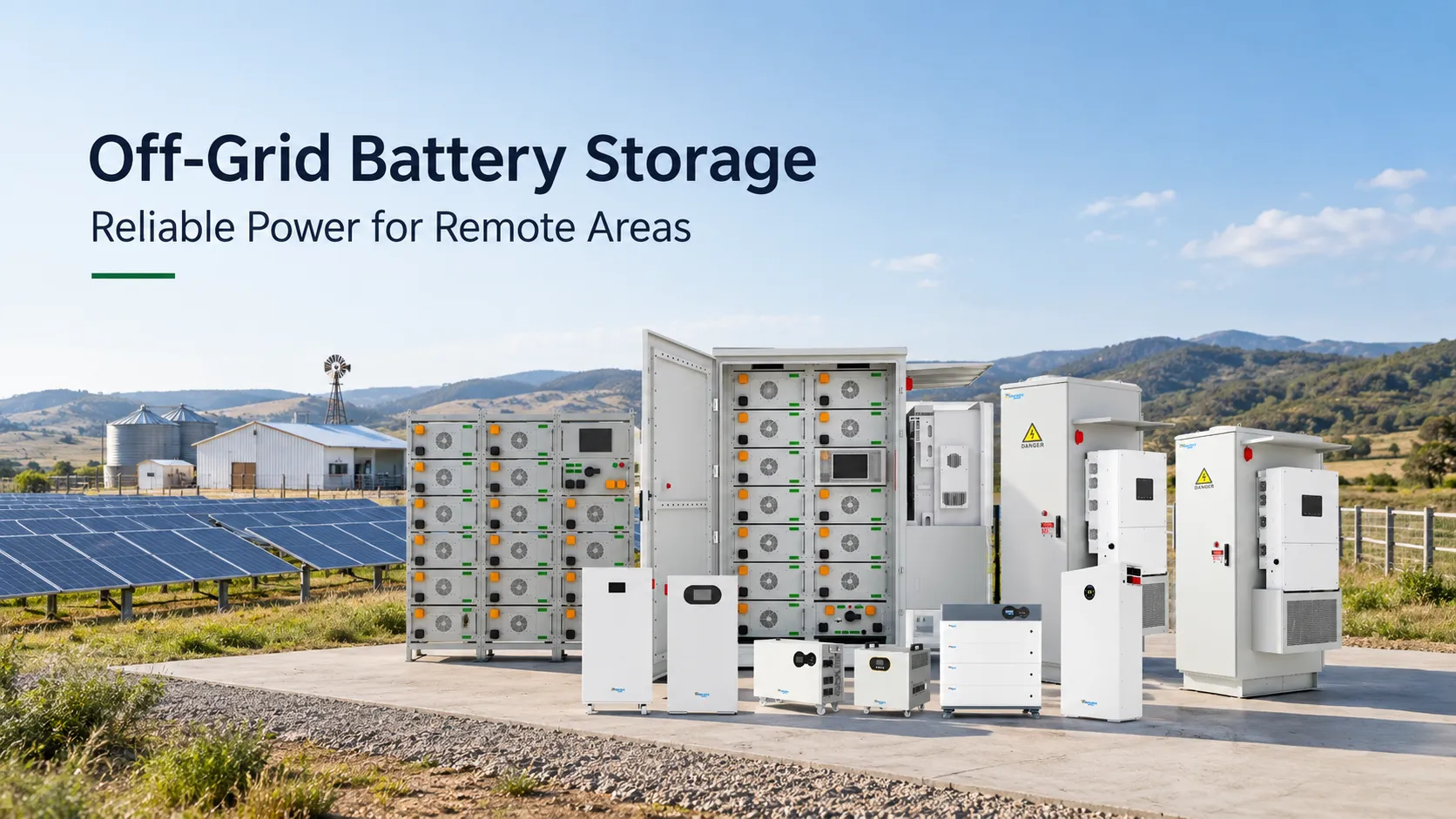
These storage units come in many sizes, from compact outdoor cabinets up to large containerised systems with MWh-scale capacity. The right layout is decided based on the client’s load profile, project targets, available footprint and grid connection rules.
Core BESS Components: BMS, PCS, EMS, and Batteries
Commercial storage systems are built from multiple functional modules that work as one integrated unit. The overall performance, safety and long-run reliability do not depend on any single part alone, but on how well these separate modules coordinate with each other.
| Component | Main Function | Importance for EPC Contractors |
|---|---|---|
| Battery Modules | Store electrical charge and release power when site demand rises. | Dictates total energy capacity, cell chemistry and the expected cycle lifespan. |
| BMS | Tracks voltage, current and temperature across every battery cluster. | Guards batteries against faults and moderates their operating status. |
| PCS | Switches power between direct and alternating current in both directions. | Sets the maximum charge/discharge rate and governs grid interaction behavior. |
| EMS | Routes energy flows and carries out custom operational plans. | Supports peak demand cutbacks, boosts solar self-consumption and enables flexible scheduling. |
| Thermal Management | Holds battery temperature within a safe, suitable operating band. | Preserves consistent output, lowers hazard risks and extends the unit’s service life. |
| Protection and Fire Safety | Flags irregular operating signals and contains heat or electrical hazards. | Helps projects satisfy local safety codes and regulatory compliance requirements. |
Lithium cells can easily become damaged if running outside safe operational thresholds. The monitoring unit continuously gathers readings from each battery group. Where supported, it balances charge levels between cells and feeds real-time status data back to the main control hub.
This power conversion hardware handles bidirectional energy transfer. To fill the battery bank, it converts grid-supplied alternating current into direct current. When power needs to be delivered out, stored direct current is converted to AC for on-site loads or grid export.
All live readings collected from batteries, converters, solar inverters and power meters go into the site’s energy control platform. This platform works out the best time to capture surplus power or dispatch stored energy to match the facility’s usage patterns.
Integration teams must verify seamless data exchange across all these devices. Even premium battery hardware will deliver poor results if these core control units cannot communicate steadily with one another.
Thermal Management Systems: Air-Cooled vs. Liquid-Cooled
Keeping battery packs within a stable thermal window is one core design priority for commercial energy storage. Extreme heat will slow charging, weaken discharge output, speed up cell ageing and create safety hazards, so every project needs a practical heat management plan.
When engineers design thermal control for these storage systems, two mainstream solutions are widely selected: forced air cooling and liquid loop cooling.
Air-cooled configurations rely on ventilation fans to move ambient air through gaps between battery modules and carry excess heat away. This option features simple hardware setup. It does not require complex pipework, making routine upkeep much easier for site operators.
It fits well for smaller commercial storage deployments with moderate heat output. The main drawback shows when batteries are packed tightly together. Hotspots are hard to eliminate, and temperature gaps between different modules become obvious.
Liquid cooling systems rely on circulating coolant flowing through heat exchangers attached to battery units. This design enables far finer thermal tuning and keeps temperature differences across the whole battery bank to a minimum.
It has become the preferred option for large container-type industrial storage. It performs best for high-density battery layouts, sites running nonstop, or locations exposed to consistently high ambient temperatures.
| Comparison Points | Air Cooling | Liquid Cooling |
|---|---|---|
| Overall build difficulty | Low, fewer auxiliary components | Higher, with pumps, pipes and coolant circuits |
| Thermal balancing effect | Restricted, highly tied to air duct layout | Highly consistent if the loop layout is optimized |
| Battery packing density | Works for low-density rack layouts | Ideal for compact, high-density cabinet designs |
| Regular maintenance scope | Fan checks and periodic filter replacement | Coolant inspection, pump and pipeline troubleshooting |
| Common application scenarios | Small and medium commercial battery storage | Large industrial and utility-scale container storage |
There is no one-size-fits-all thermal solution. EPC teams need to run a full evaluation covering the system’s power rating, local climate features, rack density, parasitic power consumption, maintenance plans and total life-cycle expenditure before finalizing the cooling scheme.
Key Advantages of Integrating Storage into Commercial Solar Systems
Peak Shaving and Demand Charge Reduction
Business electricity billing often includes extra demand fees calculated from the site’s maximum power draw captured within each billing window. Manufacturing plants, hospitality venues, logistics warehouses and other commercial premises frequently see these charges take a big chunk out of their monthly energy spending.
Peak load reduction relies on stored battery power to offset grid consumption whenever the facility hits its highest electricity usage.
As an illustration, one production site runs steadily at 500 kW, but its load can surge up to 700 kW the moment multiple production equipment units start together. A correctly configured battery storage setup can supply around 150 kW during these spikes, which brings the grid power draw down to roughly 550 kW.
Potential financial gains vary according to local utility pricing schemes, how long these load surges persist, the battery’s output capability, and how frequently peak events take place.
This gives solar EPC builders a fresh way to structure project designs. Rather than only highlighting how many solar kilowatts are installed, they can frame proposals around tangible, calculable cost savings for their customers.
Maximizing Solar Self-Consumption and Energy Arbitrage
It is normal for commercial solar installations to create more power than the building can use at midday. When there is no battery bank or favorable grid export terms, the extra energy cannot translate into meaningful savings for the business owner.
Energy storage systems capture this unused solar output. The stored power is then released to support the site’s load when on-site generation drops off.
Businesses get to utilise more of their own solar energy and buy less electricity from the grid. This benefit stands out for night-shift work or cloudy stretches with limited sunlight.
Time-varying power prices also open another cost-saving route. Under time-of-use rate plans, batteries can store power in cheaper windows and supply power when electricity becomes costly.
That said, this price-shifting tactic does not always end up profitable. Project teams need to consider energy loss through charge and discharge cycles, gradual battery wear, charging expenses, local tariff rules, and grid limits on importing or exporting power.
Enhanced Grid Resilience and Microgrid Backup Power
When the main grid goes down, companies lose money fast. A sudden outage can stop an entire assembly line, leave a hotel without basic services, or ruin temperature-sensitive stock in cold storage.
This is precisely why businesses look at commercial BESS. The idea is simple: keep the essential equipment running when utility power fails. However, running a system completely off-grid requires a lot more than just battery racks. You need grid-forming inverters, physical isolation gear, proper control logic, and a solid microgrid design to actually pull off islanded operation without tripping the system.
Solar arrays cause a lot of confusion here. Most clients think their PV systems will automatically power the building during a blackout. They won't. Standard grid-following solar inverters are built to cut off immediately when they lose the utility signal. If you want solar to stay active during an outage, the system must be engineered from day one with a compatible microgrid or backup architecture.
If you're an EPC, don't over-promise on this. Calling a storage project "uninterruptible power" when the transfer switches, protection schemes, and inverter topologies aren't actually set up for it is a quick way to run into legal and technical trouble.
Commercial BESS Product Configurations and System Types
Outdoor Cabinet BESS Solutions
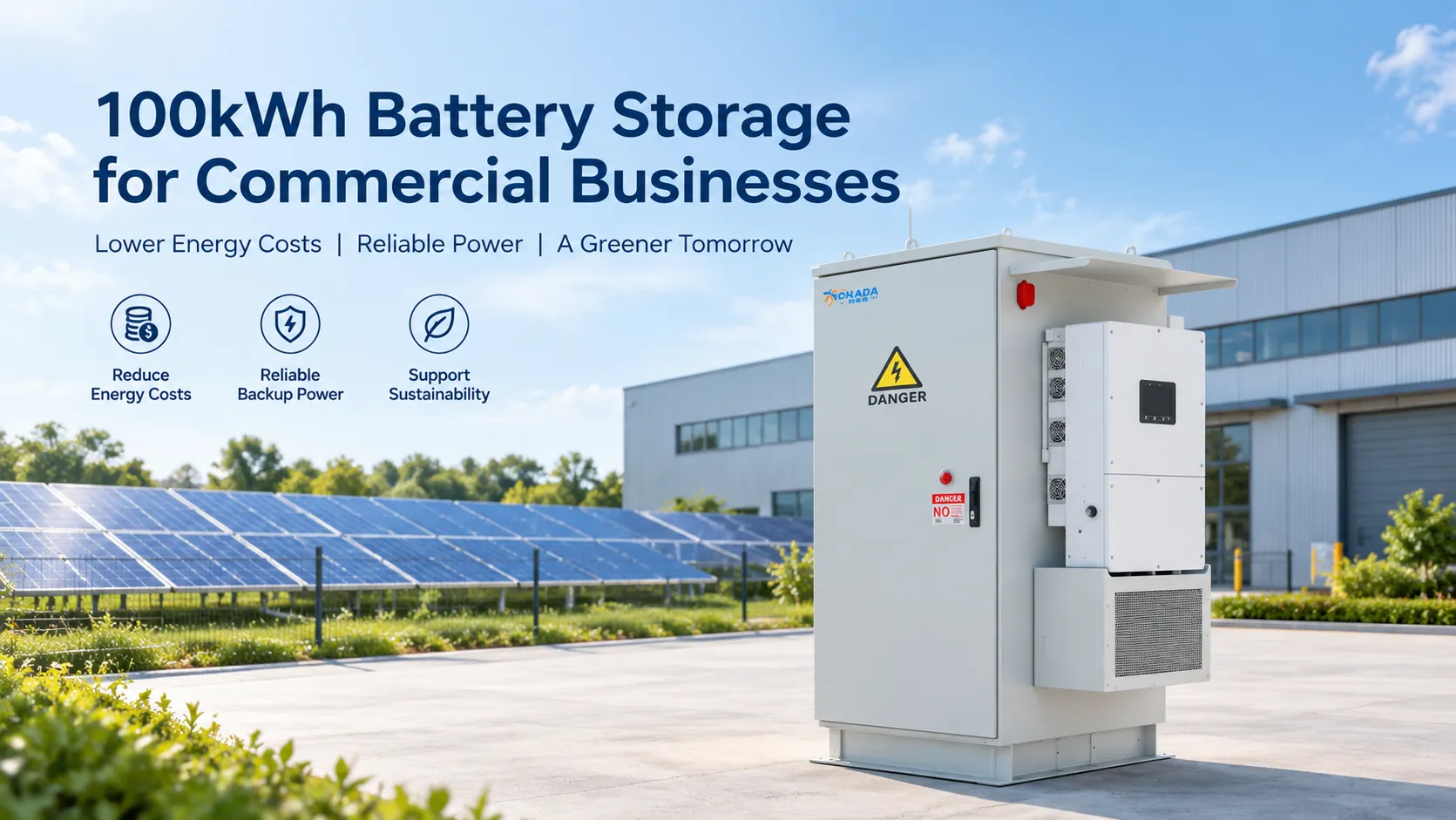
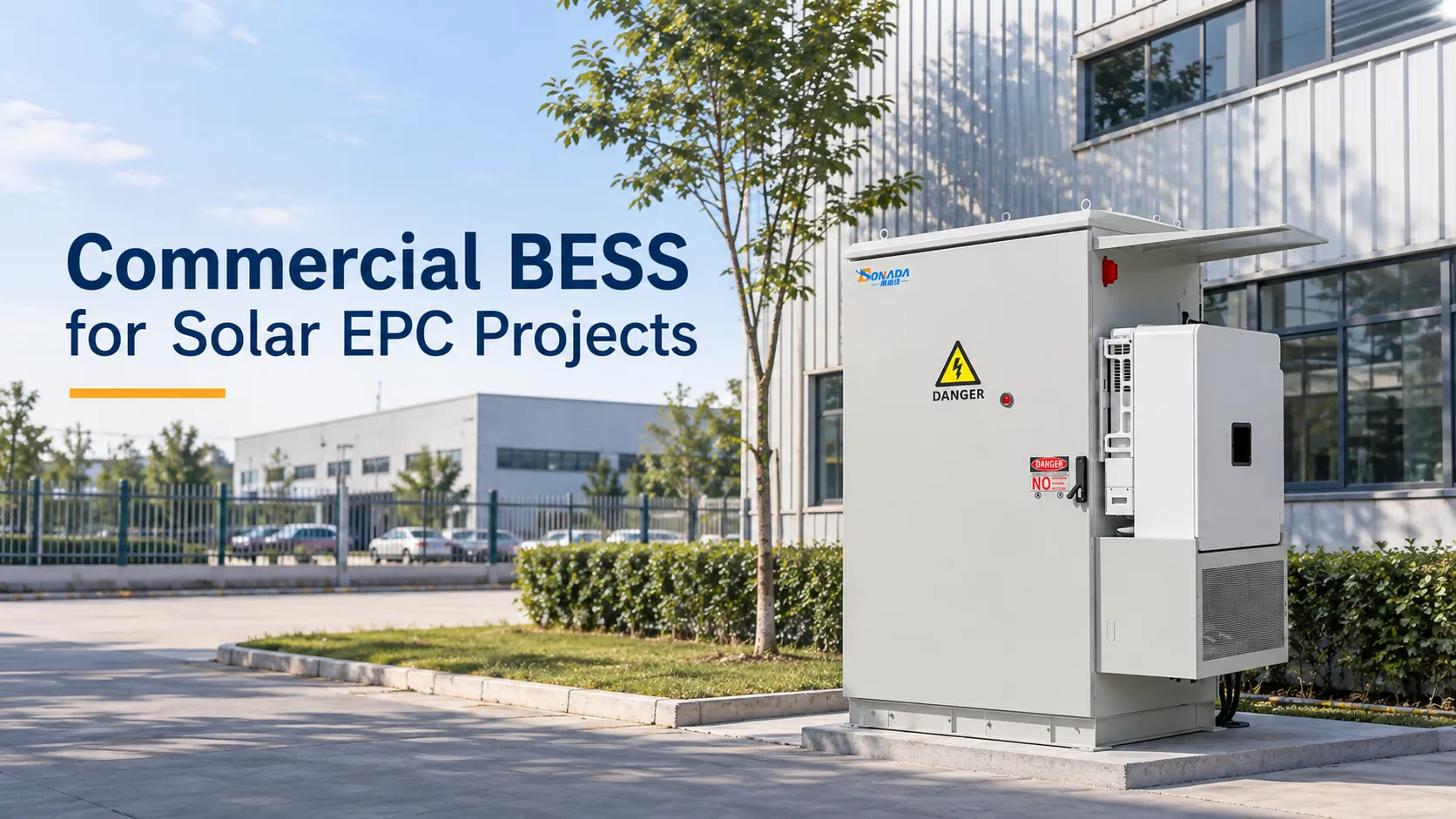
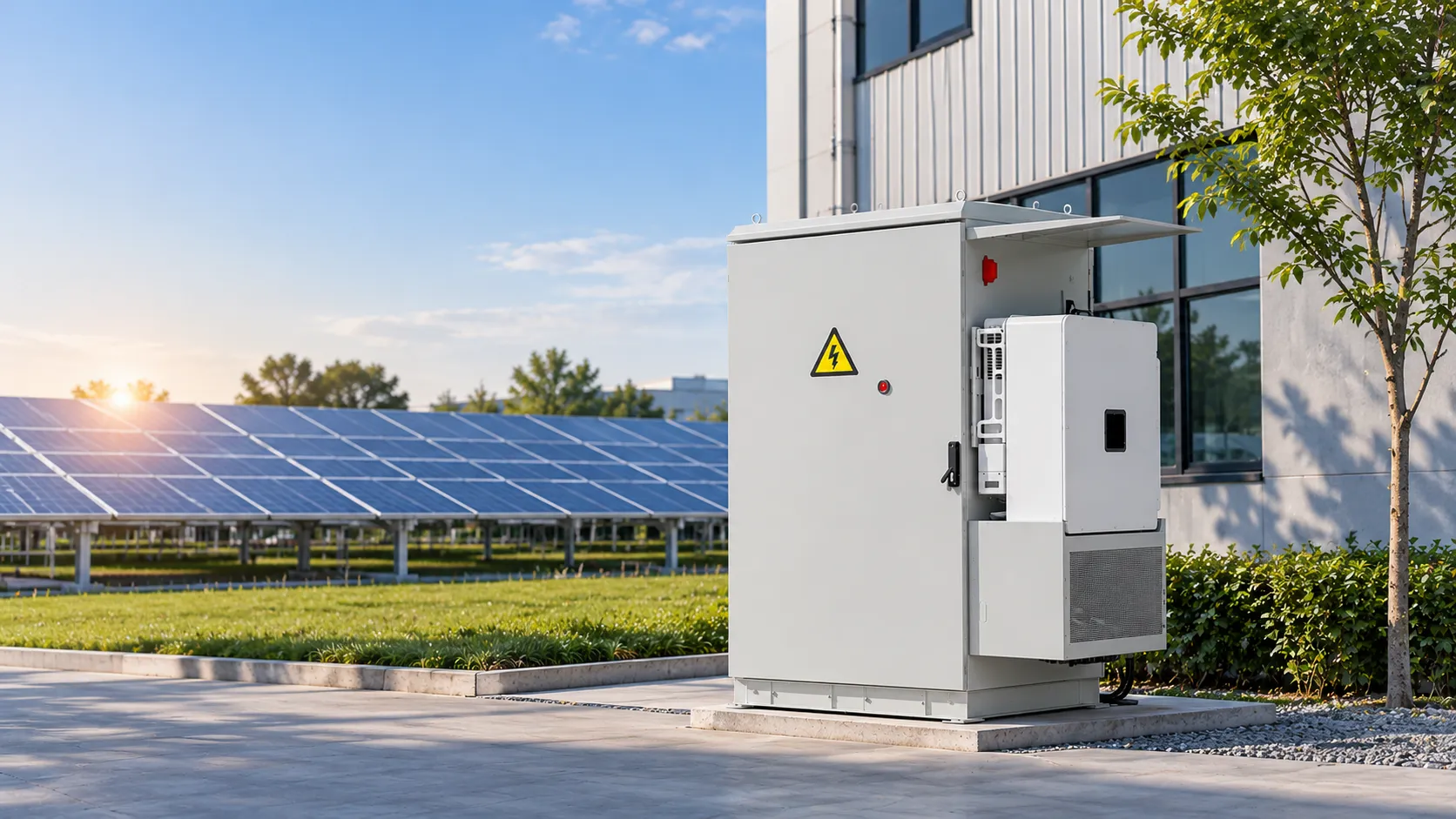
Many C&I energy projects pick outdoor battery cabinets, as clients want all-in-one, space-saving hardware that can be set up without overly complex site work.
These enclosures pack battery packs, BMS units, temperature control hardware, electrical safety gear and control modules together in one weatherproof shell. Some models come with PCS and EMS built inside, while other product lines ship these control units as standalone devices.
This style of outdoor battery storage fits a broad range of use cases:
- Production plants and manufacturing sites
- Holiday resorts and hotel premises
- Malls and other commercial real estate
- Industrial zones and corporate facilities
- Solar EV charging hubs
- Mid and small-scale microgrid deployments
EPC firms favour cabinet-type storage solutions, largely because they cut the hassle of shipping, field assembly and later capacity upgrades.
For instance, a business can start with a 97 kWh setup and add more cabinets later when its power consumption grows — as long as the overall system framework supports modular expansion.
When sourcing this kind of outdoor storage hardware, installers need to review the shell’s ingress protection grade, allowable working temperature band, cooling scheme, cell type, fire suppression setup and the required spacing around each unit.
Containerized Battery Storage Systems
Container-based battery storage targets bigger C&I and utility-grade energy schemes. Manufacturers pre-assemble many battery racks, thermal control hardware, fire suppression kits, power distribution parts and monitoring tools inside a standard shipping container.
The 20ft and 40ft sizes are the most widespread options, though internal layouts and exact measurements differ across suppliers.
This storage format works well for these scenarios:
- Large-scale production facilities
- Industrial parks with heavy power consumption
- Grid-tied solar plant sites
- Renewable setups that need load shifting functions
- Microgrids covering several separate buildings
- Commercial projects needing MWh-level storage capacity
Its strongest benefit lies in flexible scaling. Developers can link several containers together to hit the target energy size, and match PCS plus transformers to meet the project’s power needs.
Even so, containerized storage calls for thorough site engineering work. EPC teams need to plan vehicle access for delivery, concrete base layout, fire gap distances, cooling or air exchange needs, cable paths, transformer placement and enough room for routine service work.
Behind-the-Meter (BTM) vs. In-Front-of-the-Meter (FTM) Systems
People sort commercial battery storage schemes mainly by where they sit relative to the utility meter and what core function they serve.
Behind-the-meter (BTM) storage sits on the end-user’s side of the power meter. It is built to tune and manage the electricity usage of that specific site.
Common use cases for BTM setups cover peak load cutting, maximising onsite solar usage, emergency backup supply and taking advantage of time-based electricity rates.
In-front-of-the-meter (FTM) storage connects to the grid side, before the customer meter. These assets deliver services that benefit the wider power network and energy trading platforms.
Subject to local regulatory frameworks, FTM systems can carry out tasks such as frequency support, smoothing renewable power output, easing grid bottlenecks and joining wholesale electricity markets.
| Item | BTM BESS | FTM BESS |
|---|---|---|
| Mounting Location | End-user side of the meter | Grid / utility side |
| Core Goal | Cut the site’s power expenditure | Deliver grid support and market services |
| Typical Stakeholders | Manufacturing plants, hotels, business premises | Power utilities, independent power developers |
| Key Value Streams | Peak load management and solar self-use | Grid stabilisation and market trading |
Grasping this difference lets EPC teams lock in the right project specifications early on, before drafting formal technical proposals for clients.
How to Right-Size BESS for Commercial & Industrial Projects
Differentiating Power Capacity (kW) and Energy Capacity (kWh)
Many people confuse two core metrics when planning battery storage projects: instantaneous output capability and total energy holding capacity. Distinguishing them correctly is foundational to proper system sizing.
Power rating, measured in kW or MW, refers to the maximum flow of electric power the battery can either send out or take in at any single moment.
Energy capacity, measured in kWh or MWh, means the overall volume of electricity that can be kept inside the battery pack for later use.
These two specs together define how the storage unit will respond to changing load conditions on site.
For reference, a 100 kW / 200 kWh storage unit could, under perfect theoretical conditions, maintain a steady 100 kW output for two full hours. This rough estimate ignores practical limits such as usable capacity cutoffs, inverter losses and built-in safety restrictions.
The core formula behind this calculation is shown below:
Energy (kWh) = Power (kW) × Discharge Time (hours)
Let’s use a factory peak demand case: the site requires an extra 150 kW of supply for three hours each day during its load spike. The baseline energy demand calculation gives:
150 kW × 3 hours = 450 kWh
The final battery selection must be larger than this baseline value. Designers have to account for maximum safe discharge levels, energy waste during conversion, reserved backup margin and gradual performance decay as the battery ages.
EPC teams should never make hardware choices based purely on energy capacity numbers. The PCS power output rating and battery energy size both have to fit the actual operational needs of the project.
Analyzing Load Profiles and Solar Production Curves
To size a battery storage system correctly, the first step is mapping out the site’s power usage and on-site renewable output across a full day.
A load curve tracks how much power the premises draws at different times, while PV generation logs capture the timing and volume of solar power produced on location.
EPC specialists are advised to collect a full year’s utility records and billing information if possible. Readings captured every 15 minutes or less deliver far more insight for spotting load spikes and working out the best battery discharge logic.
The data review needs to cover these key points:
- Power use trends that shift by time of day and season
- Peak power draw and how long those high-load windows last
- How daytime consumption aligns with solar output
- Timeframes where solar generation outpaces onsite usage
- Power needs after sunset and overnight
- Priority loads that must keep running during outages
- Local tariff rules and how demand surcharges are calculated
Take a hotel as an example. Air conditioning, kitchen appliances, lighting and hot water systems push up its power needs in the morning and evening. Its solar array hits peak output around noon, often creating excess power that cannot be used straight away.
A well-matched storage system captures that midday solar surplus and feeds the stored energy back when the venue’s power demand rises later.
Manufacturing sites usually show much more erratic load behaviour. Production timetables, motor inrush currents, equipment runtime and shift arrangements all alter power draw. For these jobs, battery dimensioning must rely on real measured operating data instead of rough monthly consumption averages.
Factoring in Battery Degradation, C-Rate, and Cycle Life
Every battery loses its storage capability as time goes on. Capacity fade happens in two ways: natural ageing even when sitting idle, plus wear from repeated charging and discharging.
Capacity fade is the term for this steady drop of available energy. Operating temperature, how quickly power flows in and out, how deeply the battery is drained, voltage setpoints and daily usage habits all shape how fast this wear occurs.
C-rate is used to quantify charging or discharging speed relative to the battery’s total rated energy.
Take a 200 kWh battery for reference. When it discharges at 100 kW, the C-rate works out to 0.5C. If it delivers 200 kW continuously, that equals 1C.
Cycle life indicates the number of charge-discharge rounds a battery can sustain before its remaining capacity hits a predefined cutoff value, based on standardized lab testing.
EPC practitioners should never take cycle life figures at face value. Vendors’ test results rely on fixed conditions, including temperature, charge/discharge speed, discharge depth and the end-of-life capacity threshold.
To keep the system meeting load requirements throughout its service life, project designers need to evaluate the following points:
- Original capacity and practically usable energy range
- Peak and typical discharge depth
- Expected daily cycling frequency
- Thermal control performance and surrounding environment
- Assumed yearly capacity loss
- Plans for module expansion or future replacement
- Warranty coverage and performance guarantee terms
Reviewing all these parameters prevents insufficient capacity at later stages and delivers a reliable long-term performance forecast for the storage project.
EPC Site Design, Layout, and Electrical Integration
Modular System Architecture and Layout Clearances
Site preparation is a critical early step for commercial battery storage, which must be finalized well before ordering parts and starting on-site build.
When cabinet-style modular storage is chosen, project teams need to sort out unit quantities, placement direction, cable entry paths, maintenance gaps and room reserved for later capacity growth.
Container-type storage brings more layout constraints. Planners have to reserve space matching the container size, check truck delivery routes, crane working zones, heat dissipation setups, fire safety hardware and matching power infrastructure.
Core layout points to verify:
- Minimum gaps specified by the supplier for operation and upkeep
- Enough room to swap battery modules and conduct routine repairs
- Safe separation distances for fire control and emergency escape routes
- Air circulation, cooling and heat discharge arrangements
- Defences against surface pooling and flood hazards
- Protective fencing and access limits for high-risk zones
- Reserved area for transformers, switch cabinets and auxiliary devices
Modular frameworks support incremental capacity expansion. Still, upgrade potential must be reviewed at the very beginning of design. This confirms circuit ratings, signal connections, safety relays and control software can work with extra storage units added in the future.
Civil Works, Foundations, and Environmental Routing
Storage battery units have considerable mass, which means groundworks must be properly planned to support them safely.
Prior to any onsite construction, EPC teams carry out ground assessments. They check how stable the subsoil is, how much load the base can bear, water runoff arrangements, local earthquake rules, wind pressure and other surrounding environmental factors.
Outdoor storage hardware is commonly mounted on custom concrete plinths. These structures are engineered around the unit’s weight and the supplier’s technical notes. Container-based storage normally demands sturdier foundations, decided by its outer footprint and total loaded mass.
Cable channels, protective tubing and buried wiring routes need to align with the overall site arrangement. Power wires of different voltage classes, signal cables and earthing conductors should be laid in compliance with local electrical codes and the project’s design plan.
Durability against environmental stress also deserves attention. Persistent heat, damp air, dust, sea salt mist and corrosive airborne contaminants all degrade hardware and cut its usable service time.
Projects built in tropical regions like Southeast Asia require extra attention. Engineers need to focus on moisture control, shell ingress protection, anti-rust treatments, water drainage and steady cooling output.
Electrical Protection, Grounding, and MV Integration
Tying battery storage into existing power circuits ranks among the trickiest engineering work for commercial storage jobs.
The battery bank links up with the site’s power distribution network via properly rated protective hardware. This set covers breakers, isolating switches, protective relays and other safety gear mandated for the setup.
Bigger C&I deployments sometimes call for medium-voltage interconnection. The PCS output goes through matched transformers and switch cabinets to fit the site’s distribution voltage or grid connection specs.
Engineers need to work through these critical design points:
- DC and AC conductor selection, factoring current load, voltage drop and laying environment
- Coordinated safeguards against overload and short-circuit faults
- Earthing layout and equal potential bonding implementation
- Surge suppressors and full lightning defence arrangements
- Transformer power rating and impedance parameters
- Harmonic levels and overall power quality control
- Grid-tie protection and anti-islanding compliance rules
- Fast cut-off pathways for emergency shutdown scenarios
Aligning all protection logic becomes especially vital where storage, solar inverters, backup gensets and grid feed run on the same power network.
Every electrical drawing needs sign-off from certified engineers, and must follow local wiring standards, grid interconnection rules and the equipment supplier’s technical guidance.
Power Plant Control, EMS Integration, and Grid Compliance
Importance of Integrating Controls During the Design Phase
Energy scheduling logic needs to form part of the initial planning for commercial battery storage, instead of being fitted as an afterthought once hardware is already in place.
An EMS steers the whole system to react dynamically to shifting solar yield, onsite power draw, grid status and time-based electricity pricing.
A site can run with different priorities across the day: making the most of in-house solar power under regular conditions, activating peak load cutbacks during demand spikes, and keeping a fixed portion of battery charge in reserve for blackout support.
These operational priorities are coded into control routines, which sync up with the battery BMS, power conversion units, PV inverters, metering tools and the site’s existing management platforms.
Poorly integrated control logic causes the battery to charge or release power at unsuitable moments. This erodes possible cost benefits and triggers extra, unnecessary charge-discharge cycles that wear the cells faster.
Communication Protocol Compatibility and Monitoring
Most commercial storage projects mix parts coming from different makers. The battery and its management unit might come from one supplier, while the power converter, energy controller, meters and monitoring tool are sourced elsewhere by the EPC team.
Consistent, stable data transfer between all these devices is critical.
Popular industrial data communication choices include:
- Modbus RTU: Serial signal method widely used for field equipment.
- Modbus TCP: Network-based version for energy hardware on local LAN.
- CAN Bus: Often used for internal signal exchange within battery assemblies.
- IEC 61850: Standard for substation automation and grid control hardware.
- SunSpec: A set of data templates created for distributed power equipment.
Just matching the communication protocol will not guarantee everything works together smoothly. The project team must check register mapping, device addresses, data formatting, update frequency, control permissions and fault reaction rules one by one.
The remote monitoring system needs to show key runtime information:
- Current charge level (SOC)
- Health condition of battery packs (SOH)
- Voltage, current and temperature readings
- Instant charging and discharging power of the PCS
- Solar generation, plus power imported from or exported to grid
- Alarm history and fault event logs
- Daily energy flow and performance statistics
With reliable remote visibility, contractors and asset owners can spot unusual operating trends, review real performance, and schedule preventive maintenance ahead of failures.
Meeting Grid Code Compliance and Utility Requirements
Any commercial energy storage system hooked up to the shared power grid has to satisfy technical rules set by local power operators and regulators.
Such rules are not universal; they shift from region to region, and change based on operating voltage, project scale and how the asset links into the network.
Grid approval checks commonly cover these areas:
- Allowable working bands for grid frequency and voltage
- Adjustment of reactive power and power factor
- Voltage ride-through capability during grid disturbances
- Active power tuning to follow frequency shifts
- Upper limits for harmonic distortion
- Protection functions to prevent unintended islanding
- Restrictions on sending power to or drawing power from the grid
- Grid impact assessments and on-site commissioning trials
Utility firms often demand detailed power system analysis for bigger storage assets. Typical work includes load flow simulation, short-circuit calculation, protection scheme matching and dynamic behaviour evaluation.
EPC teams need to clarify all these grid constraints before picking PCS and EMS hardware. A storage unit that runs smoothly on its own may fail to satisfy the grid codes enforced in a target market.
BESS Safety Standards and Regulatory Compliance
Essential Industry Safety Certifications (UL 9540, UL 9540A, NFPA 855)
Risk management forms the backbone of lithium battery deployments for business and factory use. These cells carry high energy density; bad layout choices, shoddy field work or incorrect operating logic can lead to electric faults, out-of-control heat and fire threats.
EPC specialists need to understand the purpose behind each safety document. It is vital to draw a line between product validation sheets, lab testing methods and on-site installation codes.
UL 9540 is designed to verify safety for entire storage units. Inspectors review the whole assembled solution rather than only checking individual battery cells.
UL 9540A outlines a testing routine to track how fire spreads once thermal runaway starts. The data gathered helps designers and local authorities weigh fire risks and work out safe spacing and protective solutions.
NFPA 855 sets placement rules for stationary battery storage. It covers positioning, separation gaps, fire suppression and other risk reduction measures.
Other commonly referenced standards:
- IEC 62619, covering safety rules for lithium rechargeable cells used in industrial environments
- The IEC 62933 standard family for complete energy storage hardware
- UN 38.3, the transport test requirement for lithium battery cargo
- Regional wiring guidelines and local fire statutes
- Extra rules issued by grid service providers and building regulators
Many clients misunderstand what these certifications cover. A certificate that only approves battery cells cannot confirm the full BESS meets UL 9540 requirements. A UL 9540A test report also is not an official product approval.
When handling international EPC assignments, project teams need to gather certification records, lab results, product handbooks and setup guides from suppliers before locking in purchases.
Thermal Runaway Mitigation and Fire Suppression Systems
Lithium battery installations face a major risk from uncontrolled heat escalation. Once chemical reactions inside a cell produce heat more rapidly than it can escape, nearby cells may also get pulled into this dangerous chain event.
Well-designed storage safety builds on many lines of defence. These work together to stop faults, catch warning signs, cut power and limit fire spread.
Practical protective features to integrate:
- Temperature sensors fitted on individual cells and whole modules
- >
- Circuit safeguards against voltage drift and excessive current flow
- Temperature regulation hardware adapted to local site conditions
- Alert tools that flag abnormal changes before crises develop
- Quick disconnect devices for emergency power cutoff
- Matching flame sensors and fire control hardware
- Vents and pressure release openings, as specified in design documents
- Reserved access paths for fire crews and prearranged response plans
Choosing fire control tools depends on the battery material type, cabinet construction, local codes and safety test conclusions.
EPC teams should never rely only on fire suppression gear. Full risk control needs a mix of preventive measures, barriers to slow flame spread, physical spacing, real-time monitoring and well-prepared emergency workflows.
Financial Optimization, ROI, and Revenue Streams
BESS Pricing Structure and Primary Value Streams
Many buyers mistakenly focus only on battery hardware cost when budgeting stationary storage for business use. For EPC teams preparing quotations and financial projections, plenty of other spending items must be calculated into the overall project budget.
Common cost categories for these deployments include:
- Battery cells, pre-built modules and support racks
- Battery management hardware and temperature regulation systems
- Power converters (PCS)
- Energy control platforms and real-time monitoring tools
- Step transformers, switch cabinets and electrical protection assemblies
- Outdoor cabinet casings or complete container enclosures
- Ground civil works, foundation build and field installation labour
- Freight charges, customs declarations and logistics services
- Design drafting, on-site commissioning and grid connection services
- Long-term service arrangements and performance warranty terms
Suppliers often quote pricing based on total energy capacity. Yet comparing different solutions purely using the per-kWh rate can be deceptive and lead to poor decisions.
Two storage units with identical rated energy may differ greatly in converter output limit, usable charge range, cooling setup, safety add-ons, warranty coverage and site construction demands.
Rather than only checking the raw battery purchase price, EPC professionals should weigh total system expenditure together with its expected real-world performance over years.
The main economic benefits these storage assets bring to site operators are:
- Cutting expensive peak-demand surcharges from utility providers
- Raising local consumption share of on-site solar power
- Optimizing electricity bills under time-varying price schemes
- Reducing losses caused by unexpected grid outages
- Joining demand-response or grid auxiliary service programs where local rules allow
- Boosting the utilization rate of local PV power generation
Not every site qualifies for all these revenue streams. Any financial assessment must align with local power market policies, tariff rules, grid codes and the actual operation pattern of the premises.
Maximizing Returns Through Financial Incentives and Tax Credits
Various government support measures, such as tax relief, funding subsidies and favourable loan plans, can greatly alter the return profile of commercial battery storage investments.
Such support policies are highly localized. Differences exist not just between countries, but also across sub-regions including states, provinces and cities.
The United States, for instance, has launched national clean energy tax benefits. Eligible battery-only and PV-coupled storage jobs can apply, provided they follow relevant laws and satisfy all entry prerequisites.
Elsewhere, operators might see renewable grants, low-rate financing, accelerated depreciation benefits, import tax exemptions or special programmes launched by local power suppliers.
EPC teams need to examine these factors while checking subsidy eligibility:
- Whether the policy covers standalone battery systems or only solar-linked storage
- Capacity thresholds, including the minimum and maximum allowed system size
- Rules about local production and component procurement
- Asset ownership rules and deadlines for completing commissioning work
- Necessary certification papers and supporting paperwork
- Compatibility with other financing packages
Before adding these subsidy gains into the client’s formal investment proposal, it is necessary to seek confirmation from local tax, legal and finance specialists.
Calculating Lifecycle ROI and Payback Periods
When sizing up whether a battery storage deal makes financial sense, investors need to look across its full service cycle, instead of only focusing on upfront spending.
One widely used metric for quick assessment is the simple payback calculation:
Payback Period = Total Upfront Outlay ÷ Yearly Net Savings
Take one case for reference: a business spends 200,000 USD on a solar and storage setup, and cuts its power bills by 40,000 USD each year after covering running costs.
The payback timeline works out as follows:
$200,000 ÷ $40,000 = 5 years
This is just a basic illustration; real results will differ for every site.
A robust financial forecast needs to account for these items:
- One-time capital outlay (CAPEX)
- Yearly reductions on electricity bills
- >Savings from lower peak-demand surcharges
- Gradual battery capacity fade and energy loss from system inefficiency
- Recurring service and upkeep expenses each year
- >
- Costs for adding new modules or swapping aged battery packs
- Interest charges and any available government rebates
- Remaining asset value once the project reaches its end of life
For bigger installations, project teams often run extra calculations including net present value (NPV), internal rate of return (IRR) and discounted cash flow modelling.
These figures help clients get a realistic view on whether the proposed storage layout brings worthwhile economic returns.
It is worth noting that bigger battery capacity does not automatically translate to better profits. The best design matches the site’s actual power needs, to strike the best balance between operational performance and financial gains.
Selecting the Right BESS Solutions Partner for Solar EPC Contractors
Evaluating BESS Manufacturers and System Integrators
Picking a dependable storage partner is a critical call for solar EPC firms. Product build quality, on-hand technical backup and stable long-term collaboration all shape how smoothly projects run and how satisfied end clients will be.
It is unwise to judge vendors purely by their quoted rates; EPC teams need to check multiple core dimensions.
1. Production strength and output stability
Look into the maker’s factory setup, internal quality control workflows, cell supply channels, assembly steps and in-house test capacity. Trustworthy vendors can clearly describe their quality checks applied across the whole production chain.
2. Cell material selection and performance parameters
LFP cells are the mainstream pick for most stationary C&I storage, thanks to stable thermal behaviour, long cycle lifespan and good tolerance for repeated charge-discharge cycles.
Still, cell type alone cannot guarantee a solid system. Teams also need to check usable energy, power ratings, working temperature range, conversion efficiency, projected capacity loss and warranty terms.
3. Certifications and compliance paperwork
Confirm the supplier can supply all approvals, test records, transit papers and technical dossiers required for the destination market. Any certification must correspond exactly to the model and system variant listed in the quotation.
4. Integration adaptability and custom options
Project requirements vary widely in storage size, PCS setups, voltage classes, cooling schemes and communication standards. Competent manufacturers supply full technical materials and assist with cross-device integration work.
5. Output scale and dependable lead times
Large industrial storage builds usually have tight construction timelines. Assess factory throughput, spare component stock, pre-shipment inspection rules, packaging standards and prior experience with overseas freight.
6. Technical assistance and after-sale arrangements
Battery assets run for well over a decade. Vendors need to supply installation guidance, commissioning help, fault troubleshooting, warranty coverage and easy access to technical documents.
For EPC firms handling a pipeline of jobs, suppliers that deliver steady quality, flexible configurations and sustained engineering support often bring far more value than alternatives that only offer a cheaper upfront price tag.
Commissioning, O&M, and Warranty Requirements
Getting a battery storage project fully finished is far more than just delivering hardware to the worksite. Proper startup checks and continuous upkeep throughout its service life carry equal weight.
Before kicking off commissioning work, EPC teams must double-check all mechanical layouts, power wiring, data links and safety setups to make sure they follow the approved design drawings.
Standard startup testing covers these steps:
- Visual checks on battery housings, packs and all power joints
- Inspection of earthing arrangements, cabling and protective gear
- Confirm stable data links between BMS, PCS and EMS platforms
- Set battery control parameters and boot up the whole system
- Run functional trials for charge and discharge cycles
- Validate alert triggers, emergency cut-off and protection logic
- Test grid-tie mode and backup power functions if required
- Record performance data and prepare all handover test documents
Once commissioning wraps up, the storage setup needs regular operational care.
Routine preventive work covers tracking battery health, checking cooling assemblies, tightening electrical terminals, rolling out firmware updates, going through alert records and running periodic performance audits.
It is critical to read through warranty clauses in detail. EPC contractors need to focus on these points:
- How long the product guarantee remains valid
- Minimum guaranteed capacity retention for battery packs
- >
- Allowed energy throughput and charge cycle limits
- Valid ambient temperature and site environment requirements
- Exclusion clauses and mandatory maintenance duties
- Vendor response timelines and replacement workflows
- Supply availability of spare modules and replacement parts
A lengthy warranty only brings real value if its rules are clearly stated, and the supplier has the ability to fulfill these commitments later on.
For EPC firms aiming to build lasting partnerships with business clients, solid maintenance plans and dependable warranty support can turn into a strong edge against competitors.
Conclusion: Building Better Commercial Solar Projects with the Right BESS Partner
Battery storage is reshaping commercial solar industries worldwide. Solar EPC firms can integrate such systems into business and factory projects, helping end users lower electricity spending, maximize local renewable output, stabilize power supply, and deliver all-in-one energy services.
Yet smooth deployment of these storage setups calls for well-rounded engineering design, thorough financial assessment, risk planning and stable hardware sourcing. Battery sizing should align with the site’s actual power consumption trends. Power converters and energy controllers need to coordinate properly, while the whole installation must meet local electrical codes, fire regulations and grid interconnection rules.
It is equally critical to find a manufacturer familiar with the practical hurdles EPC teams encounter. Steady product performance, flexible system layouts, complete certification files, timely technical guidance and reliable after-sale support all help ensure projects run to plan.
For EPC teams developing solar-storage hybrid schemes, cooperating with an experienced battery producer can cut down the complexity of hardware selection, ease system integration and drive long-term business expansion.
Bonada (Fujian) New Energy Technology Co., Ltd. develops battery storage solutions for residential, commercial and industrial use. We offer direct factory supply and adapt our offerings to match varied project demands. We work alongside overseas distributors, solar EPC providers and project developers searching for trustworthy storage products.
Whether you intend to construct a commercial solar-battery facility, expand your energy product lineup, or source battery packs for upcoming industrial contracts, picking suitable technology and a reliable manufacturing partner is the very first key step.
Frequently Asked Questions About Commercial BESS for Solar EPC Contractors
1. What is the difference between a commercial BESS and a residential battery storage system?
Storage solutions for commercial sites are engineered to cope with substantial electricity demand. Many adopt multiple battery enclosures or containerized units, matched with industrial power converters, smart energy controllers and medium- voltage access. Home battery packs come with lower capacity. They mostly help families utilize rooftop solar and supply standby power once grid power cuts off.
2. How do EPC contractors calculate the required BESS capacity?
EPC teams need to study a site’s power usage patterns, peak draw levels, solar output, planned backup runtime and operational targets. The converter power rating follows the highest instant load the battery has to cover, while total energy size depends on how long it can sustain that output. Planners also need to factor in system losses, allowable discharge limits and gradual capacity decline during calculations.
3. What battery chemistry is best for commercial energy storage?
LFP cells are a popular choice for factory and commercial storage deployments. They resist heat risks well, endure thousands of charge cycles, and fit setups that cycle power daily. Even so, teams need to weigh pricing, system layout, ambient working conditions, safety mandates and guarantee terms before finalizing this cell type.
4. How long can a commercial BESS provide backup power?
Backup duration depends on the battery's usable energy capacity and the electrical load being supplied. For example, a system with 200 kWh of usable energy supplying a continuous 50 kW load could theoretically provide four hours of energy. Actual backup duration will be shorter after accounting for conversion losses, reserve capacity, auxiliary consumption, and operating limits.
5. Is liquid cooling necessary for commercial BESS?
Many commercial battery systems do not need liquid cooling setups. Air circulation can handle thermal needs for smaller units. For tightly packed battery modules requiring accurate temperature regulation, liquid cooling is the typical pick. Engineers weigh cell construction, site surroundings, system size, service plans and long-term cost benefits to decide which cooling method to use.
6. Can commercial BESS systems be expanded in the future?
A lot of commercial battery storage systems let users scale up later. You can add extra battery cabinets or container units to get more storage, but this only works if the original setup was built to allow upgrades. EPC teams need to check converter specs, communication matching, safety protection logic and battery operating rules before planning any capacity expansion.
7. What certifications should EPC contractors check when purchasing BESS?
Different papers will be required for your project. These include UL 9540 certification for the full storage assembly, UL 9540A test results for thermal runaway risk, IEC 62619 safety credentials for lithium cells, and UN 38.3 test documents for shipment. Local electrical and fire safety clearances are also needed. The exact list varies depending on which country the equipment is shipped to and the project’s technical setup. Always confirm that each certificate fits the specific battery model and configuration you are delivering.
Looking for the Right BESS Solution for Your EPC Project?
From battery capacity selection to system integration, Bonada supports solar EPC contractors with customized Commercial & Industrial BESS solutions. Share your project requirements and load profile with us to get professional technical support and a tailored energy storage configuration for your project.
Discuss Your BESS Project with Bonada
100kWh Commercial Battery Storage Systems: Applications, Cost & Buyer’s Guide
Related Article