Greenhouse Energy Storage: Improve Efficiency with Battery Storage
If you run a modern greenhouse, steady power is non-negotiable. It keeps growing conditions consistent, runs supplementary lighting, feeds irrigation systems, and looks after temperature and humidity control. Energy prices bounce around constantly, and commercial horticulture only keeps pulling more power these days — managing how much electricity you use is something greenhouse operators really need to stay on top of.
Many greenhouse sites use energy storage to keep electricity costs from getting out of hand. It also lets them get more value out of the solar they produce right on-site, alongside building greenhouse energy storage resilience. Batteries charge when power is cheap or easy to get, and growers tap into that stored energy once demand picks up or rates shoot higher. This way you can manage consumption, and there’s no risk of hurting crop quality.
Whether you own a commercial greenhouse, run a horticulture business, or work on developing agricultural energy projects, finding a battery storage setup that fits your site makes operating costs simpler to forecast and supports a more sustainable way of producing crops. Before committing to an install, you’ll want to understand how these systems actually work, what parts you’ll need, and how to work out the right size for your setup.
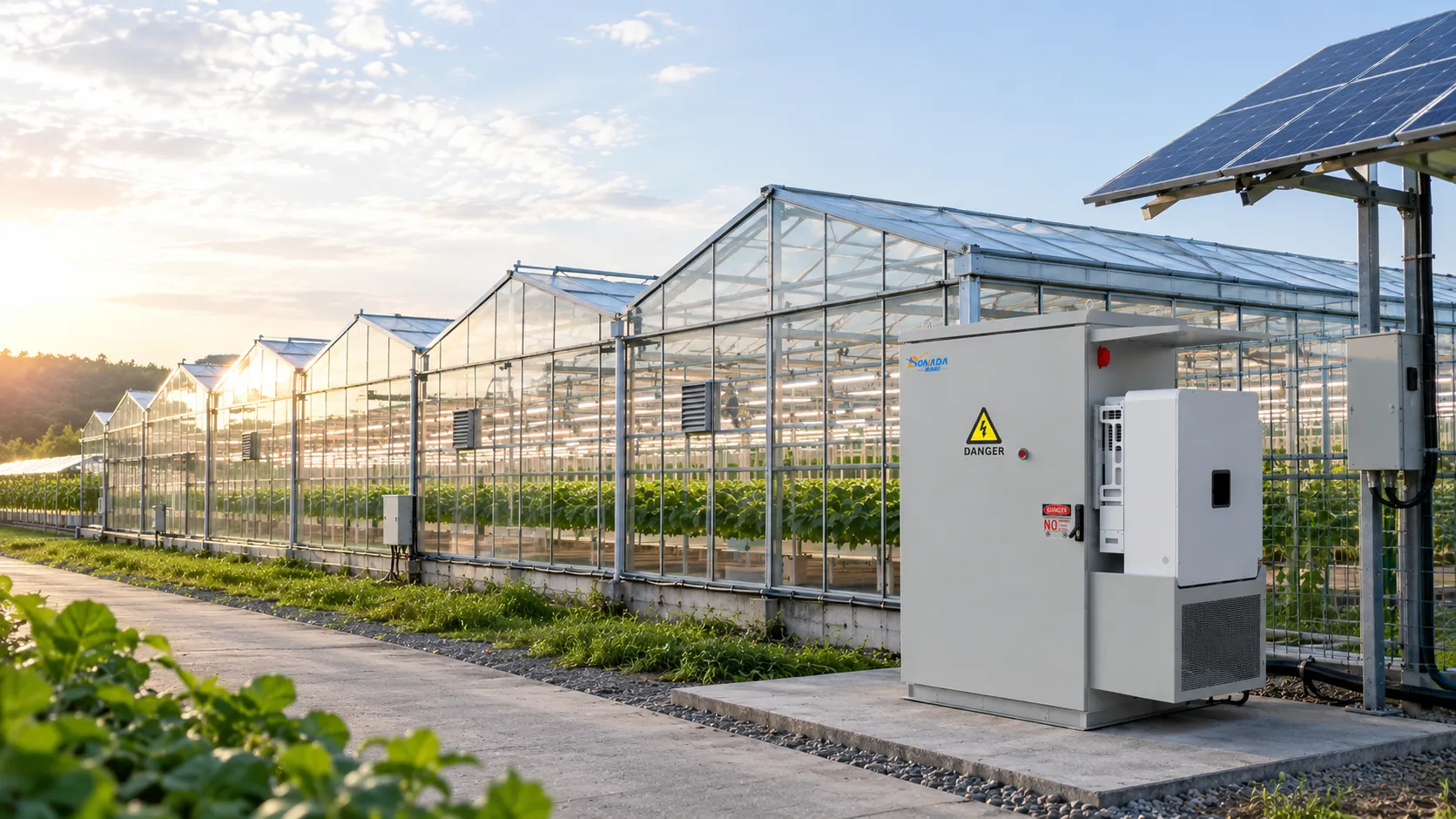
Understanding Energy Storage Solutions for Greenhouses
What Is a Greenhouse Battery Energy Storage System (BESS)?
A greenhouse battery energy storage system (BESS) holds electrical power to be used at a later time. Its core setup includes rechargeable battery packs, alongside a power conversion system (PCS), battery management system (BMS), and energy management system (EMS).
For greenhouse sites, this setup captures surplus power coming from rooftop or ground-mounted solar arrays. It can also top itself up when grid electricity falls into off‑peak pricing windows, before releasing stored power once lights, heating hardware, ventilation or irrigation gear start drawing more current.
It behaves quite differently from standard backup generators, as battery storage reacts almost instantly whenever power demand shifts. Tuned correctly, it helps cut peak grid draw and delivers backup power to your most important, pre‑selected loads.
A greenhouse BESS can be designed for different applications, including:
- Residential-scale greenhouses: Smaller battery systems for private growing facilities and hobby greenhouses.
- Commercial greenhouses: Battery storage integrated with solar PV, irrigation, ventilation, and supplemental lighting.
- Large horticultural complexes: Modular or containerized battery systems designed to support substantial electrical loads and more sophisticated energy management.
- Multi-site agricultural operations: Scalable storage solutions that support energy monitoring and coordinated power management across facilities.
The appropriate system depends on electricity consumption, available generation, local tariffs, backup requirements, and the operating schedule of the greenhouse.
How Does Battery Energy Storage Work in Horticultural Facilities?
Batteries take on power when it’s there, and send it out when the greenhouse needs extra. The EMS manages this, tracking battery charge level, current power prices, expected solar output, and live site usage.
If you’ve got solar panels on your greenhouse, a typical day tends to go something like this:
- Morning: Battery helps carry some of the load until solar picks up.
- Midday: Solar runs your equipment, and excess power fills the battery.
- Late afternoon: Solar drops off. The battery kicks in as lights and other equipment turn on.
- Evening and overnight: Stored power keeps critical gear running. We can also charge from grid when prices are low.
You can adjust this flow for different crops and seasons. A winter setup heavy on grow lights uses power way differently than summer sites mainly running irrigation and fans.
Batteries don’t make power. They let you move power to the hours you need it, reduce expensive grid buys, and keep tighter control over your energy use.
The Role of Energy Storage in Enhancing Greenhouse Energy Efficiency
Getting efficiency right in a greenhouse isn’t only about cutting power use. Timing matters too. You want to avoid hitting high peak charges, and line up your power sources with what you actually run each day.
With batteries, growers get practical help on these fronts:
- Skip buying expensive grid power when peak rates kick in.
- Make better use of the solar you generate instead of exporting it away.
- Handle sudden spikes and dips in power demand across the farm.
- Keep priority gear alive when the grid goes down, if backup is set up.
- Sync the battery with your monitoring tools and site automation.
Don’t mistake storage for a fix-all, though. Batteries can’t take the place of basic efficiency work. Tighter insulation, good LED lights, properly adjusted ventilation and regular heating service all lower your baseline energy load. Stack those improvements with a battery sized for your real needs, and you get a far more robust setup.
Key Components of a Greenhouse Battery Storage System
You can’t build solid greenhouse storage just by focusing on how much energy the batteries hold. Every piece in the setup has its own job, making sure stored power stays safe and works as you expect.
Battery Cells and Storage Modules
Single battery cells trap energy via electrochemical reactions. We stack dozens of these cells into modules, then build those modules into full packs. That’s how we reach the voltage, storage and power output the greenhouse project requires.
Lithium iron phosphate, or LFP, is a popular pick for stationary storage installs. It resists overheating well, lasts through many charge cycles when operated correctly, and handles frequent back-and-forth cycling reliably.
If you’re choosing batteries for a commercial greenhouse, there are several key things to weigh up:
- Usable capacity: This tells you how much energy you can actually use to run greenhouse equipment, measured in kWh or MWh. Don’t confuse it with the total rated capacity.
- Power capability: Max charge and discharge speed falls under this spec, with kW and MW being the standard units here.
- Cycle life: Think of it as the rough number of charge-discharge runs you can get, staying within the manufacturer’s operating rules.
- Operating temperature: Check the temperature band the hardware can safely work in. Some setups will need extra thermal controls to stay inside that range.
- Warranty and degradation: Look at how much capacity the battery should retain over years, and read exactly what the warranty covers through its service life.
Greenhouses are tough environments. Humidity, irrigation spray, dust and big seasonal temperature shifts are all normal. Battery hardware must go into a protected space fitted with suitable environmental controls. The enclosure’s IP rating, ventilation plan and temperature management have to fit your real site conditions.
Battery Management System (BMS) for Safety and Health
The BMS watches over your battery pack, making sure individual cells never drift outside safe working ranges. It reads voltage, current, temperature and charge level continuously, and kicks in safety controls if something goes off track.
A good unit will balance cells, spot faults right away, and exchange data with your PCS and energy management setup.
For greenhouse operators, this set of features really counts. These batteries cycle day in and day out all growing season long. Regular oversight lets you pick up on odd behaviour early, before it turns into expensive, unexpected failure.
When you’re checking out suppliers, take time to verify their BMS matches your expected usage pattern. It has to interface smoothly with your chosen inverter or PCS, and deliver all the monitoring and safety features your project needs.
Power Conversion System (PCS) and Inverters
The power conversion system handles electricity moving back and forth between the battery and your site’s AC wiring. When charging, it takes AC power and converts it to DC that the battery can accept. When the battery sends power out, it turns stored DC into usable AC to run all your greenhouse gear.
If you’re pairing storage with solar, you can go with a hybrid inverter or a standalone battery PCS — this choice mostly comes down to how you design the whole system.
Getting the PCS size right is really important. A battery might hold plenty of energy to run loads for hours, yet you won’t be able to tap into that power if your PCS is too small for the demand.
Keep these points top of mind when picking out your PCS or inverter:
- How much steady charge and discharge power it can sustain
- Short burst overload capacity, needed to kick on motors and heavy loads
- Whether it works with your greenhouse’s existing electrical distribution
- Three-phase setup needs and clean power output quality
- Grid-tied operation plus off-grid backup functionality
- Interoperability with solar inverters, the BMS and EMS
Many greenhouses run pumps, compressors, big ventilation fans and climate gear. For these setups, engineers need to look closely at motor inrush current and overlapping loads, instead of just adding up every piece of equipment’s nameplate rating.
Energy Management System (EMS) for Smart Automation
The energy management system keeps track of and orchestrates power generation, battery storage, and on-site consumption all together. It pulls live readings, preset run schedules, and utility rate info to work out the best times for the battery to charge up or send power out.
As one example, your EMS can first route solar power straight to run the greenhouse. Any extra solar power gets pushed into the battery, and that stored power gets released when grid electricity rates spike higher.
More capable setups will also factor in weather outlooks, expected solar yield, scheduled supplemental lighting for crops, and demand caps. This lets growers align their energy strategy around what their greenhouse crops actually need.
You’ll also want your EMS to have usable dashboards for live tracking, log past energy usage, let you set custom operating boundaries, and link up with your existing site controls. At the end of the day, it’s meant to save on energy costs, without messing up the temperature, humidity, light or irrigation levels your plants rely on.
Key Benefits of Battery Storage for Modern Greenhouses
Peak Shaving and Load Shifting to Lower Electricity Costs
Peak shaving cuts down how much power your site pulls off the grid when demand hits its highest. Load shifting simply moves your power use to different hours — mostly to grab cheaper rates or make the most of available renewable power.
These tactics work really well for bigger greenhouses running heavy loads like grow lights, pumps, fans and climate gear all at once.
Think of a typical greenhouse situation: evening supplemental lights fire up while pumps and climate gear are already online, creating a quick demand jump. A well-matched battery can supply power through that busy stretch and bring down how much you pull from the grid.
Your actual savings will depend heavily on how your local utility structures its rates. If your contract charges demand fees, knocking down that single peak draw can add up nicely. For time-of-use plans, you fill the battery during low-cost hours and use that stored power when rates jump.
Don’t assume batteries will slash every power bill by default. Real savings boil down to how your tariff is set up, battery round-trip efficiency, how often and how long those peak spikes last, and whether the battery has enough power and stored energy to cover those peaks.
Maximizing Self-Consumption of On-Site Solar PV Generation
Solar PV setups crank out plenty of power through daylight, but a greenhouse’s power needs rarely line up perfectly with when the sun is shining. If you don’t have storage, extra solar power might get fed back to the grid for very little payout, or even get cut off when grid export limits kick in.
A battery system for greenhouses catches some of that leftover solar energy to use later on. That way, more of the power you generate onsite can run evening grow lights, irrigation pumps, circulation fans, monitoring gear and other loads you need after the sun drops.
Whether this setup makes good financial sense comes down to the gap between what you pay to buy grid power versus what you get for sending power out. You also have to account for energy lost in the battery charge-discharge cycle. If export rates are generous or grid power is cheap, banking every spare kWh isn’t always the smartest move.
When sizing batteries for a solar-plus-storage build, you want to follow your usual excess solar curve, instead of just picking a battery size that matches the solar panel nameplate output.
Backup Power and Protection Against Grid Outages
Grid outages can knock out greenhouse ventilation, irrigation, climate regulation and all your automated monitoring gear. What this means for your crops varies, but bad weather paired with lost power can create serious risks in surprisingly little time.
When your battery setup has backup features enabled, it can feed power only to your preselected priority loads once the grid drops out. Common items on that priority list are:
- Ventilation fans and main circulation runs
- Irrigation pumps and their control valves
- Temperature and humidity tracking sensors
- Vital lighting or automated control hardware
- Alarm units and communication equipment
One important note: most standard grid-tied batteries won’t run standalone during an outage. Backup functionality needs extra hardware — an islanding controller, transfer switches, grid-forming inverter, and a separate distribution board built for these critical loads.
Your backup runtime hinges on available battery energy and how much power your connected devices draw. A system just keeping sensors and circulation fans online will last much longer than one trying to carry the full greenhouse, including power-hungry grow lights and electric heating.
If long blackouts are frequent at your site, linking battery storage with solar panels and a properly sized generator delivers better resilience than depending solely on batteries.
Revenue Generation Through Grid Services and Energy Trading
Certain power markets let commercial battery owners bring in extra income by joining demand response, frequency regulation, capacity schemes or energy trading activities. Whether you can tap these chances hinges on local rules, market entry rules, equipment certifications, and whether you have an aggregator or qualified market player to work with.
Your greenhouse battery could cut grid draw during scheduled market events, or deliver the flexible power you’ve agreed to supply — all while still holding enough reserve energy to keep your critical farm systems running.
Still, don’t count on these grid-service payments as locked-in profit. Taking part comes with strings attached: performance targets, faster battery wear, extra comms hardware, and rules that dictate when your stored power has to be ready for dispatch.
Growers need to weigh if that extra income makes all these obligations worthwhile. It’s key to make sure joining these market programs never gets in the way of normal crop care or your backup power reserves.
Integrating Battery Storage with Greenhouse Operations
Hybrid Integration with Combined Heat and Power (CHP) Systems
Some bigger greenhouse sites run combined heat and power, or CHP, systems. These units make power and usable heat out of one fuel stream at the same time. CHP can cover a share of the site’s electric load, while also putting out heat to keep growing spaces at the right temperature.
Pairing battery storage alongside CHP gives you much more leeway to manage generation and power use. If the CHP unit is making more electricity than you need right then, the battery can soak up that extra power, as long as you stay within the system’s operating boundaries. When loads pick up later, the stored energy can top up what the CHP is putting out.
This setup means you don’t have to keep tweaking the CHP just to react to quick, short swings in electricity use. It also makes it easier to align power generation with thermal storage and the greenhouse’s heating needs.
That said, linking these two systems takes thoughtful engineering work. The battery only holds electricity — it cannot capture any of the heat the CHP produces. Plus, charging your battery from CHP output isn’t automatically cheaper than pulling power from the grid or your solar array. Your final economics depend on fuel prices, electric efficiency, how much heat you actually need, emissions rules, and local energy rates.
Supporting High-Energy Supplemental Grow Lighting
Supplemental grow lights are one of the biggest power draws for greenhouses that run through dim seasons or grow crops needing lots of light. LEDs are far more efficient than older lamp types, but big banks of these fixtures still eat up a huge amount of electricity.
Battery storage helps here: you can move some of that lighting load out of high-price hours, or bank solar power to run the lights once the sun goes down.
Take a common setup where lights turn on every evening. The battery fills up from midday solar output, then feeds power when the lighting cycle kicks in. How much you actually save hinges on how solar output lines up with your lighting timetable, how big your battery is, and what you’d otherwise pay for grid power.
Still, your lighting controls always have to follow what the crop needs. Your schedule has to respect DLI targets, day length, growth phase, and any mandatory dark window. Tuning the battery to save energy should never mess with these critical growing settings.
Optimizing Day-and-Night Temperature and Climate Control Loads
Greenhouse climate gear handles heating, cooling, air exchange, circulating fans, dehumidification and automatic shading. Their power draw shifts a lot, depending on outdoor temperatures, sunlight, humidity, and the crops you’re growing.
Batteries help manage the electric side of these loads. They shine most when cooling units, pumps or ventilation fans create quick, short power surges.
Your energy controller can time battery output around those expected demand spikes, and still keep enough reserve juice for equipment you can’t afford to lose. It can also check solar predictions to get a sense of how much stored power will be there later into the night.
When you’ve got thermal mass or separate thermal storage installed, you can move some heating and cooling needs around, instead of leaning only on batteries. As an example, these setups capture heat or cold when conditions are right, then release it later to hold steady growing conditions.
Keep this difference clear: batteries store electricity, thermal storage holds heat or cooling. Using both together usually makes better financial sense than trying to run all climate controls off batteries alone.
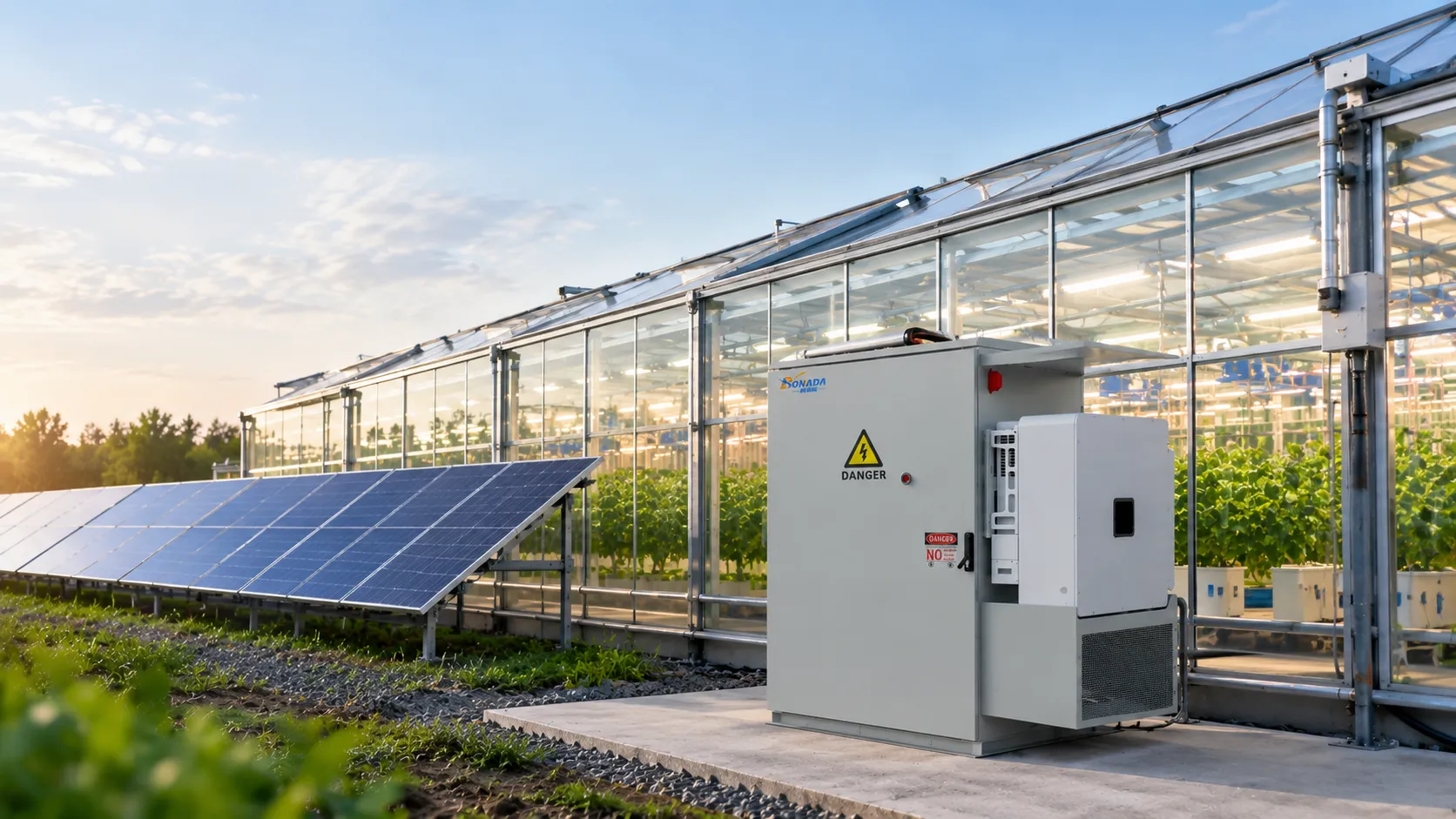
How to Choose the Right Energy Storage Solution for Your Greenhouse
Assessing Facility Energy Consumption and Load Profiles
Before picking out battery storage for your greenhouse, start by mapping out exactly how your site burns power each day and through every growing season.
Grab 12 months of utility invoices if you can, plus meter interval logs, solar output history, and specs for all your big power-hungry gear. Data logged every 15 minutes or even more frequently works best — it lets you spot those sharp, brief demand spikes and check whether time-of-use pricing will work in your favour.
You’ll want to gather details on:
- Total power used each day and over the full year
- Peak demand levels, plus when those peaks tend to hit
- Load breakdowns by hour or meter interval
- Current solar PV size and how much excess power it makes
- Seasonal shifts for lights, heating, cooling and irrigation
- Import and export electricity rates from your provider
- Priority loads and how long they need backup power
If you’re putting solar and batteries in at the same time, run the numbers to match predicted solar output against your site’s load pattern. That shows you roughly how much extra power you can actually bank, and how often you can draw from the battery when it matters.
When solar panels are already up and running, past generation and export readings give you a far more solid reference to size your battery correctly.
Determining Optimal Battery Capacity and Chemistry
Figuring out how big your battery needs to be boils down to two separate choices: how much total energy you want to store, and how much power the system can push out at once.
Battery capacity, given in kWh, tells you how much energy you can draw over time. PCS power, measured in kW, controls how fast the battery can charge up or send power out.
A simple way to work out the usable energy you’ll need looks like this:
Required usable battery capacity (kWh) = Average supported load (kW) × Required operating hours (h)
As an example: say a greenhouse needs to keep a 30 kW critical load running for four hours when the grid drops out. The energy you need to deliver works out like this:
30 kW × 4 hours = 120 kWh.
This number is the energy reaching your equipment, and it won’t match the battery’s nameplate rating straight away. When sizing the pack, you have to factor in usable SOC limits, conversion losses, power used by auxiliary gear, temperature effects, long-term degradation, plus whatever operating rules the manufacturer lays out.
If your setup also has to handle big, sudden load spikes, your PCS has to have enough output and overload headroom. Engineers need to check motor startup currents, phase balance, and the chance that several large pieces of equipment kick on all at the same time.
LFP batteries are often a solid pick for these stationary commercial systems, thanks to their stable thermal behaviour and good cycle life. Other battery chemistries can fit better depending on what the project calls for. The final call should look at total lifecycle cost, usable energy, power requirements, built-in safety features, warranty terms, and local code requirements.
The table below lays out common points to weigh during planning.
| Greenhouse application | Primary storage objective | Key sizing consideration |
|---|---|---|
| Small commercial greenhouse | Solar self-consumption | Daytime surplus and evening demand |
| Lighting-intensive facility | Peak shaving and load shifting | Lighting schedule, demand peaks, and discharge duration |
| Greenhouse in an unreliable grid area | Backup power | Critical load, outage duration, and islanding capability |
| Large horticultural complex | Integrated energy management | Load diversity, multiple energy sources, and scalability |
Keep in mind these are just planning groups, not hard-set battery size recommendations. The real capacity and power ratings come from your measured site data and how you plan to run the storage system day to day.
Evaluating Financial Return on Investment (ROI) and Payback Periods
Whether battery storage makes financial sense for your greenhouse all comes down to how you plan to run it. You can cut demand charges, buy less pricey grid power, make better use of on-site solar, and even earn extra money by joining approved grid service programs.
Total project outlays cover battery packs, PCS or hybrid inverters, wiring work, safety hardware, site prep, monitoring tools, system commissioning, and regular upkeep. Any financial forecast also needs to factor in battery wear, energy losses, loan expenses, and the eventual cost to swap the batteries out.
Here’s a straightforward formula for working out yearly savings:
Annual net benefit = Electricity bill savings + Eligible additional revenue − Annual operating costs
And the basic simple payback calculation looks like this:
Simple payback period = Initial project investment ÷ Annual net benefit
As an example: imagine a greenhouse battery build that costs $100,000 to install, with projected yearly net gains of $20,000. That gives a five-year simple payback.
This is just for illustration. It’s not standard market returns, and there’s no guarantee you’ll hit these numbers. A solid investment review relies on your actual utility rates and site load data, accounts for gradual battery capacity fade, and compares cash flow year over year across the system’s service life.
To get a much clearer picture, run through these points:
- Test multiple battery sizes instead of assuming a bigger system automatically delivers better value
- Model seasonal swings in solar output and the greenhouse’s power requirements
- Verify if you can actually reduce demand charges under your local tariff rules
- Build round-trip efficiency and battery degradation into your savings model
- Factor in how future electricity price shifts might change the outcome
- Split proven cost savings apart from less predictable grid service or trading income
Battery storage gives the best return when it solves a specific energy-cost headache or delivers tangible backup reliability. A full technical and financial feasibility study will tell you if the expected gains are enough to justify the spend.
Frequently Asked Questions About Greenhouse Energy Storage
1. How Much Battery Storage Does a Commercial Greenhouse Need?
It really depends on your site. Your battery size is driven by your typical power draw, peak loads, how much solar you generate, and what backup runtime you’re after. Say you’ve got a 30 kW critical load that needs four hours of power if the grid drops — that works out to 120 kWh of deliverable energy. You can’t just spec the battery for that number alone, though. You have to make allowances for conversion waste, limited usable SOC and other site conditions. Going over your daily power usage and listing your non-negotiable loads is the practical way to figure out the right battery setup.
2. Can a Greenhouse Battery Storage System Operate During Cloudy Weather or at Night?
Sure, it can. As long as there’s energy stored inside the battery, it can supply power after dark or when cloud cover kills solar output. When tied to solar panels, it tucks away extra power made on bright days to use later when sunlight is thin. If grey weather sticks around for days, you’ll likely need to recharge the battery from grid supply or another compatible source. Any well-sized system will take seasonal solar variation, overnight loads and required backup time into account.
3. Which Greenhouse Equipment Should Receive Backup Power During a Grid Outage?
Focus first on gear that protects your crops and keeps basic operations alive. Usually that means ventilation fans, irrigation pumps, climate controls, alarms and communication gear. Heaters or cooling kit might also need backup, depending on your crop type and local weather. Before picking a battery, map these priority loads out and calculate how much power and runtime you need. Also double-check your inverter and transfer hardware are built to run in backup island mode.
4. Is It Worth Combining Solar Panels with Battery Storage for a Greenhouse?
Pairing solar with batteries helps you get more out of the power you make onsite. Extra solar power captured during daylight gets stored up for evening use, cutting how much grid power you buy and possibly lowering running costs. Whether it pencils out relies on your solar output, utility rates, battery losses, install cost and your unique load pattern. It’s smart to compare the numbers for solar-only versus solar plus storage, so you can judge if the battery adds enough benefit to justify the expense.
5. How Can Greenhouse Operators Calculate the Return on Investment for Battery Storage?
Start by adding up the yearly savings you get from peak shaving, time-of-use rates and higher on-site solar consumption. Subtract annual maintenance and operating costs to get your estimated net gain. As an example: a $100,000 battery setup saving you $20,000 each year gives a simple five-year payback. This is just an example, not a promise. A realistic financial check also has to factor in battery capacity fade, round-trip losses, changing power prices, warranty terms and the expected service life of the whole system.
Conclusion: Building a Sustainable Energy Future for Your Greenhouse
Battery storage works well for horticulture operators wanting more say over their power expenses, more value from renewables, and a safety buffer when grid power cuts out. Once you combine these batteries with solar panels, smart energy controls and efficient greenhouse kit, you’re able to align available power with what your crops require each day.
A reliable setup always starts by looking closely at how your site uses power. Skip generic rules of thumb. Choose battery size, PCS rating, cell type, backup features and control compatibility based purely on your greenhouse’s real-world needs.
Modular LFP battery packs are often a good starting point to assess for commercial greenhouses, especially if you need daily cycling, solar integration or peak load management. Even with that, your final design has to check out against project budget, site conditions, safety rules and local electrical codes.
Get the planning right, and this storage setup can slot into your wider plan to cut energy waste, stabilise operational costs and run a more sustainable growing business.
Looking for the Right Greenhouse Energy Storage Solution?
Reduce electricity costs, maximize solar energy use, and keep essential greenhouse equipment running with a customized battery storage system. Bonada can help you evaluate your energy needs and recommend a suitable solution based on your load profile, backup requirements, and project goals.
Contact Bonada for a Storage Solution
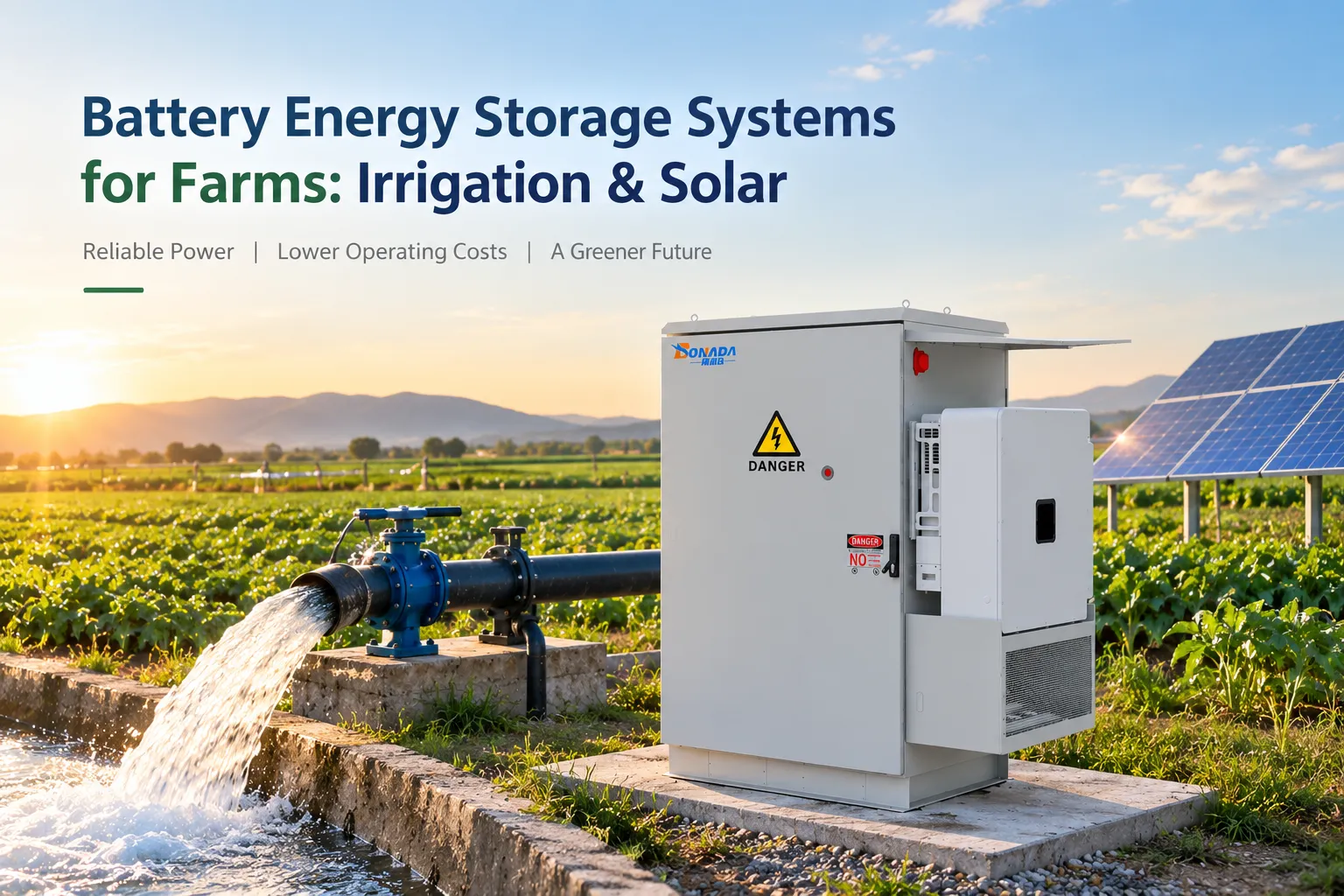
Battery Energy Storage Systems for Farms: Irrigation & Solar
Related Article