Battery Energy Storage Systems for Farms: Irrigation & Solar
The relationship between reliable electricity and efficient modern farming cannot be overstated. Electricity plays a crucial role in running farm equipment, from irrigation systems and groundwater pumps to refrigerated storage units and livestock ventilation systems. With electricity being costly, combined with poor rural electricity lines and increased prices for diesel, managing energy can be a big challenge for farmers!
Solar power can be a solution that helps reduce dependence on conventional electricity. However, solar power alone is not sufficient to guarantee continuous energy supply for farmers. If your crops need irrigation, there might be no sunlight after sunset or during cloudy weather. This means that there might be a problem with supplying energy for your farm equipment.
Combining solar power with the battery energy storage system (BESS) can solve this and provide farmers with the necessary technology to supply energy for their equipment.
In a nutshell, for agricultural operations, the solar photovoltaic (PV) panels installed along with a baseball-sized battery may drastically reduce costs of operation while making energy management more reliable.
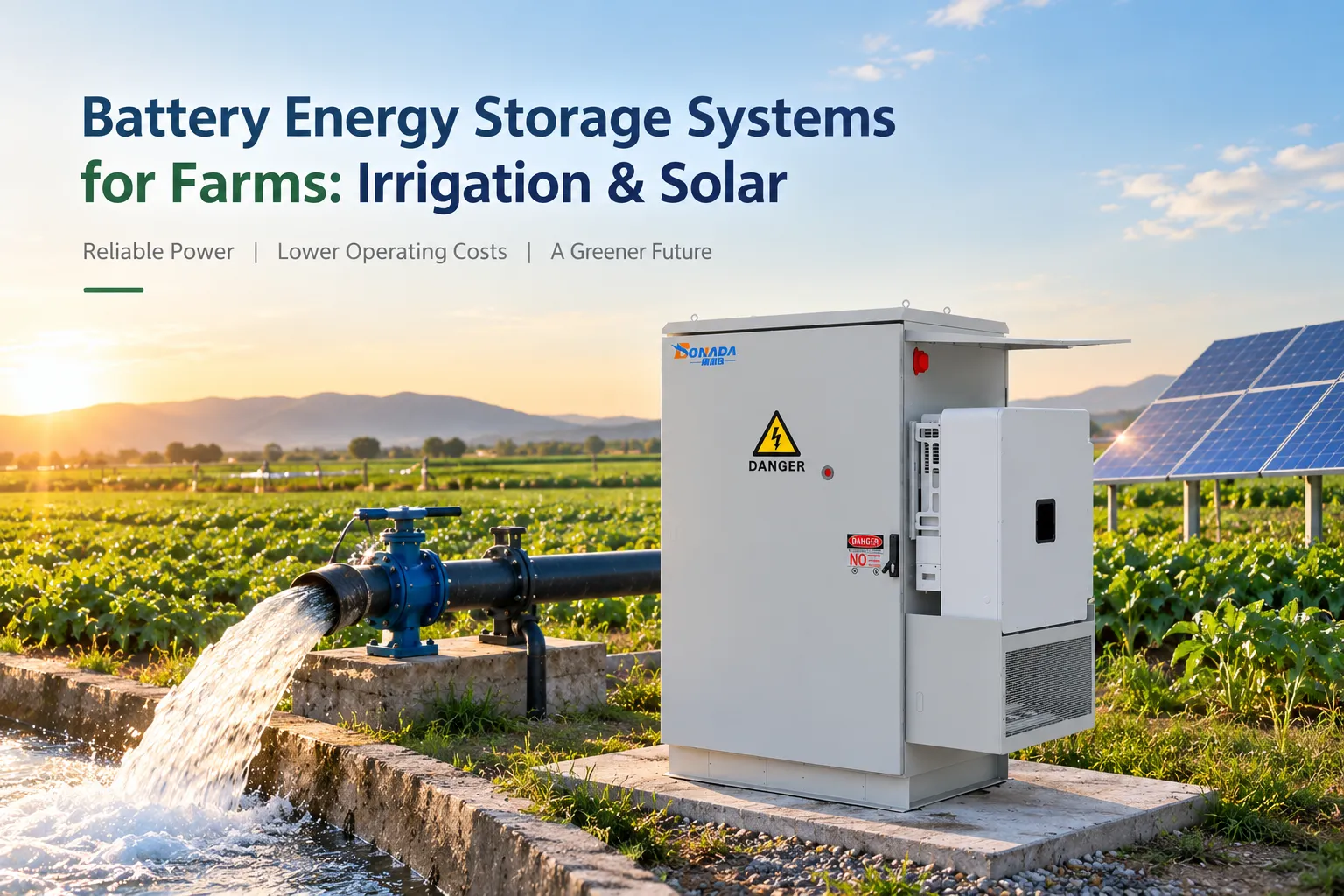
The Energy Challenge in Modern Agriculture and Irrigation
Agri-food industry electricity needs differ greatly from those of most commercial buildings. For instance, irrigation pumps often require considerable electricity during peak use times of the season while refrigerated cooling, ventilation, and automatic feeding equipment are likely to use significant amounts of electricity throughout the day. Compounding the situation in specific areas is the difficulty of limited grid availability.
High Demand Charges and Unreliable Rural Power Grids
Energy bill at some farms includes a combination of energy consumption costs and demand charges. Energy costs show how much electricity is used (in kWh), while demand charges (if there are any) reflect the greatest values of power demand according to the billing cycle.
At times, simultaneous start-up of several pumps or the use of heavy equipment in the irrigation process may result in a short-time surge in demand, which (subject to the utility tariffs) may increase a monthly electricity bill.
Rural networks often experience voltage drops, outages and overloading, especially during hot weather when both agricultural and household demand is at its peak.
A properly configured BESS can help by:
- Discharging during periods of high electricity demand.
- Storing solar generation that would otherwise be exported or curtailed.
- Providing backup power to selected critical farm equipment.
- Reducing exposure to unreliable grid supply when the system includes suitable islanding and backup capabilities.
Actual savings depend on the local tariff, the battery's usable capacity, inverter power, and the farm's daily load profile. A battery does not automatically eliminate demand charges or guarantee uninterrupted power.
Understanding Irrigation Pump Loads and Starting Currents
Irrigation pumps represent, many times, one of the bigger electrical loads on a farm. The motors these pumps use need more current when they start up. Especially if they are hooked up directly to the power supply, this temporary demand for electricity can be quite a bit higher. It is often several times what the motor normally uses when it is running. How much extra current depends on how the motor was designed and also the method chosen for starting it.
For instance, consider a pump that normally operates quite steadily and at a moderate level of power. Even such a pump might n͏eed a si gnificantly larger, instantaneous power supply just for starting. So if an inverter is not able to give this necessary starting current, you can see some problems. The whole system might trip off. Or, there could be a voltage d͏rop, which is not good. Worse still, the motor could just fail to start altogether.
When sizing an agricultural battery system, engineers should assess:
- Motor rated power and voltage.
- Full-load current and starting current.
- Starting method, including direct-on-line, soft starter, or variable frequency drive (VFD).
- Whether several pumps start simultaneously.
- Other equipment operating at the same time.
A VFD can reduce starting current and adjust pump speed to match irrigation requirements. However, compatibility with the inverter, motor, and control system must be verified. A battery's kWh rating alone does not determine whether it can start a large pump.
Why Farms Are Moving Beyond Diesel-Only Power
Diesel generators are crucial for off-grid agricultural areas, for backup power, and for mobile power purposes. However, using diesel alone may expose farms to increases in fuel prices, transportation expenses, maintenance requirements, noise, and pollution.
Solar-can-storage technology can help cut diesel generator use, by making solar power available during the day, storing excess power produced, and making it available for irrigation at night or on cloudy days when power yields are low.
For farms that are not completely ready to run on renewable energy, hybrid solutions may serve as a helpful step. Solar energy will be used when it is available, batteries will provide energy when needed, and the diesel generator will serve as backup energy source in times of low solar power supply or at the times when electricity demand is especially high.
How Battery Energy Storage Systems Power Farm Irrigation
A typical farm BESS consists of the battery modules, battery management system (BMS), the power conversion system (PCS) or a compatible hybrid inverter, protection devices and energy management system (EMS). Depending on the installer, the system may include solar inverters, generator interface, grid connection and dedicated backup distribution board.
When the solar panel system starts generating electricity during the day, the energy produced is sent first to meet the needs of the farm operation. Should extra power be available, it is used to charge the battery. In the opposite case, the batter is discharged by the system when solar generation is insufficient or the demand for power rises.
Managing Pump Startup and Motor Loads
Reliable pump operation requires more than adequate battery energy capacity. The inverter or PCS must deliver enough continuous and short-duration power to accommodate the motor's operating and starting requirements.
Three design measures are particularly useful:
- Choose the correct inverter: Verify continuous output power, overload capability, surge duration, and compatibility with the motor's electrical characteristics.
- Use appropriate motor controls: Soft starters or VFDs can reduce starting stress and improve pump control when properly selected.
- Sequence large loads: Start pumps one at a time and coordinate them with other major loads to avoid unnecessary power peaks.
These measures can improve system stability and may reduce the inverter capacity required compared with a design that starts every motor simultaneously. Final sizing should follow manufacturer specifications and an electrical load assessment.
Integrating Solar PV with Agricultural Battery Storage
Combining solar panels with battery storage allows farms to use more of the electricity generated on-site. During the day, PV generation can power irrigation pumps directly. When production exceeds demand, surplus electricity can charge the battery.
Later in the day, stored electricity can support irrigation, lighting, communications, or other loads. The amount available depends on battery capacity, charging efficiency, discharge limits, and the energy reserved for backup.
Solar-plus-storage systems are particularly useful when a farm has:
- Strong daytime sunlight and substantial irrigation demand.
- Evening or early-morning pumping requirements.
- Limited grid capacity or expensive peak-period electricity.
- Several buildings or loads that can share a coordinated power system.
Solar generation and irrigation demand should be modeled together. In some agricultural applications, scheduling irrigation during peak sunlight is more economical than storing all daytime solar electricity for later use. Water storage tanks or reservoirs can also act as a form of energy flexibility: solar power can pump water when electricity is available, while irrigation continues later using the stored water.
Off-Grid Operation and Microgrid Design
An off-grid farm energy storage system can operate without a utility connection when its generation, storage, inverter, and backup resources are designed for the site's energy requirements. Such a system must account for seasonal solar variation, periods of high demand, and the consequences of a prolonged energy shortage.
A farm microgrid may combine:
- Solar PV panels for renewable electricity generation.
- Battery storage for energy shifting, short-term power support, and backup.
- A grid connection, where available, for additional supply or export.
- A diesel or other compatible generator for extended low-generation periods.
- An EMS that coordinates generation, charging, discharging, and load priorities.
Equipment that can create and sustain local energy source is necessary for islanded operation. Most grid-tied solar inverters don't actually have a capacity for stand-alone consumption during outages. Such components must encompass full functionality including protection, grounding, transfer mechanism, motor-starting possibility and logic for load-shedding.
The purpose for off-grid farms may not be to keep power flowing constantly to all devices. One option is to give precedence to irrigation controls, important water pumps, livestock ventilation, communications, and refrigeration thereby achieving lower energy storage needs.
Key Benefits of Solar Battery Storage for Farms
Peak Shaving and Electricity Cost Reduction
Peak shaving refers to the practice of discharging battery energy in order to lower the amount of power consumed. This can help farms manage electricity costs better when demand charges and time-of-use tariffs are applicable.
For instance, the energy produced by one machine can be used to supply power to another for a certain time (therefore, two machines can operate at the same time without exceeding a set demand level). In this case, it is important to have enough electricity and energy available throughout the entire period of peak shaving.
It is advisable to monitor actual expenses and interval meter data rather than assuming that the operation of each kilowatt hour produces the same benefits.
Increasing Solar Self-Consumption
Solar energy production can exceed a farm’s energy needs during sunny weather. In the absence of on-farm energy needs, energy storage, or a reasonable export agreement, the value of excess generation can be low.
Batteries can store excess electricity for later use. This applies when irrigation takes place later in the day, as well as when the farm uses electric refrigeration, processing machinery, or livestock facilities at night.
However, energy storage using batteries involves losses and additional capital costs. Direct solar energy use and flexible irrigation scheduling should be considered before investing in energy storage.
Protecting Critical Agricultural Operations
Electricity failing can influence a variety of aspects beyond just irrigating. Always requiring power are the cooling of stored foods and milk, ventilating animals, working of the automatic feeder, treating water and functioning of the control system.
In this case, one can choose a backup electrical system powered by batteries, which enables maintaining only the required critical load during power outages, thereby depending on the overall power requirement of the circuits of the backup system the required duration of maintaining the loads will be determined by the amount of energy contained in the batteries.
It could be the case that the farmer will opt to set up a separate backup circuit for control devices only, for ventilation, and for pumping of water rather than planning to switch on all the machinery and equipment in the workshop.
This comes down to improving the resilience of the power supply while controlling the costs of storage batteries installation.
Selecting the Right Battery Technology for Agricultural Environments
Agricultural installations may face dust, humidity, high ambient temperatures, corrosive substances, vibration, and limited access for maintenance. Battery chemistry, enclosure design, thermal management, and control systems all influence long-term performance.
Why LiFePO4 Batteries Are Widely Used
Lithium iron phosphate (LiFePO4 or LFP) batteries are widely used in stationary energy storage because they offer a useful combination of thermal stability, cycle life, and operating performance.
Potential advantages include:
- High usable energy density compared with many traditional lead-acid systems.
- Good cycle-life potential when operated within specified temperature, voltage, and current limits.
- Relatively stable thermal characteristics compared with several other lithium-ion chemistries.
- Modular configurations that can support different power and energy requirements.
Battery life is not determined by chemistry alone. Depth of discharge, temperature, charge and discharge rates, cell balancing, installation quality, and maintenance all affect performance. Buyers should compare the manufacturer's cycle-life conditions, warranted energy throughput, capacity-retention guarantee, and warranty exclusions.
Enclosure Protection, Dust, Moisture, and Corrosion
Farm environments require careful equipment placement and enclosure selection. Dust can interfere with cooling systems, while moisture and corrosive agricultural chemicals can damage electrical connections and exposed components.
When evaluating an agricultural battery system, review:
- Ingress protection: Select an appropriate IP rating for the actual exposure to dust and water. IP65, for example, indicates dust-tight protection and protection against water jets under specified test conditions; it does not mean the equipment is suitable for immersion.
- Corrosion resistance: Consider coatings, fasteners, cable glands, and enclosures for coastal or chemically aggressive environments.
- Thermal management: Confirm the permitted operating temperature and cooling requirements for both the battery and inverter.
- Installation conditions: Provide adequate ventilation, clearances, drainage, access for service, and protection against flooding or direct physical damage.
NEMA 4X is a North American enclosure classification associated with protection against specified environmental hazards, including corrosion. It should not be treated as automatically equivalent to an IP rating; verify the applicable certification and test conditions.
Even a well-sealed battery enclosure can experience performance limitations in extreme heat. Equipment should be installed within the manufacturer's permitted environmental range, with suitable shading or climate control where necessary.
BMS and EMS: Coordinating Energy and Water Management
The battery management system monitors battery conditions, helps protect cells against operation outside permitted limits, and manages functions such as cell balancing and temperature monitoring where supported.
The energy management system operates at a broader level. It coordinates the battery, solar array, grid or generator, and connected loads according to operating priorities and energy costs.
For agricultural applications, useful EMS functions may include:
- Scheduling irrigation around solar availability and electricity tariffs.
- Maintaining a minimum battery reserve for outages.
- Preventing excessive simultaneous demand from multiple pumps.
- Prioritizing essential loads when available energy is limited.
- Monitoring power consumption and generating performance reports.
Remote monitoring can be especially valuable for farms with several pump stations or facilities spread across a large site. Communications coverage, cybersecurity, controller compatibility, and access to technical support should be checked before deployment.
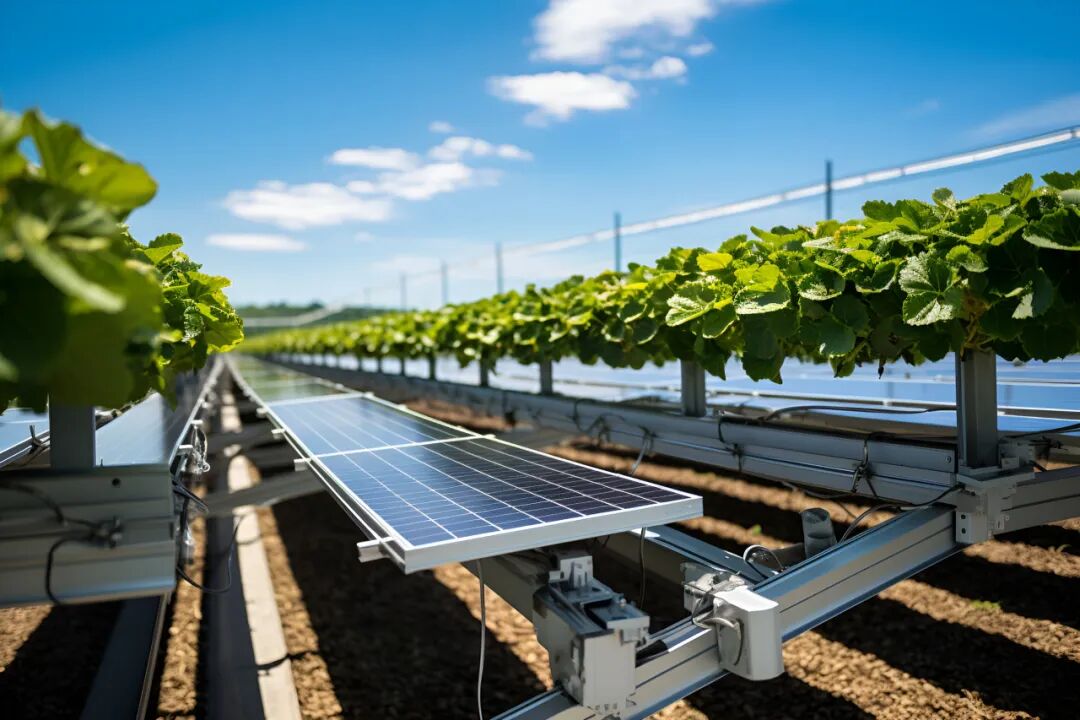
How to Size a BESS for Farm Irrigation
Correctly sizing BESS for agricultural operations requires separate calculations for power and energy. Power, measured in kilowatts (kW), determines how much equipment can operate at once. Energy, measured in kilowatt-hours (kWh), determines how long the battery can supply that equipment.
A system with plenty of stored energy may still fail to start a large pump if its inverter cannot deliver the required power. Conversely, a powerful inverter paired with a small battery may operate a pump but provide insufficient runtime.
Step One: Calculate the Required Power Capacity
Start by listing every load the battery system must support. Record the rated power, operating schedule, starting characteristics, and whether each load is essential or optional.
The basic running-load calculation is:
Required running power = Sum of the power of all simultaneously operating loads
For instance, if a farm operates a 30 kW pump alongside 5 kW of other equipment, the combined running demand is 35 kW. This is only an initial estimate. The final inverter rating must also account for motor startup, power factor, overload duration, ambient temperature, and other manufacturer limits.
Motor nameplate data and electrical measurements are more reliable than estimates based solely on horsepower. For a motor-driven pump, engineers should determine whether a soft starter or VFD can reduce starting demand and whether the inverter supports the selected control method.
Step Two: Calculate the Required Battery Energy
Battery energy capacity depends on the electrical load and the duration for which it must operate.
Load energy (kWh) = Load power (kW) × Operating time (hours)
To estimate the nominal battery capacity required, account for the usable depth of discharge and the efficiency of the discharge path.
Nominal battery capacity (kWh) = Required delivered energy (kWh) ÷ (Usable depth of discharge × Discharge-path efficiency)
Consider a farm that needs to run a 20 kW pump for four hours without sufficient solar generation.
| Parameter | Illustrative value |
|---|---|
| Pump running power | 20 kW |
| Required runtime | 4 hours |
| Required delivered energy | 80 kWh |
| Assumed usable depth of discharge | 90% |
| Assumed discharge-path efficiency | 95% |
| Calculated nominal capacity | Approximately 94 kWh |
The calculation is 80 ÷ (0.90 × 0.95), giving approximately 93.6 kWh. A system designer may recommend additional capacity for battery aging, temperature effects, unexpected loads, reserve requirements, or future expansion.
This example assumes a constant 20 kW electrical load and does not include energy needed for other equipment. Actual pump consumption may vary with flow rate, head pressure, irrigation demand, and control settings.
Step Three: Match Solar PV Capacity to Daily Energy Demand
Solar array sizing should reflect both the farm's daily energy consumption and the available solar resource. A useful preliminary estimate is:
Daily solar generation (kWh) ≈ PV capacity (kW) × Peak sun hours × Performance ratio
Suppose a farm requires 160 kWh of electricity per day, receives an average of five peak sun hours, and has an assumed overall PV performance ratio of 80%.
The approximate PV capacity required to generate that amount of energy is 160 ÷ (5 × 0.80), or 40 kW.
This is an energy-balance estimate, not a final system design. It does not establish whether enough solar power will be available at the exact time a pump starts or whether the array can recharge the battery fully during winter, cloudy weather, or other low-generation periods.
Designers should use local solar irradiance data, shading analysis, seasonal irrigation schedules, module orientation, inverter limits, and the expected battery charging profile to determine the appropriate array size.
Step Four: Choose the Right System Configuration
Different farms have different electrical requirements. The most suitable arrangement depends on grid availability, load size, irrigation schedules, and the importance of uninterrupted operation.
| System configuration | Best suited for | Main consideration |
|---|---|---|
| Grid-connected solar plus battery | Farms with utility access and high electricity costs | Tariff structure and backup capability |
| Off-grid solar plus battery | Remote farms without reliable grid access | Seasonal generation and backup sizing |
| Solar, battery, and generator hybrid | Sites with variable weather or demanding loads | Generator control and fuel-saving strategy |
| Shared farm microgrid | Multiple buildings, pumps, or distributed loads | Distribution design, load coordination, and protection |
Before ordering equipment, prepare a load schedule, confirm motor-starting requirements, calculate daily energy consumption, and establish the required backup duration. These details allow suppliers and installers to recommend a system based on actual operating conditions rather than battery capacity alone.
Financial Analysis: ROI, Payback Period, and Incentives
The economic case for agricultural battery storage depends on the electricity or fuel costs it can realistically avoid. Farms with frequent outages, high demand charges, expensive diesel generation, or substantial unused solar output may have stronger business cases than farms with inexpensive, reliable electricity.
Calculate Total Cost of Ownership
Total cost of ownership (TCO) includes more than the initial battery purchase. A practical assessment should include:
- Battery modules, inverter or PCS, EMS, and related electrical equipment.
- Solar PV modules, mounting structures, wiring, and installation where applicable.
- Site preparation, enclosures, protection equipment, and commissioning.
- Routine maintenance, monitoring, cooling, and auxiliary electricity consumption.
- Battery augmentation or replacement during the evaluation period.
- Financing costs and applicable taxes, fees, or incentives.
Compare these costs against the expected savings from lower grid purchases, reduced demand charges where applicable, lower generator fuel consumption, and avoided operational losses from power interruptions where those losses can be reasonably quantified.
Estimate Annual Savings and Payback
A simplified payback calculation is:
Simple payback period = Net initial investment ÷ Annual net savings
When calculating annual net savings, it is important to take into account operating expenses. For example, if solar electricity is being used by the pump directly, the electricity saved should not also be represented by the discharge load from the battery.
Let’s take an illustrative project with a net investment of $100,000, where the annual savings total to $20,000. The simple payback in this case would be five years.
The case given above is only for computation purposes and does not reflect what could be expected for a typical farm as the results vary with prices of equipment, solar conditions, tariffs, battery load, maintenance and financing conditions.
In a more complete evaluation, it should be calculated NPV, IRR, and total life cost of electricity, based on data regarding battery degradation, replacement considerations, changes in electricity prices, power reliability benefits.
Government Incentives and Agricultural Energy Programs
Certain agricultural projects might qualify for grant funding, tax credits, depreciation benefits, or financing programs. However, it is essential to determine whether a project is eligible based on location, ownership structure, technology, installation date, and rules of the program at the time.
Farm owners in the United States should explore the programs administered by the U.S. Department of Agriculture.
Tax credits and depreciation rules also continue to evolve, and batteries might be subject to certain technical and ownership criteria for eligibility. It is necessary to check with the relevant government authorities to confirm the current rules before allocating incentives in an investment plan or financial forecast to plan accordingly.
Do not assume all solar battery installations will receive the subsidy for certain. Instead, the financial model must distinguish between the incentives that are confirmed and the ones that are still subject to approval.
Frequently Asked Questions About Agricultural Battery Storage
How Large a Battery Is Needed to Run a 50 HP Irrigation Pump?
A 50 HP motor has a mechanical rated output of approximately 37.3 kW. Its electrical input will generally be higher because the motor is not 100% efficient, and the actual operating demand depends on the pump and operating conditions.
For illustration, assume the motor draws 42 kW electrically and needs to operate for four hours. The pump would consume approximately 168 kWh during that period.
Using an assumed 90% usable depth of discharge and 95% discharge-path efficiency, the preliminary nominal battery requirement would be about 196 kWh: 168 ÷ (0.90 × 0.95).
This is only an energy estimate. The inverter must also handle the motor's starting requirements, and the solar array or other charging source must provide enough energy to replenish the battery. The final system may need a larger battery or a different configuration based on measured load, starting method, backup requirements, and seasonal conditions.
Can a Farm BESS Operate Completely Off-Grid?
Yes. An appropriately engineered off-grid farm energy storage system can supply electricity without a utility connection. It requires a suitable energy source, sufficient storage, an inverter capable of forming and maintaining the islanded grid, and protection and control equipment designed for independent operation.
For year-round irrigation, designers must account for seasonal solar variation, consecutive cloudy days, and peak demand. A generator or other backup resource may be necessary where a prolonged energy shortage would threaten crops or livestock.
Load prioritization, water storage, and flexible irrigation scheduling can help reduce the battery capacity and renewable generation required.
Can LiFePO4 Batteries Handle Dusty and Hot Farm Conditions?
LiFePO4 batteries can be suitable for agricultural applications when the battery system is designed for the site's environmental conditions. Their suitability still depends on the manufacturer's operating limits, enclosure protection, thermal management, and installation quality.
For dusty or hot environments, select equipment with an appropriate ingress protection rating, corrosion-resistant components where necessary, and adequate cooling. Avoid exposing battery equipment to temperatures outside its specified range, and verify whether capacity, charging power, or warranty coverage changes under extreme conditions.
Is Battery Storage Always Better Than Running Irrigation Pumps During the Day?
No. If irrigation can be scheduled during peak sunlight, operating pumps directly from solar generation may be more economical than storing electricity for later use.
Battery storage becomes more valuable when irrigation must continue after sunset, the farm needs outage protection, demand charges are significant, or solar generation and load timing do not align. In some cases, storing pumped water in a reservoir offers a lower-cost way to separate water delivery from electricity generation.
What Information Is Needed for an Accurate System Quote?
To develop a suitable proposal, a system integrator or battery supplier will generally need:
- Country and project location.
- Number of pumps, motor ratings, voltage, and starting methods.
- Daily operating hours and seasonal irrigation schedules.
- Other equipment that must operate at the same time.
- Existing solar PV capacity and available grid or generator supply.
- Required backup duration and critical loads.
- Available installation space and environmental conditions.
Utility bills, motor nameplate photographs, and interval-meter data can improve the accuracy of the assessment. With this information, suppliers can estimate the required inverter power, nominal battery capacity, solar generation, and expected operating costs.
Friendly Reminder
Farms can use battery storage technology to enhance the reliability of irrigation systems, increase the efficiency of solar energy utilization, save the cost of energy and fuel consumption, and secure the success of agriculture activities, but the best performance is obtained when the system is adjusted to the actual consumption patterns of energy, water supply intervals, solar capacity levels, and operating environment conditions.
Successful initiatives start with performing two independent calculations: the electricity demand needed to operate and start the equipment and the amount of energy that has to be consumed within the specified period of operation. Then the characteristics of the battery technology, power inverter, protection of the equipment, control functions, and economics must be evaluated together.
For certain farms that require a lot of water, are located far away from power plants or need to operate several critical pieces of machinery at the same time, a properly designed battery system can be considered an integral part of the efficient working energy strategy.
Need a BESS Solution for Farm Irrigation?
Find the right battery capacity for your irrigation pumps and agricultural operations. Bonada can help you evaluate power requirements, solar PV integration, backup duration, and system configuration to support reliable farm energy storage and efficient irrigation.
Discuss Your Farm Energy Project
Solar Battery Storage for Businesses: Cut Electricity Costs and Grid Dependence
Related Article