EV Charging Station Battery Storage: Solve Grid Capacity Limits
Adding more EV chargers sounds straightforward until the utility connection becomes the problem.
A commercial property might have enough parking spaces for ten new chargers, but its transformer is already close to capacity. A highway charging operator may want to install high-power DC chargers, only to discover that increasing the grid connection will take months. For a fleet depot, the challenge can be even more practical: dozens of vehicles need to charge before the next working day, but the available electrical supply cannot support them all at once.
This is where battery energy storage becomes useful.
Instead of drawing all the power directly from the grid at the moment it is needed, an EV charging station can store electricity in advance and use it during busy periods. The arrangement gives operators more flexibility over how much power they draw, when they draw it, and how they serve multiple vehicles.
For developers planning new charging sites, EV charging station battery storage is worth considering before committing to a costly grid upgrade. Whether it makes financial sense, however, depends on the site's actual electricity demand, connection limits, charging schedule, and local energy prices.
What Is Battery Energy Storage for EV Charging Stations?
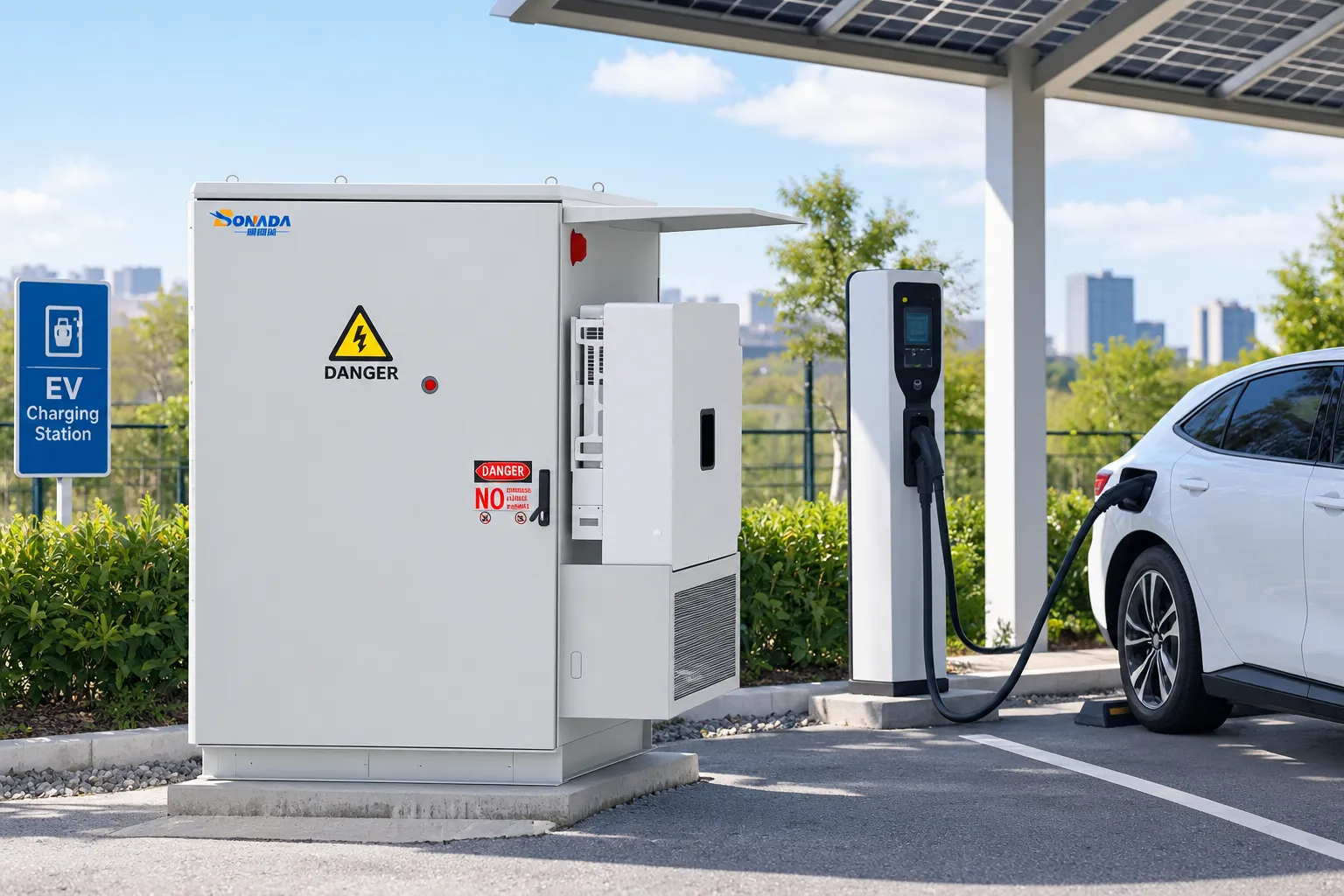
A battery energy storage system, commonly called BESS, stores electricity for use at a later time. In an EV charging installation, it works alongside the utility connection and charging equipment to meet demand that would otherwise exceed the preferred grid import level.
The system typically includes battery modules, a battery management system (BMS), a power conversion system (PCS), an energy management system (EMS), and the necessary cooling, electrical protection, and safety equipment.
Each component has a specific job. The battery stores energy. The PCS controls the flow of electrical power between the battery and the site's electrical system. The EMS decides when to charge or discharge the battery based on demand, electricity prices, and operating requirements.
Some installations also include solar panels. Others operate entirely with grid electricity, charging the battery during quieter periods and using the stored energy when vehicles arrive in greater numbers.
How Battery Storage Works with EV Chargers
Consider a charging station connected to a grid supply that can provide 300 kW after allowing for the site's other electrical loads. The operator plans to install four DC chargers, each rated at 150 kW.
The chargers have a combined rated output of 600 kW. That does not mean they will always draw 600 kW, since vehicle charging rates vary. But if several vehicles charge at high power simultaneously, demand could exceed the available grid supply.
Without storage, the operator has a few choices: restrict charger output, install a larger grid connection, or accept that some charging sessions will take longer.
With a suitably sized BESS, the battery can provide additional power when demand rises above the site's chosen grid limit. The grid continues supplying its available share, while the battery covers part of the difference.
The distinction between power and energy matters here. A battery rated at 300 kW can deliver substantial power, but its ability to maintain that output depends on how much usable energy remains. A system with 300 kW of discharge power and 600 kWh of usable energy could theoretically supply that power for two hours under ideal conditions. Actual duration will be shorter if losses or operating reserves need to be allowed for.
For this reason, choosing a battery based only on its kWh rating is not enough. The design must account for both the size of the power shortfall and the length of time it is expected to last.
The Role of BESS in Supporting the Power Grid
EV charging creates a different kind of electricity demand from many traditional commercial loads. Several vehicles can connect within minutes, and high-power chargers can increase the site's load quickly.
When many charging sessions overlap, the resulting peak may be much higher than the site's average demand. A battery can absorb some of this variation by charging when demand is low and discharging when it rises.
At an individual site, this helps keep grid imports within a defined limit. Across a wider electricity network, appropriately controlled storage may also provide flexibility services, such as demand response or frequency regulation, where local rules and market arrangements permit.
These wider grid benefits should not be confused with the basic function of a charging station battery. Most projects begin with a simpler objective: supply the power vehicles need without requiring the grid connection to handle every short-duration peak.
Key Challenges Solved by EV Charging Battery Storage
Overcoming Grid Capacity Bottlenecks
Grid connection delays can change the economics of an EV charging project. A location may be commercially attractive, yet unable to accommodate the proposed charging capacity without changes to its transformer, switchgear, cables, or upstream distribution network.
The cost is not limited to equipment. Utility studies, permits, civil works, and construction schedules can all affect the time needed to bring a site into operation.
Battery storage offers another way to approach the problem. Rather than designing the site around the highest possible simultaneous charger demand, the developer can combine the available grid supply with a battery that covers the difference during selected periods.
This can be particularly useful at:
- Highway service areas where drivers expect fast charging and short waiting times.
- Urban charging sites with limited spare transformer capacity.
- Shopping centers, hotels, and office buildings adding chargers to existing electrical infrastructure.
- Bus and delivery depots where many vehicles return within a narrow time window.
- Remote locations where increasing the grid connection is difficult or expensive.
There is an important limit, though. A battery can cover a shortfall only while it has sufficient stored energy and discharge capacity. If a charging station operates near maximum demand throughout the day, storage alone may not be enough. The project may still need a larger grid connection or a different charging strategy.
Mitigating Expensive Peak Demand Charges
Electricity bills for commercial customers do not always depend solely on the number of kilowatt-hours consumed. In some markets, utilities also charge for the highest level of power demand recorded during a billing period.
This can create an unexpected cost for EV charging operators. A station may have moderate electricity consumption for most of the day, but a short period of simultaneous fast charging can establish a high demand peak.
A battery can reduce that peak by supplying part of the load when grid demand reaches a preset threshold.
For example, suppose a site aims to limit grid imports to 400 kW. When charging demand reaches 520 kW, the battery could supply the additional 120 kW, provided its power rating and state of charge allow it.
Whether this saves money depends on the tariff. The operator needs to compare the demand charge avoided with the cost of battery charging, conversion losses, maintenance, and battery degradation.
Peak shaving is usually more attractive when demand charges are high and the largest peaks are relatively brief. If the tariff places little emphasis on peak demand, the investment may need to be justified by other benefits.
Addressing Power Reliability and Outage Risks
A grid outage can interrupt charging sessions, delay fleet operations, and leave public charging points unavailable. Battery storage may provide backup power, but this capability must be included in the system design.
A standard grid-connected battery system does not necessarily continue operating when the utility supply fails. Safe backup operation can require islanding controls, suitable switching equipment, compatible inverter functions, and an electrical design that prevents unintended power export to a disconnected grid.
Operators should decide in advance which loads need to remain available. A fleet depot might reserve energy for vehicles due to depart soon. A public charging site may prioritize a small number of chargers rather than attempting to operate the entire station throughout an outage.
The battery reserve matters as much as the installed capacity. If all available energy is used for daily peak shaving, little may remain when the grid fails. Sites that need emergency charging should establish a minimum reserve and make it part of the EMS operating strategy.
Major Benefits of Battery Storage for EV Charging
Peak Shaving and Operational Cost Optimization
One advantage of EV charger energy storage is that it gives operators more control over their electricity demand. They can buy or generate energy when conditions are favorable, then use the stored electricity when the site needs additional power.
Depending on the project, this may help reduce demand charges, shift consumption away from expensive tariff periods, make better use of existing electrical infrastructure, or increase the number of vehicles that can charge during busy periods.
These benefits should be evaluated together rather than treated as separate guarantees of savings. A battery that reduces demand charges may also increase electricity consumption slightly because charging and discharging are not perfectly efficient.
For a realistic financial estimate, the operator needs an interval load profile, the applicable electricity tariff, expected charging revenue, battery operating limits, and a forecast of how the battery will be used over time.
Enabling Fast and Ultra-Fast DC Charging
High-power DC chargers are attractive because they can reduce charging time. The difficulty is that a site with several high-power chargers may need a much larger electrical connection than a conventional commercial property can provide.
Battery storage can help bridge that gap. The grid supplies energy over a longer period, and the battery provides extra power during busy charging windows.
Imagine a station where drivers arrive in clusters during the late afternoon. Demand might rise sharply for 20 or 30 minutes, then fall as vehicles finish charging and leave. A battery can support that temporary increase without requiring the grid connection to match the maximum theoretical output of every charger.
This approach works best when the battery has enough time to recharge between peaks. If the next group of vehicles arrives before the battery has recovered, the available discharge power or charging capacity may become the limiting factor.
Charger management is also important. The EMS can allocate available power across vehicles rather than allowing every charger to compete for the same limited supply. The result is a coordinated charging strategy based on vehicle requirements, expected departure times, and the site's grid limit.
Seamless Integration with Solar and Renewable Energy
Solar generation and EV charging do not always happen at the same time. A commercial building may produce its highest solar output around midday, while its busiest charging period occurs later in the afternoon.
Without storage, some surplus solar energy may be exported to the grid or remain unused on-site, depending on the system and local rules. Adding a battery allows part of that energy to be stored and used for charging vehicles later.
A solar-plus-storage installation generally combines PV panels, battery modules, power conversion equipment, EV chargers, and an EMS. The control system determines whether available solar power should serve the chargers directly, charge the battery, or supply other site loads.
For factories, commercial buildings, and fleet depots, this arrangement can increase on-site solar consumption. It may also reduce grid imports during certain periods.
However, the financial outcome depends on the difference between the value of exported electricity and the cost of importing electricity later. Battery losses, solar production patterns, equipment costs, and the charging schedule all affect the result.
Emergency Backup Power and Resilience
Battery storage can also support selected charging operations when grid power is unavailable. This is particularly relevant to fleet operators whose vehicles must be ready for scheduled routes.
The system can reserve energy for critical vehicles and temporarily suspend less urgent charging sessions. For commercial sites, the same battery may support selected building loads if the electrical design allows it.
Backup operation introduces a trade-off. Keeping more energy in reserve improves outage readiness but leaves less capacity available for everyday peak shaving. Operators should decide which function matters most and configure the control strategy accordingly.
Primary Application Scenarios for BESS-Powered Charging
Public Fast Charging Stations and Highway Hubs
Highway charging sites need to accommodate unpredictable arrivals. Several vehicles may pull in together during holiday periods or busy travel hours, creating a brief but substantial increase in demand.
Battery storage can help the operator serve these periods without sizing the grid connection solely around the highest possible simultaneous charger output. It can also provide more flexibility when planning future charger installations.
Before selecting a system, the developer should examine traffic forecasts, average charging duration, the number of charging bays, peak simultaneous demand, and the time available to recharge the battery between busy periods.
A site with occasional peaks may need less storage than a hub with consistently high utilization. The distinction matters because a battery sized for rare peaks can be expensive relative to the amount of energy it delivers over a year.
Commercial Fleets and Transit Depots
Fleet charging is often easier to plan because vehicle movements follow a schedule. Electric buses, delivery vans, service vehicles, and logistics fleets may return to a depot at predictable times and need to leave again by a set deadline.
The challenge is that many vehicles can need charging at once. Installing enough grid capacity to charge every vehicle at maximum power simultaneously may be unnecessary if the vehicles have several hours to recharge.
A battery-supported charging system can combine controlled charging with additional stored power. The EMS can prioritize vehicles that leave first, account for their energy requirements, and distribute the available power across the fleet.
For these projects, the most useful starting information includes the fleet size, battery capacity of each vehicle, daily energy consumption, arrival and departure times, and the minimum state of charge required for the next shift.
With those figures, an EPC contractor can assess whether controlled charging alone is sufficient or whether a BESS would provide additional value.
Commercial Real Estate and Industrial Parks
Adding EV chargers to an existing building is not simply a matter of installing charging points in the parking lot. The building may already use much of its available electrical capacity for air conditioning, production machinery, elevators, lighting, or other equipment.
A factory, for instance, may experience high demand during its production shift. If employees also charge their vehicles during that period, the site could exceed its preferred demand limit.
Battery storage can supply part of the additional charging load while the building continues operating. In a hotel or shopping center, it may also work alongside rooftop solar and a broader building energy management system.
For EPC companies, these installations often call for an integrated design rather than a battery supplied in isolation. The project may involve chargers, switchgear, transformers, PV inverters, metering, EMS software, and coordination with the existing building system.
Critical Technical and Safety Considerations
Thermal Management and Fire Suppression Systems
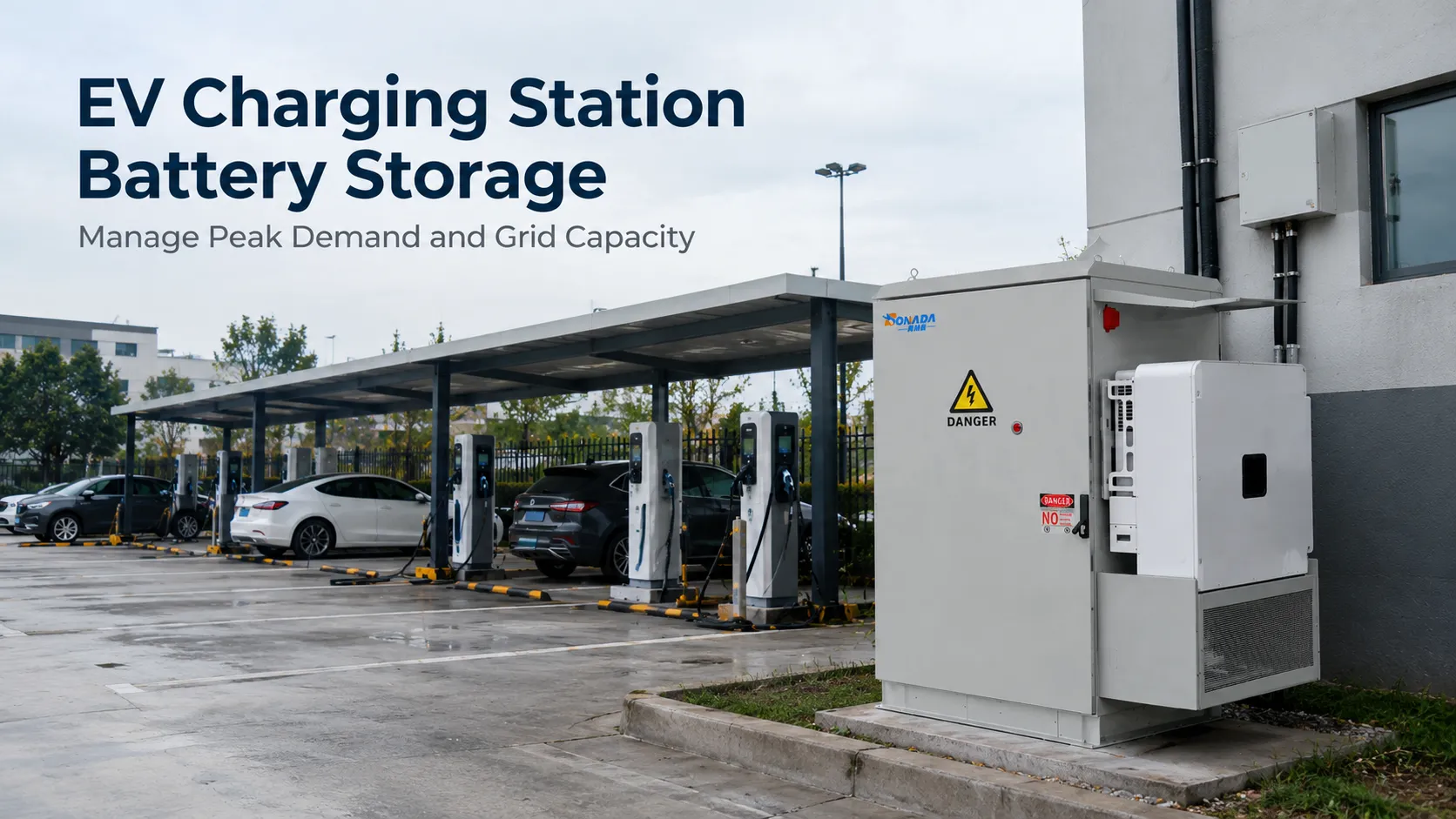
Battery safety should be considered during site planning, equipment selection, installation, and operation. A commercial BESS may operate through repeated charge and discharge cycles, so temperature control and fault monitoring are important to its performance and service life.
The battery management system should monitor relevant cell and pack conditions and keep operation within the manufacturer's specified limits. Thermal management may use air cooling, liquid cooling, or another suitable design, depending on the battery system and its operating environment.
Project teams should check the following before installation:
- Battery voltage, current, and temperature monitoring.
- Protection against overcurrent, short circuits, and other electrical faults.
- Cooling capacity under expected ambient temperatures and operating loads.
- Enclosure protection appropriate to the installation environment.
- Fire detection, suppression, separation, and emergency access requirements.
- Applicable local electrical codes, building rules, fire regulations, and energy storage standards.
Fire suppression alone does not make a battery installation safe. The complete design needs to address fault detection, propagation risks, access for emergency responders, and the procedures used to isolate the system during an incident.
Buyers should request product test reports, applicable certifications, warranty terms, installation documentation, and details of the safety systems included in the proposed configuration. Requirements vary by market, so compliance should be verified for the actual site and project scope.
Modularity, Scalability, and Footprint Optimization
A charging station that starts with four chargers may eventually expand to eight or twelve. A modular BESS can make that expansion easier, but only if the original design accounts for future requirements.
The battery enclosure is only part of the space calculation. Developers also need to allow for power conversion equipment, electrical panels, cooling, maintenance access, cable routes, and any required safety clearances.
Outdoor battery cabinets may suit smaller commercial installations, while larger charging hubs may use several cabinets or containerized systems. The right choice depends on the required power, energy capacity, available land, installation conditions, and expansion plan.
When comparing systems, pay attention to these specifications:
| Specification | What to Check |
|---|---|
| Rated power (kW) | Whether the system can cover the expected peak power shortfall |
| Energy capacity (kWh) | Whether stored energy can support the required charging period |
| Usable capacity | How much energy is available within permitted operating limits |
| Round-trip efficiency | How much energy is recovered after a complete charge-discharge cycle |
| Expansion capability | Whether additional battery capacity and conversion equipment can be integrated later |
| Operating temperature | Whether the system suits the local climate and expected duty cycle |
Modularity does not automatically mean that a system can be expanded without further work. The PCS, EMS, protection equipment, cooling system, and grid connection must all support the planned configuration.
Smart Energy Management and Dynamic Load Balancing
The value of a battery depends partly on how well it is controlled. A system that discharges whenever a charger requests power may run out of energy before the busiest part of the day begins.
An EMS should consider the grid import limit, individual charger demand, battery state of charge, electricity prices, solar output, and the energy needed for upcoming charging sessions. It can then determine when to charge the battery, when to discharge it, and how much power to make available to each charger.
Dynamic load balancing is particularly important when several vehicles are charging at once. Instead of allowing every charger to draw its maximum power, the control system distributes available capacity according to charging priorities and site limits.
For a fleet depot, a vehicle leaving in 30 minutes may need priority over one that will remain parked overnight. At a public station, the operator may use a different allocation strategy to balance waiting time and available power.
Compatibility should be confirmed before procurement. The battery controller, PCS, chargers, meters, and charging management platform need to exchange the information required for the intended operating strategy.
Economic Viability and Business Case for BESS
CapEx vs. Long-Term Avoided Grid Upgrade Costs
The central financial question is not whether a battery can supply extra power. It is whether that capability is worth more than the cost of installing and operating the system.
In some projects, the main benefit is avoiding or postponing a grid upgrade. In others, savings come from demand charge reduction, better use of solar generation, or additional charging sessions that would otherwise be limited by the site's electrical connection.
The comparison should include the full cost of the BESS, not just the battery modules. Installation, power conversion, cooling, fire safety, electrical works, commissioning, maintenance, and eventual battery replacement can all affect the final result.
A useful preliminary assessment includes:
- The cost and estimated delivery schedule of the required grid upgrade.
- The proposed battery system's installed cost.
- Expected annual demand charge savings.
- Electricity prices and battery charging losses.
- Expected charging revenue and likely station utilization.
- Battery degradation, warranty conditions, and replacement assumptions.
For example, a BESS might make it possible to install additional chargers before a planned grid upgrade is completed. If the extra chargers generate meaningful revenue during that period, the value of earlier operation should be included in the analysis.
On the other hand, a battery that is rarely used may not justify its cost, even if it provides substantial peak power when needed. The number of useful discharge events each year can matter as much as the rated capacity.
A proper financial model should compare the BESS with realistic alternatives, including managed charging, a larger grid connection, or a combination of both.
Revenue Generation via Grid Services and V2X
Some projects can generate value beyond ordinary EV charging. Depending on local market rules, a battery may qualify for demand response, frequency regulation, or other grid services. Participation requires suitable equipment, metering, communications, and an eligible commercial arrangement.
Vehicle-to-everything (V2X) is another potential option, although it is a separate capability from stationary battery storage. Vehicle-to-grid (V2G) allows compatible EVs to send electricity back to the grid, while vehicle-to-building (V2B) can supply energy to building loads.
These arrangements require compatible vehicles, bidirectional charging equipment, suitable control systems, and permission to export or use the electricity as intended. They should not be assumed to be available at every charging site.
For most early-stage projects, it is safer to build the investment case around benefits that can be demonstrated from the site's own load data. Revenue from grid services or V2X can be added when the technical and commercial arrangements have been confirmed.
How to Estimate the Right BESS Size for an EV Charging Station
Battery sizing should begin with the power limitation at the site. The total rated output of all chargers is useful information, but it does not tell the whole story. What matters is how much power the chargers will actually need at the same time, after accounting for existing building loads.
For an initial assessment, the project team should establish the following:
- Available grid capacity: Confirm the permitted import limit and the site's existing electrical demand.
- Charging demand: Estimate peak simultaneous charger output using realistic vehicle arrival and charging data.
- Power shortfall: Calculate the difference between expected site demand and the grid power available for charging.
- Support duration: Determine how long the battery must cover the shortfall during a typical peak event.
- Recharge opportunity: Check whether the grid can recharge the battery before the next peak period.
- Operating reserve: Allow for conversion losses, permitted state-of-charge limits, degradation, and any backup requirement.
A basic calculation for delivered energy is:
Delivered energy required (kWh) = Power shortfall (kW) × Support duration (hours)
Suppose the site's charging demand exceeds the preferred grid import level by 180 kW for two hours. The battery would need to deliver 360 kWh during that period.
That figure is not the same as the battery's nominal energy capacity. The final capacity needs to account for usable state of charge, conversion losses, reserve requirements, and the battery's expected condition over its service life.
The power rating must also be checked separately. A battery with sufficient kWh but an undersized PCS may not deliver the required output. Conversely, a high-power battery with limited energy may cover a brief peak but struggle with a longer charging period.
For a bankable project design, the preliminary calculation should be checked against interval load data, charger specifications, site electrical drawings, and the intended EMS strategy.
Frequently Asked Questions About EV Charging Battery Storage
How Does Battery Storage Lower the Cost of EV Charging?
It can reduce demand charges, shift electricity use to less expensive periods, and increase the amount of solar power used on-site. It may also allow a station to serve more vehicles during periods when grid capacity would otherwise limit charging. The actual savings depend on local tariffs, utilization, system efficiency, and investment costs.
How Does BESS Help Avoid Expensive Grid Infrastructure Upgrades?
The battery supplies part of the load when charging demand exceeds the site's preferred grid import level. This can reduce the need for a larger connection if the power shortfall is limited in duration and the battery can recharge between peak periods. If high demand continues for long periods, a grid upgrade may still be necessary.
Can BESS Be Paired with Existing Solar Installations?
Yes. A battery can store surplus solar electricity and release it when vehicles need to charge. The integration design depends on the existing PV inverter, electrical connection, protection settings, export restrictions, and battery conversion equipment. An engineer should confirm whether an AC-coupled or DC-coupled arrangement is more suitable.
What Is the Expected Lifespan of a Commercial BESS Unit?
Many commercial lithium-ion battery systems are designed for approximately 10 to 15 years of operation, although actual service life varies by product, temperature, cycling pattern, depth of discharge, and maintenance. Buyers should compare warranty duration, capacity retention guarantees, permitted operating conditions, and any throughput limits.
How Long Does It Take to Deploy a BESS Unit Compared to Traditional Grid Upgrades?
A modular battery system may be installed in weeks or a few months after equipment delivery, site preparation, permits, and required approvals. A grid upgrade can take longer when it involves utility studies, transformer replacement, or upstream network work. Neither timeline is guaranteed: large BESS projects also require engineering, construction, and interconnection approvals.
Friendly Reminder
For many EV charging projects, the difficulty is not finding space for more chargers. It is finding enough electrical capacity to operate them when drivers need them.
Battery storage gives developers another way to address that problem. It can supply short-duration power peaks, reduce demand charges, improve the use of solar generation, and make better use of an existing grid connection.
The best results come from matching the system to the site rather than selecting a battery by capacity alone. Charger demand, grid limits, peak duration, recharge time, safety requirements, and electricity tariffs all need to be considered together.
For charging network operators, commercial property owners, fleet managers, and EPC contractors, the first step is straightforward: understand the site's load profile and calculate the cost of meeting its charging demand with and without storage.
That comparison will show whether EV charging station battery storage is a practical investment, how large the system needs to be, and which operating strategy is most likely to deliver lasting value.
Need a BESS Solution for Your EV Charging Station?
Facing grid capacity limits or high peak demand charges? Bonada provides battery energy storage solutions for EV charging stations, helping businesses expand charging capacity, optimize energy use, and reduce reliance on costly grid upgrades. Contact our team to discuss your project requirements and find the right BESS configuration for your site.
Discuss Your EV Charging Project
How Office Buildings Can Save Energy with Battery Energy Storage Systems
Related Article