Solar Battery Storage for Businesses: Cut Electricity Costs and Grid Dependence
Electricity is not simply another operational cost for companies anymore, but rather has value above the cost of energy in terms of its effect on production schedules, operating margin and the efficiency of equipment in factories or on investment in industries over a long period of time. A production plant might have peak demand during its working hours while hotel facilities expect constant power supply even after their solar energy production is over. Thus, the timing of electricity use is as important as its volume.
Therefore, commercial battery energy storage system allows business to store electricity for later use. When a facility generates energy during the day, electricity can be utilized when its demand rises which results in smaller purchases from grid and better use of solar energy production.
The return on investment level greatly relies on the type of an enterprise, electricity cost, and energy utilization. A battery installed in a company without any calculation of electricity usage can be a must-be purchase. However, if the system is designed according to the consumption patterns, it can be beneficial for the company.
What Is Commercial Solar Battery Storage and How Does It Work?
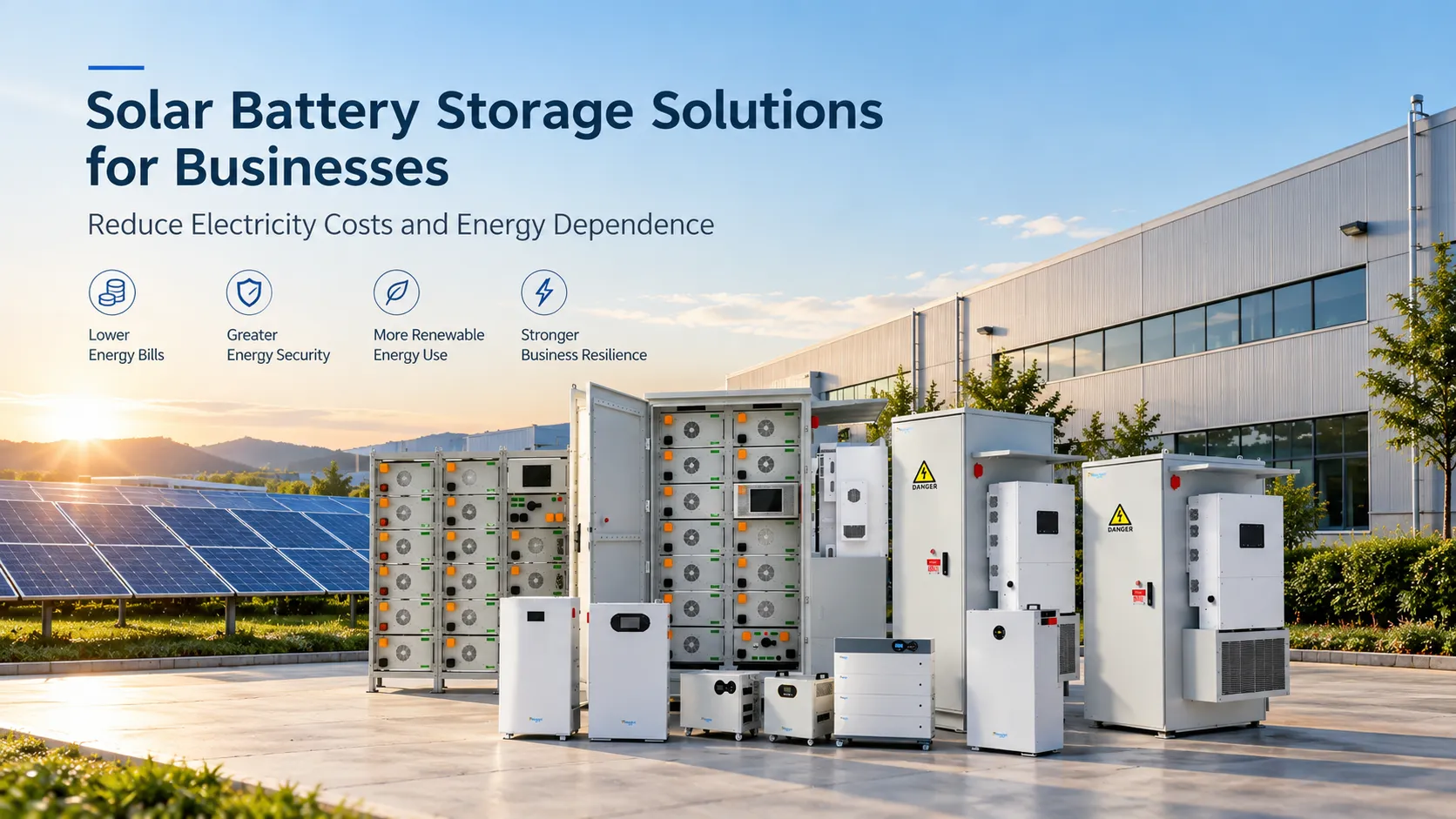
Commercial solar battery storage combines solar photovoltaic panels, battery storage, power conversion equipment, and control systems to manage electricity at a business facility. Instead of relying entirely on electricity as it is generated or purchased, a company can store energy and use it at a more suitable time.
These systems serve a wide range of applications, from office buildings and retail properties to warehouses, hotels, and manufacturing plants. Their size and configuration depend on how much electricity a facility consumes, when it consumes it, and whether backup power is required.
The Mechanics of Solar Plus Battery Energy Storage Systems (BESS)
A solar plus storage installation manages three main energy flows: electricity generated by the solar panels, electricity stored in the battery, and electricity consumed by the facility or supplied by the grid.
During daylight hours, solar panels generate direct current (DC) electricity. Power conversion equipment makes this electricity available for business loads and battery charging. When solar production exceeds immediate consumption, the control system can direct the surplus into the battery.
Later in the day, the battery discharges to support the facility. Depending on the system settings, this may happen when solar generation falls, electricity prices rise, demand approaches a costly peak, or the grid becomes unavailable.
An energy management system (EMS) coordinates these operations. It can use consumption data, electricity tariffs, solar forecasts, and battery charge levels to determine when storing or releasing energy makes the most sense.
Consider a warehouse that generates more solar electricity at noon than it needs but uses substantial power during evening operations. Storing part of the midday surplus allows the business to use more of its own renewable electricity after sunset, rather than purchasing the same amount from the grid.
The result depends on battery capacity, inverter power, system efficiency, and the relationship between solar generation and electricity demand. Storage is most useful when the energy available at one time can offset a more expensive or operationally important load later.
Overcoming the Limitations of Standalone Commercial Solar
Solar panels reduce electricity purchases when they generate power, but their production schedule does not always match a business's operating hours.
A factory may run production lines into the evening. A hotel may experience its highest demand after sunset. A cold-storage facility may need refrigeration around the clock. In these situations, a solar-only installation may leave the business purchasing substantial amounts of grid electricity even when its panels produce a healthy surplus earlier in the day.
Commercial battery storage addresses this mismatch by moving some available energy from one period to another.
- Excess daytime solar generation can be stored for later use.
- Evening consumption can be partly supplied by the battery.
- Battery discharge can reduce grid demand during selected peak periods.
- A suitably configured system can supply designated loads during a grid outage.
- Businesses can increase solar self-consumption when exporting surplus electricity offers limited financial value.
Storage does not eliminate every limitation of solar power. Batteries have finite capacity, lose some energy during charging and discharging, and cannot supply loads beyond their power rating. Extended outages or prolonged periods of poor solar production may still require grid electricity or another energy source.
Key Components of Commercial Energy Storage Solutions
A commercial battery energy storage system (BESS) relies on several components to operate safely and efficiently.
- Battery modules: Store electricity for later use. Lithium iron phosphate (LFP) is a common choice for stationary storage because of its thermal stability and cycle-life characteristics.
- Battery management system (BMS): Monitors cell voltage, temperature, current, and state of charge to help keep the battery within its permitted operating limits.
- Power conversion system (PCS): Controls the conversion of electricity between AC and DC and manages charging and discharging.
- Solar inverter: Converts the electricity produced by solar panels into a form suitable for the facility's electrical system.
- Energy management system (EMS): Coordinates solar generation, battery operation, and electricity consumption according to the site's requirements.
- Protection and safety equipment: Includes electrical isolation, circuit protection, monitoring, and any required fire detection or suppression provisions.
Facilities that need backup power may also require islanding controls, transfer equipment, and an inverter capable of operating independently of the utility grid. These features should be included in the original design rather than assumed to be available with every grid-connected solar system.
How Solar Battery Storage Reduces Business Electricity Costs
The financial case for commercial solar battery storage comes from changing when electricity is purchased and how much grid power a facility needs. Depending on local tariff rules, a battery may reduce demand charges, shift consumption away from expensive periods, or increase the value of on-site solar generation.
These savings are not the same for every business. Before selecting equipment, companies should examine their actual utility bills and identify which charges a battery can realistically reduce.
Peak Shaving and Demand Charge Reduction
Some commercial electricity tariffs include demand charges based on the highest level of power drawn during a billing period. Unlike energy charges, which are generally calculated using kilowatt-hours (kWh), demand charges are associated with power measured in kilowatts (kW).
A short period of unusually high consumption can therefore affect the electricity bill for an entire month.
Peak shaving uses battery power to reduce the amount of electricity drawn from the grid when facility demand approaches a costly peak. For example, if a factory normally draws 500 kW and a battery supplies 100 kW during a demand peak, grid demand could fall to approximately 400 kW, provided the battery has sufficient output and the facility's other loads remain unchanged.
The resulting savings depend on the utility's demand measurement rules. A reduction in one peak may have little value if another period establishes the monthly maximum. Battery controls must therefore target the intervals that actually determine the charge.
Businesses should review the following factors before estimating demand charge savings:
- The demand charge rate and billing method.
- The timing, frequency, and duration of demand peaks.
- The battery's available discharge power and energy.
- The length of the utility's demand measurement interval.
- Whether multiple peaks occur on different days or shifts.
For facilities with predictable demand spikes, peak shaving can be an important source of value. The system should be sized around those peaks rather than selected solely on the basis of total battery capacity.
Time-of-Use (TOU) Load Shifting and Energy Arbitrage
Electricity prices often vary throughout the day. Under a time-of-use (TOU) tariff, a business may pay more during periods of high demand and less during off-peak hours.
Battery storage allows some electricity consumption to be shifted between these periods. A battery can charge using low-cost electricity or surplus solar generation, then discharge when electricity prices are higher.
This practice is commonly called load shifting or energy arbitrage. Its profitability depends on the price difference between charging and discharging periods, the battery's round-trip efficiency, and any associated operating costs.
For example, a battery may receive 100 kWh during charging but deliver only 90 kWh later if its round-trip efficiency is 90%. The value of the delivered electricity must be sufficient to cover the charging cost and the energy lost during operation.
For solar-charged batteries, the analysis should also consider what the business would have earned by exporting the same electricity or how much value it would have received by using it directly.
TOU rates vary by utility and may change over time. Businesses should model their actual tariff rather than assume that charging at night and discharging during the day will always generate savings.
Maximizing On-Site Solar Self-Consumption
Solar self-consumption measures how much of a facility's solar generation is used on-site rather than exported to the grid.
Without storage, a business may export surplus electricity during sunny periods and purchase electricity again in the evening. If the export payment is lower than the retail price of electricity, this arrangement can leave some potential savings unrealized.
A battery helps bridge that gap. It stores some surplus solar energy and makes it available when the facility needs power but solar production is low.
This can be useful for hotels with evening air-conditioning loads, warehouses operating after sunset, factories running multiple shifts, and commercial buildings with substantial late-day consumption.
However, maximizing self-consumption is not always the same as maximizing financial returns. A business may benefit more from exporting some solar electricity, preserving battery capacity for demand peaks, or reserving energy for backup power. The best operating strategy depends on the tariff and the company's priorities.
Strengthening Energy Independence and Business Resilience
Electricity interruptions can have consequences beyond the cost of unused energy. Production may stop, refrigeration may be compromised, customer services may be interrupted, and equipment may need to be restarted.
Commercial battery storage gives businesses another way to manage these risks. Its value depends on the loads being protected, the duration of an outage, and whether the system has been designed to operate safely without the grid.
Seamless Backup Power and Outage Protection
A battery system equipped with suitable backup and islanding capabilities can continue supplying designated loads when utility power fails. The system isolates those loads from the grid and draws on stored energy. If the installation supports solar operation during an outage, the panels may also recharge the battery when sunlight is available.
Depending on the design, backed-up loads may include communications equipment, security systems, emergency lighting, refrigeration, selected production machinery, and essential pumps or controls.
Battery power rating determines which loads can operate simultaneously. Usable energy capacity determines how long they can be supplied.
For example, a system with 200 kWh of usable energy could theoretically supply a constant 50 kW load for four hours. Actual runtime will depend on conversion losses, auxiliary consumption, operating reserves, and changes in demand.
Businesses should also check the startup requirements of motors, compressors, and other equipment. A load that consumes relatively little energy during normal operation may require a much higher power output when starting.
Not every solar installation provides backup power automatically. Conventional grid-tied inverters generally shut down when the grid fails unless the system has been designed to operate in an islanded mode. Facilities that cannot tolerate even a brief interruption may also need a UPS or other equipment to bridge the transfer period.
Mitigating Risks from Utility Price Volatility
Electricity prices can change with fuel costs, grid congestion, market conditions, and utility tariff adjustments. Businesses with high energy consumption may find these changes difficult to absorb, particularly when electricity represents a substantial share of operating expenses.
Solar generation reduces the need to purchase electricity, while battery storage provides flexibility over when that electricity is used. A business can store surplus solar power and draw on it during periods when grid electricity is expensive.
Depending on local market arrangements, commercial batteries may also support demand-response programs or respond to dynamic electricity prices. These opportunities require appropriate controls and eligibility under the relevant utility or market rules.
Storage does not remove every component of the electricity bill. Fixed service charges, grid connection fees, and some demand-related charges may remain. A realistic financial model should distinguish between charges that can be reduced and those that cannot.
Minimizing Dependence on the Centralized Grid
For most commercial facilities, reducing grid dependence is a more practical objective than eliminating the grid entirely. Solar panels and batteries can supply part of the facility's energy needs, while the utility remains available when on-site generation and stored energy are insufficient.
The proportion of electricity a business can supply from its own system depends on seasonal solar production, daily consumption patterns, battery capacity, and the duration of periods without adequate sunlight.
A facility with predictable daytime demand may achieve strong results from solar generation alone. A business that operates at night or experiences frequent outages may need a larger battery, additional generation, or a different backup arrangement.
Energy independence should therefore be measured against a defined target. Some businesses want to reduce annual grid purchases; others need several hours of backup for critical equipment. Those objectives lead to different system designs and investment costs.
Sustainability and Financial Incentives for Commercial Systems
Commercial solar battery storage can contribute to environmental goals while improving energy management. Its financial and environmental benefits should nevertheless be evaluated using the operating conditions of the individual project.
Accelerating Decarbonization and Corporate ESG Goals
Solar power can reduce the amount of electricity a business purchases from the grid. Battery storage makes it possible to use a greater share of that solar generation outside the hours when the panels are producing electricity.
For companies working toward environmental, social, and governance (ESG) targets, this can support efforts to reduce operational emissions and improve energy reporting.
Potential benefits include lower grid electricity consumption, improved use of renewable generation, and better visibility into the relationship between energy demand and operating schedules.
The emissions benefit depends on which electricity sources are displaced, the grid's generation mix, and the timing of battery charging and discharging. A battery charged from surplus solar generation may have a different emissions profile from one charged using grid electricity during a carbon-intensive period.
Businesses with formal emissions targets should monitor electricity flows and apply a consistent accounting methodology. Battery manufacturing, material sourcing, transportation, recycling, and end-of-life management should also be considered when evaluating the system's broader environmental impact.
Leveraging Tax Credits, Rebates, and Depreciation
Depending on the country and local regulations, commercial energy storage projects may qualify for tax incentives, rebates, grants, accelerated depreciation, or payments through eligible grid-support programs.
In the United States, the availability and value of these benefits depend on current federal and state rules, project timing, ownership, equipment eligibility, and other applicable requirements. Businesses should not assume that every battery installation qualifies for the same incentives.
Before including an incentive in a project forecast, confirm:
- Whether the battery qualifies independently or must be installed with another energy system.
- Which equipment and project costs are eligible.
- Whether sourcing, labor, ownership, or commissioning conditions apply.
- Whether multiple incentives can be combined.
- When the financial benefit can actually be claimed or received.
Tax rules and incentive programs can change. A qualified tax professional or project finance adviser should confirm eligibility before the business commits to an investment.
Calculating Commercial BESS Return on Investment (ROI)
The financial return from a commercial battery energy storage system depends on its installed cost, operating strategy, and the value of the electricity it helps the business save.
Potential benefits include reduced demand charges, lower purchases during expensive periods, increased use of on-site solar generation, and eligible revenue from demand-response programs. Where reliable data is available, businesses may also account for certain costs avoided during power interruptions.
Project costs extend beyond the battery itself. Installation, engineering, commissioning, monitoring, maintenance, financing, energy losses, degradation, and eventual replacement should all be included in the assessment.
A simplified calculation is:
Annual net savings = Electricity bill savings + Other operating benefits − Annual operating costs
Simple payback period = Net upfront investment ÷ Annual net savings
Consider a hypothetical project with a net upfront investment of $180,000 and estimated annual net savings of $36,000.
| Financial metric | Illustrative value |
|---|---|
| Net upfront investment | $180,000 |
| Estimated annual net savings | $36,000 |
| Simple payback period | 5 years |
| Cumulative savings over 10 years | $360,000 before capital recovery |
In this example, subtracting the original $180,000 investment from the ten-year cumulative savings leaves $180,000 before financing costs, replacement expenses, taxes, and other unmodeled items. The figures illustrate the calculation and are not a forecast for a specific installation.
For a more complete assessment, businesses should calculate net present value (NPV) and internal rate of return (IRR) over the expected project life. The model should include battery degradation, changing electricity prices, operating costs, financing terms, and any expected replacement expenditure.
Key Factors to Consider When Choosing a Commercial Battery System
Selecting a battery system involves more than comparing prices or choosing the largest available capacity. Businesses need to consider how the equipment will perform under real operating conditions and how its performance may change over time.
Battery Chemistry and Round-Trip Efficiency
Battery chemistry affects safety characteristics, cycle life, energy density, temperature requirements, and lifecycle cost. Lithium iron phosphate (LFP) batteries are widely used in commercial stationary storage because of their thermal stability and cycle-life characteristics.
Other lithium-ion chemistries and emerging battery technologies may suit particular applications. The right choice depends on the project's energy requirements, available space, operating environment, safety provisions, and budget.
Round-trip efficiency measures how much electricity can be recovered after a complete charging and discharging process. If a battery receives 100 kWh and later delivers 90 kWh under the specified test conditions, its round-trip efficiency is 90%.
Energy losses affect the economics of every cycle. When comparing products, businesses should check whether efficiency figures refer to the battery cells, DC system, or complete AC system. These figures are not directly interchangeable.
Other points to review include the operating temperature range, documented cycle-life conditions, thermal management, safety certifications, and compatibility with the intended inverter and control system.
Sizing Capacity, Power Rating, and Depth of Discharge (DoD)
Energy capacity and power rating describe different aspects of battery performance.
- Energy capacity (kWh): The amount of electricity the battery can store.
- Power rating (kW): The amount of power it can deliver at a given moment.
- Depth of discharge (DoD): The proportion of battery capacity used during discharge.
- Usable capacity: The energy available within the system's permitted operating limits.
A battery may contain enough energy to supply equipment for several hours but lack the power needed to start a large motor. Conversely, a high-power battery may support heavy loads briefly but run out of usable energy before the required operating period ends.
Suppose a facility needs to supply a continuous critical load of 100 kW for three hours. Its basic delivered-energy requirement is 300 kWh. The installed battery must account for conversion losses, operating reserves, and permitted discharge limits, while the inverter must meet the load's continuous and startup power requirements.
Accurate sizing starts with interval meter data. By examining demand peaks, operating schedules, and critical loads, an engineer can compare different battery configurations and determine which one offers the best balance between performance and cost.
Warranty Coverage, System Lifespan, and Degradation Rates
Battery capacity gradually declines through calendar aging and repeated cycling. The rate depends on factors such as temperature, depth of discharge, charging practices, and the number of cycles completed.
A warranty should be reviewed in detail rather than judged by its duration alone. Businesses should check the guaranteed remaining capacity, energy throughput limits, permitted operating conditions, and coverage for battery modules, inverters, and control equipment.
Service response times, spare-parts availability, monitoring requirements, and replacement procedures also matter. A long warranty may offer limited practical protection if its conditions are difficult to meet or support is unavailable when needed.
Comparing these details helps businesses estimate the total cost of ownership and avoid choosing a system based solely on its initial purchase price.
Is Solar Battery Storage Right for Your Business?
Commercial solar battery storage is worth evaluating when a business has high electricity costs, meaningful demand charges, surplus solar generation, or a need for backup power. Its suitability depends on whether the system can address a measurable operational or financial problem.
In some facilities, energy efficiency improvements or a change in operating schedules may deliver better returns than adding storage immediately. A feasibility study helps identify the most appropriate investment.
Analyzing Your Facility's Load Profile and Energy Demands
Start with at least 12 months of electricity bills and, where available, interval meter data recorded every 15 minutes or more frequently. This information helps establish when electricity is consumed and which charges drive the total bill.
The assessment should cover daily and seasonal consumption, peak demand, TOU rates, solar generation potential, existing backup equipment, and the loads that must remain operational during an outage.
The next step is to model how different battery sizes would perform against the facility's actual demand. This can reveal whether the main opportunity comes from peak shaving, load shifting, increased solar self-consumption, or backup power.
A business with low demand charges and inexpensive electricity may find it difficult to justify storage through bill savings alone. Another facility with expensive demand peaks and low compensation for exported solar electricity may have a stronger financial case.
Capital Purchase vs. Energy-as-a-Service (EaaS) Financing
Businesses can purchase a battery system directly or use a service-based arrangement that reduces the need for upfront capital.
| Consideration | Direct purchase | Energy-as-a-Service |
|---|---|---|
| Initial capital | Usually higher | Often lower, depending on the agreement |
| Ownership | Business owns the equipment | Usually retained by the service provider or financing partner |
| Maintenance | Arranged by the business | May be included in the service contract |
| Financial benefits | Depend on system performance and ownership costs | Allocated according to contract terms |
| Risk allocation | More responsibility rests with the owner | Some performance and maintenance risks may be transferred |
Under an Energy-as-a-Service arrangement, a provider may finance, install, operate, and maintain the system in return for service payments. This can help a company preserve working capital, although the contract may include long-term commitments, payment escalations, performance conditions, or termination fees.
Direct ownership may be more attractive to businesses with available capital, favorable financing, and a preference for controlling system operation. The appropriate structure depends on cash flow, investment priorities, and the company's appetite for technical and financial risk.
Steps to Implement a Commercial Storage Solution
A successful project begins with a clear objective and a practical understanding of the facility's energy use.
- Define the objective. Decide whether the priority is reducing demand charges, shifting electricity consumption, improving solar self-consumption, providing backup power, or combining several goals.
- Review energy data. Collect utility bills, interval meter readings, tariff information, and solar generation data to establish a baseline.
- Complete a feasibility study. Compare battery sizes and operating strategies, then estimate installed cost, annual savings, payback, NPV, and lifecycle expenses.
- Select compatible equipment. Review battery chemistry, usable capacity, power rating, EMS functions, safety provisions, and warranty terms.
- Confirm technical and regulatory requirements. Check permits, electrical and fire codes, utility interconnection rules, and backup isolation requirements.
- Install and commission the system. Test charging, discharging, monitoring, protective functions, and backup operation where applicable.
- Monitor performance. Track electricity savings, peak demand, efficiency, battery degradation, and maintenance needs, adjusting the control strategy as operating conditions change.
After commissioning, regular performance reviews help ensure that the battery continues to serve the business's needs. Changes in production schedules, electricity tariffs, or facility expansion may justify adjustments to its operating strategy.
The strongest commercial solar battery storage projects begin with actual energy data, a defined business objective, and realistic financial assumptions. When system capacity, power output, and controls are matched to the facility's requirements, solar plus storage can reduce selected electricity costs and give businesses greater flexibility in managing their energy supply.
Frequently Asked Questions About Commercial Solar Battery Storage
1. How do I determine the right battery size for my business?
Start with your electricity consumption data, peak demand, and the purpose of the system. A battery designed to reduce demand charges may require high discharge power for short periods, while one intended to provide backup needs enough usable energy to support critical loads for the required duration. Reviewing at least 12 months of interval data helps determine the appropriate kW rating and kWh capacity.
2. Can I add battery storage to an existing commercial solar system?
Yes, many existing solar installations can be upgraded with battery storage. The design depends on the existing inverter, system voltage, available solar surplus, and battery control requirements. An AC-coupled system may work with existing solar equipment, while a DC-coupled configuration may be suitable for certain installations. Compatibility and installation costs should be assessed before selecting the system.
3. Will a commercial battery reduce my electricity bill even without solar panels?
It can, depending on the electricity tariff. A battery may charge during lower-cost periods and discharge when electricity prices or demand charges are higher. However, savings depend on the price difference, round-trip efficiency, and operating costs. If the tariff offers little opportunity for load shifting or demand reduction, the financial benefit may be limited.
4. How long can a commercial battery supply power during a grid outage?
Backup duration depends on usable battery capacity and the power consumed by the connected loads. For example, 200 kWh of usable energy could theoretically supply a constant 50 kW load for four hours, before accounting for conversion losses and other operating limits. Businesses should identify essential equipment and specify the required backup duration before finalizing the system design.
5. What information should I prepare before requesting a commercial BESS quotation?
Prepare your recent electricity bills, interval load data if available, existing solar system specifications, peak demand, site location, and expected backup requirements. It is also helpful to identify your main objective, whether that is reducing electricity costs, increasing solar self-consumption, or maintaining critical operations during outages. These details allow the supplier to recommend a more suitable configuration and provide a more meaningful cost and performance estimate.
Need a Commercial Solar Battery Storage Solution?
Every facility has a different energy profile. Bonada helps businesses evaluate battery capacity, power requirements, solar integration, and backup needs to develop a practical BESS configuration for their projects. Share your load profile and application requirements with our team for a tailored technical proposal.
Discuss Your Project with Bonada
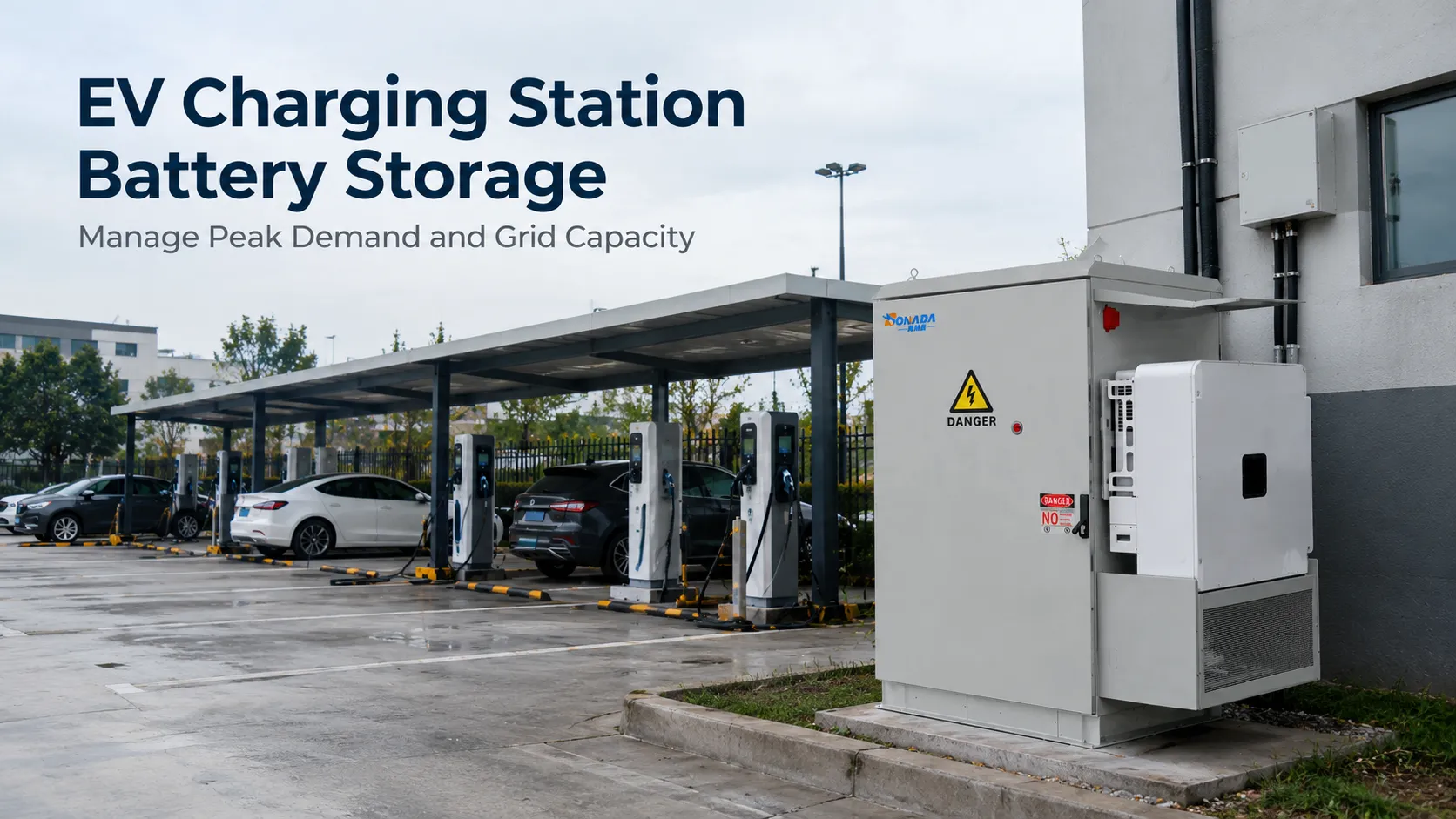
EV Charging Station Battery Storage: Solve Grid Capacity Limits
Related Article