Off Grid Energy Storage Solutions for Remote Areas Without Reliable Power
Consistent power is something every household, shop, factory and vital public setup needs. A lot of remote settlements and sites cut off from the main grid deal with constant supply drops. Many run diesel gensets round the clock, which pushes up running costs heavily. Normal grid-linked power gear simply isn’t a good fit here, neither cheap nor easy to roll out.
Standalone Off Grid battery storage helps fix these real-world headaches. You can hook it up with solar panels, small wind machines or backup generators. It stores surplus power when production is good, and feeds power out when usage spikes or renewables stop producing. This lets sites far away from utility lines get steady power they can count on.
Farm operators, telecom teams, factory managers and private homeowners all benefit from this setup. It cuts down fuel use and lets them run their sites without relying on outside power. Picking the right system can’t be rushed though. You first work out how much power you actually use daily, choose a battery size that matches your load, consider local weather, and calculate all recurring costs down the line.
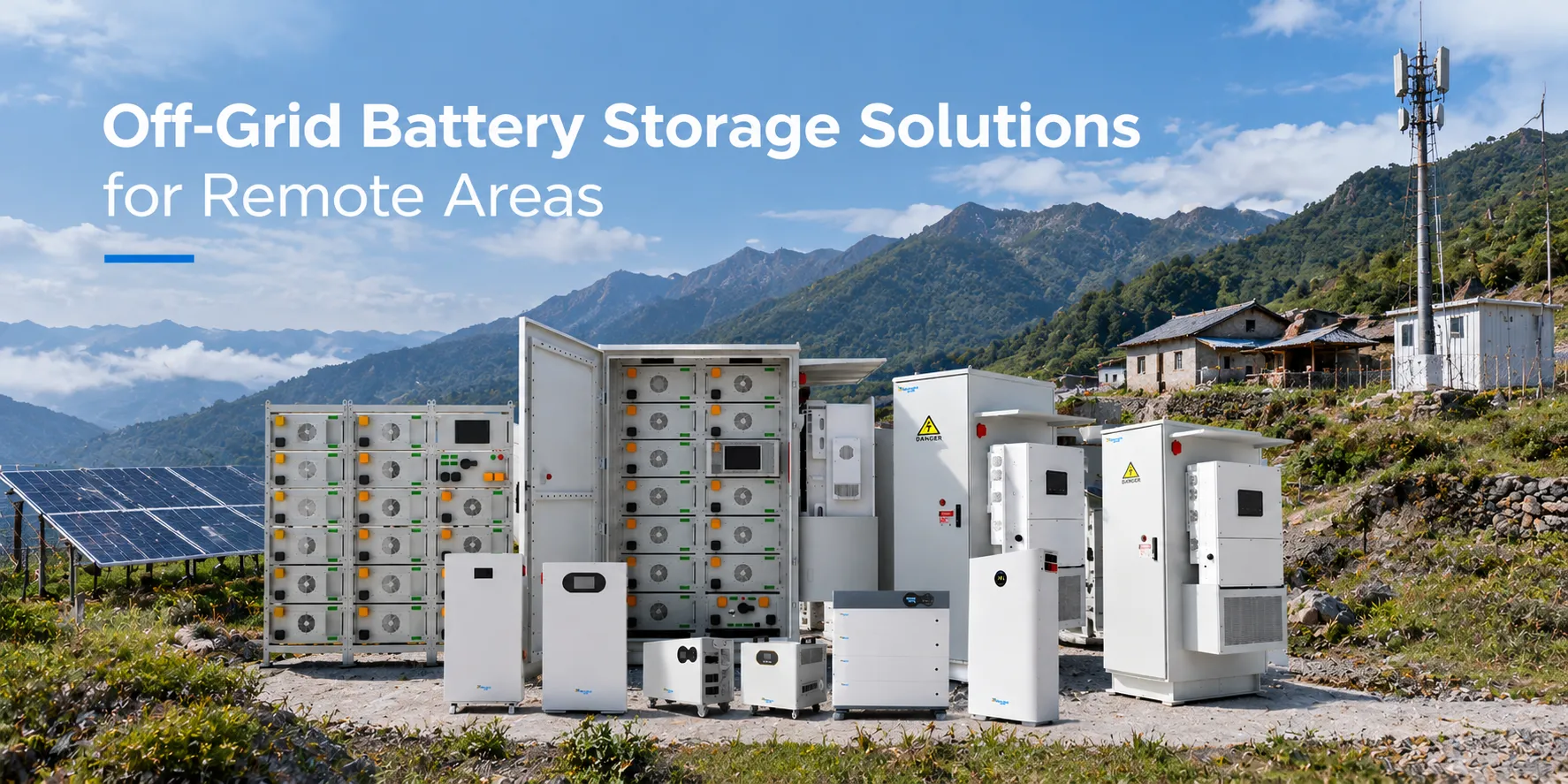
Understanding Off-Grid Battery Storage for Remote Areas
The Challenges of Power Reliability in Remote Locations
Power troubles in far-off sites are nothing like those faced in cities and big industrial zones. Many small settlements have no grid connection whatsoever. Even those connected often sit on weak local lines, which can’t hold stable power round the clock.
Typical pain points include:
- Scarce grid works: Pulling power cables to isolated villages, farms, islands or hilltop sites comes with very high price tags.
- Recurring supply cuts: Shaky power can stop production, ruin sensitive hardware and disrupt critical daily services.
- Costly diesel operation: Fuel hauling, generator upkeep and shifting fuel rates keep pushing running bills higher.
- Unsteady renewable yield: Solar drops under cloud cover and stops at night; wind output rises and falls based on local wind patterns.
- Slow service response: Technicians may struggle to reach these sites when equipment needs checks, fixes or part replacements.
That’s where storage becomes really useful here. Users don’t have to generate power the instant they consume it. They can save energy whenever it’s available, and draw it later on demand.
What Is an Off-Grid Energy Storage System (ESS)?
These standalone ESS units don’t link up with the public power grid at all. They bring together power producers, battery packs, power converters and control hardware to run on-site electrical equipment.
Solar panels are the most common power source, paired with battery storage, an inverter and an energy controller. People sometimes add diesel gensets, small wind machines or micro-hydro kits if the location allows it.
When not much power is being used, batteries catch the extra electricity made on site. Once power production drops or equipment draws more current, the stored power takes over. This keeps supply and use balanced, and cuts down fuel use from backup generators.
Batteries built for grid-tied sites always have the utility line to fall back on. Off-grid systems have no such buffer. Every part — how much power you can generate, stored energy reserve and inverter rating — has to be sized specifically for that site’s actual usage.
How Off-Grid ESS Works: Core Components and Functionality
Every part of this rig does its own job to keep power running smoothly. You need to balance power generation, battery charging and release, and manage which loads get power. That way you won’t run out of supply, and you don’t throw away energy unnecessarily.
| Component | Main Function |
|---|---|
| Solar panels or other power makers | Grab energy from sun, wind or fuel to make electric power. |
| Battery packs | Hold onto spare power, for nights, busy usage hours or when generation drops off. |
| Standalone inverter | Turn battery DC power into regular AC that your machines can use. |
| BMS | Keeps an eye on battery stats, and shuts things down to avoid damage. |
| EMS controller | Decides when to charge or discharge, and which equipment gets power first. |
| Backup genset | Fires up when renewable power stays too low, or you suddenly need much more power. |
Take an off-grid farm for instance. It collects solar power through the day, and stores whatever it doesn’t use right away. That stored energy runs lights, fridges, water pumps and security gear after sunset. If cloudy weather drags on day after day and solar output stays poor, this hybrid setup will kick on the backup generator once batteries drop to that preset low mark.
Key Benefits of Off-Grid Battery Storage Systems
Reliability and Consistent Energy Availability in Remote Areas
The biggest upside of these standalone off grid battery systems is that they can step in when your main power source stops working. Batteries take over after dark, cover brief dips in generation, or handle spikes where your solar or wind setup can’t keep up with how much power you’re drawing.
For commercial users, steady power keeps operations from falling apart. Think of a remote cold storage site: its cooling has to run nonstop, otherwise stock goes bad. Telecom towers are another example; their core hardware can’t go offline even when local power cuts out.
Still, just having a big battery bank won’t guarantee reliability. You also need an inverter sized correctly, enough renewable input, solid safety protection gear, and a sensible backup plan. If downtime cannot be tolerated, you need to sort out which loads matter most and build the system around those priorities from the start.
Economic Efficiency and Cost Reduction
For sites far from the grid, battery storage can cut power expenses over time. It maximises the power you generate on site and lessens how much diesel you burn — this matters a lot when shipping fuel out to these hard-to-reach spots is pricey or logistically tough.
Batteries can take the load during moderate power draws, so generators don’t need to run as often. On hybrid setups, gensets only turn on when truly required, instead of idling nonstop at inefficient low loads.
That said, these systems come with an upfront bill. You have to pay for the battery packs, inverters, wiring work and all the auxiliary hardware. Whether it makes financial sense hinges on local fuel rates, how much renewable resource you have, future battery swap fees, system losses and how long you plan to run the whole setup.
Anyone planning this build should look at the full cost over the system’s life, not just the sticker price of the hardware. A solid evaluation covers these points:
- What you pay at the start for gear and installation
- Yearly fuel and service costs with your old power setup
- How much less diesel the generator will burn after the upgrade
- Battery wear and the cost to replace them down the line
- Total projected savings across the system’s usable lifespan
Working through these figures tells you if a pure solar-battery off-grid layout, or a hybrid version, delivers the stronger economic result.
Environmental Sustainability and Renewable Integration
Battery storage let you decouple renewable power production from when you actually need electricity. All that solar harvested around midday can be saved up for nighttime use, so you won’t have to run the generator nonstop once it gets dark.
When batteries carry some of the load that would otherwise fall to a diesel unit, fuel use drops. This cuts down exhaust fumes and that constant hum from the running genset. It’s worth noting the environmental upside isn’t fixed, though. It changes based on your power sources, system efficiency, the carbon cost of battery production, and how the old cells get handled or recycled at end-of-life.
For remote settlements and operators aiming to lower their environmental footprint, combining renewable power with battery storage offers a down-to-earth path to cleaner, self-reliant power.
Off-Grid Battery Storage Technologies and Energy Sources
Lithium-Ion and Emerging Off-Grid Battery Storage Solutions
Not all batteries act the same. Their internal makeup decides how much usable power you get, how fast they fill up, what temperature they can handle, safety rules, and how much money you’ll spend over time. Most off-grid projects lean on lithium cells these days. They transfer energy well and can be put together in many setups to fit different sites.
LFP is a common choice for fixed storage installations. It’s much less likely to overheat, can be charged and drained many times, and holds up well with regular cycling. You will find these batteries in home backup packs, remote business sites and large storage banks.
Other battery types might work for certain projects. Lead-acid units cost less at first, but they are heavy and wear fast if you cycle them often. Flow batteries are an option when you need long hours of stored power, though they take up more room, cost more, and the whole system is trickier to install.
| Battery Technology | Advantages | Considerations |
|---|---|---|
| Lithium iron phosphate (LFP) | Stable against heat, efficient, long cycle lifespan | Must pair with matching BMS, protection and temperature control |
| Other lithium-ion cells | Pack lots of energy in a small case | Safety and performance vary a lot by cell design |
| Lead-acid | Proven old tech, low upfront price | Heavy. Lifespan depends on how deep you discharge and regular service |
| Flow batteries | Good fit for multi-hour stationary backup | Bigger footprint and needs special supporting hardware |
When shopping for batteries, don’t only look at the advertised cycle count. Check what capacity the manufacturer guarantees under warranty, their test conditions for cycles, how deep you can safely discharge, energy loss during charge and discharge, working temperature range, and all warranty fine print. A number on the spec sheet won’t reflect real-world service life once you deploy it on site.
Solar Power System Integration
Most remote sites pick solar to pair with battery storage, and for good reason. Sunlight is easy to come by in many regions, and PV gear runs nonstop without you hauling fuel out regularly.
Here’s how this common setup works. The panels crank out power while the sun is up. Any equipment on site draws power first. Whatever is left over fills the battery. Once solar output can’t keep up with what you’re using, the battery kicks in to cover the gap.
You can’t just throw panels up and expect it to work reliably. You need to look at how strong the local sun resource is, weather shifts across seasons, which way the panels face, shade issues, inverter losses, and the daily rhythm of your power use. If you only size the system based on yearly average sun levels, it will struggle in the darker, cloudier months.
Places that have clear wet and dry cycles need extra care. Designers have to plan around the stretch with the weakest solar output. That can mean adding more panels, a bigger battery bank, or bringing in a backup genset so power stays consistent.
Wind and Micro-Hydro Supplementary Systems
People don’t have to stick with solar panels for renewables. If the local environment works out, small wind or micro-hydro can team up with off-grid batteries too.
Wind units perform nicely on coasts, wide flat land or hilltops that get regular breeze. Unlike solar, they can spin and make power when it’s dark out. That helps avoid putting all your energy eggs in one basket.
Micro-hydro makes power from running water. When there’s stable water flow plus enough height difference, it can keep generating far more reliably than solar or wind, which bounce around with weather.
You can’t guess your way into these systems, though. You have to run proper site checks first. Wind results depend on real wind patterns and where you place the turbine. For micro-hydro, power output changes with water volume, elevation, seasonal shifts and environmental limits. Don’t pick either just because it feels windy or there’s a stream nearby.
Hybrid Power Systems and Backup Generators
It’s not always cheap to hit strict reliability targets only with solar and batteries out in remote spots. That’s why many teams build hybrid systems, mixing different power sources to cut the risk of blackouts.
Take the solar-battery-genset setup most people use. Solar covers most everyday consumption, batteries handle ups and downs in demand, and the diesel unit only runs when clouds stick around for days or there’s an unexpected heavy draw of power.
The controller follows a straightforward logic. It turns the generator on once battery reserves fall too low. While the engine runs, it charges the battery bank first. It will shut the generator off once renewable power is enough to take over the load.
This solution works well for factories, remote construction camps, mining zones, island sites and farms. For these operators, any long power cut can easily lead to heavy money losses.
Planning and Sizing Your Off-Grid Battery Storage System
Conducting an Accurate Energy Audit
Before you lay out any remote storage system, the very first thing is figuring out how much power the site actually uses — and exactly when that power gets pulled.
Write down every piece of gear that runs on electricity. That covers lights, fridges, pumps, comms hardware, laptops, production machines and cooling units. Note how many kilowatts each one draws, roughly how long it runs each day, and when it typically turns on.
You can work out daily energy use with this basic rule:
Daily energy consumption (kWh) = Power (kW) × Operating hours per day
As an example: a 1 kW device left running for six hours uses 6 kWh over that day. Do this math for every load on your list, then add all those numbers up to get the total daily energy requirement.
For bigger business or industrial sites, just listing equipment won’t give you the full picture. You need real load readings, peak power figures, extra surge power for motor startups, and seasonal run plans. These details often change how you build the whole system.
You also need to sort your loads into two groups: must-have and optional. Cooling for stock, communication links, security gear and key production tools stay high on the priority list when power is tight. Less important loads can be switched off or scaled back for a while.
Sizing Your Off-Grid Energy Storage Capacity
When sizing your battery bank, you have to look at how much energy you use, how long you want it to run without new generation, how deeply you can drain the cells, system losses, and how dependable the supply has to be when renewable output drops.
You can run this quick estimate to get a starting figure:
Nominal battery capacity (kWh) = Daily energy demand × Required autonomy days ÷ (Usable depth of discharge × System discharge efficiency)
Let’s walk through an example. A remote location burns 20 kWh each day and needs one full day of backup from batteries. We set usable discharge at 80% and discharge efficiency at 92%. The rough battery size works out like this:
20 ÷ (0.80 × 0.92) ≈ 27.2 kWh
Keep in mind this is only a rough starting point, not a finished design. It doesn’t factor in battery wear, performance drops in cold weather, unexpected load spikes, or extended stretches of cloudy weather. If you want two days of backup under these same settings, the calculated battery size jumps to around 54.3 kWh.
Also, don’t mix up battery energy with inverter power. kWh tells you how much total energy the battery can hold. kW describes the maximum power the setup can put out at any single instant.
It’s possible your battery has enough stored energy to last through the night, yet the inverter still won’t work for your needs. That happens when it can’t cover all devices running together or handle the big surge when motors kick on. Pumps, compressors and industrial motors are common culprits here and need extra care.
Anyone working on the design should check two things separately: the total energy you need, plus the peak steady and surge power draw, before locking in your hardware choices.
Choosing the Right Technology for Remote Environments
Don’t overlook site conditions — they can make or break how reliably your batteries and related hardware run. A unit that works nicely in a sheltered residential spot may not survive hot, sticky, dusty or salt-laden industrial locations.
Keep these practical points in mind while selecting your off-grid battery setup:
- Temperature: Know the acceptable range for charging and draining the battery. Lithium packs sometimes need charge limits or heating protection when temperatures drop low.
- Moisture and corrosion: Pick suitable housings, connectors and protective coatings, especially for coastal sites exposed to salt mist.
- Dust and water: Confirm the case IP rating and vent design, based on what the equipment is exposed to day to day.
- Service access: Work out how technicians and spare parts can reach this remote spot when fixes are needed.
- Room to expand: Go with an adaptable design if you might add more batteries or generation gear later on.
- Parts compatibility: Verify communication rules, voltage specs, inverter fit and BMS connections before placing your order.
For these out-of-the-way sites, straightforward monitoring and easily replaceable parts are just as important as the performance numbers listed on spec sheets. Even well-built battery hardware will lead to lengthy power cuts if servicing becomes a headache.
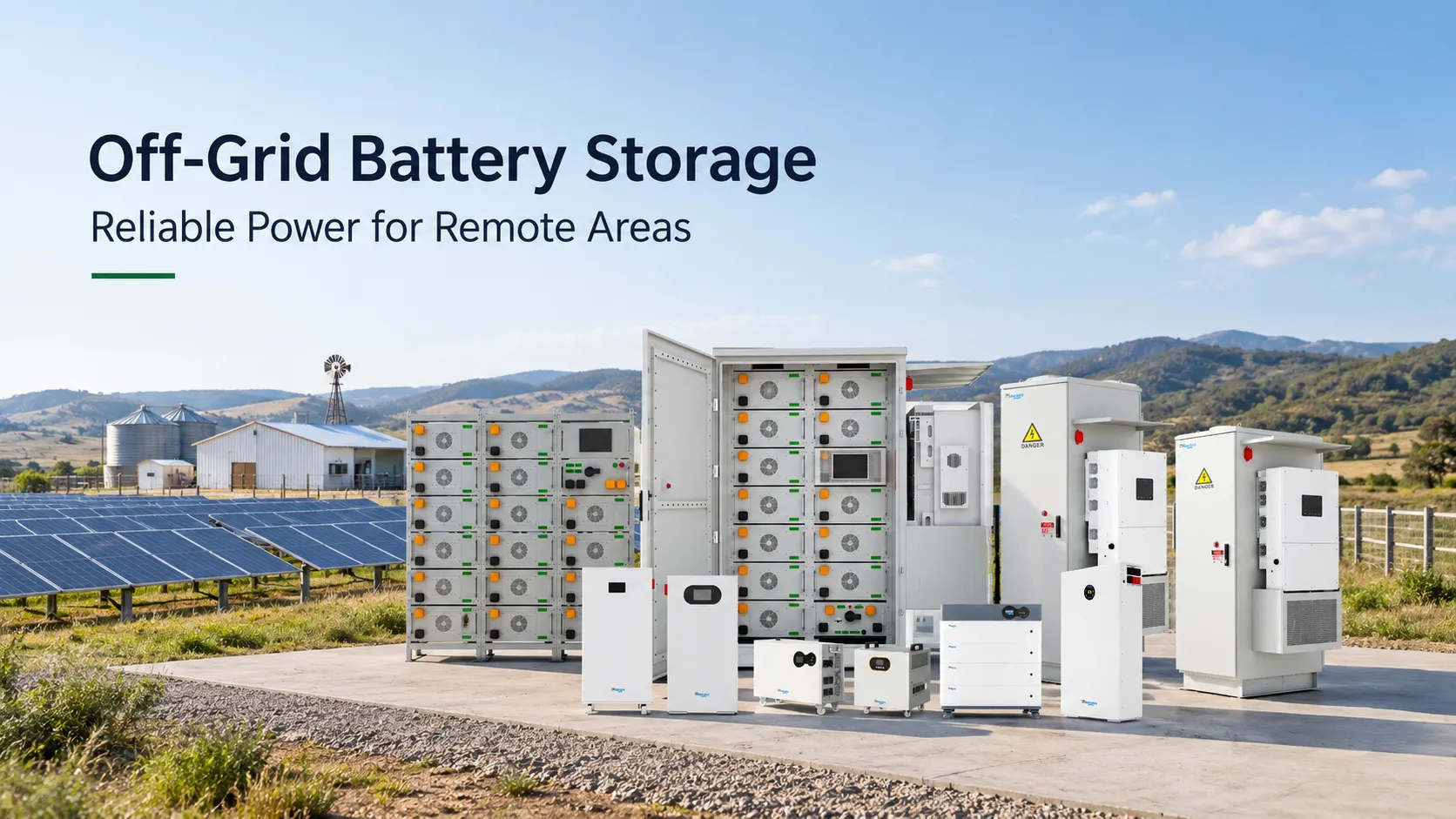
Applications of Remote Energy Storage Systems
Residential Off-Grid Living
People living in outlying villages, island settlements or secluded homesteads often rely on off-grid battery storage. This setup runs regular household gadgets, with no grid line connected at all.
These home-scale systems typically cover lights, fridges, phone and radio gear, water pumps, plus some entertainment kit. Some also run limited heating or cooling. Smaller builds use compact plug-and-play battery modules. Bigger homes with heavy power needs need larger battery banks and beefier inverters to keep up.
Residents need to watch out for power-hungry gear the most. Air conditioners, electric water heaters and electric stoves push up how much battery you need, and also drive up inverter expenses a lot.
If the place gets decent sunlight, pairing solar panels with batteries cuts how often you burn fuel. It’s far handier than firing up a diesel generator each single day.
Remote Industrial and Commercial Operations
Unlike home setups, business and industrial sites need plenty of power and cannot afford unexpected shutdowns. You’ll find these power needs at mine zones, standalone factories, crop processing lines, storage yards, island resorts and temporary construction camps.
Battery banks help these sites keep key equipment running. They balance ups and downs from solar or wind power, and cut down how long diesel generators have to stay running.
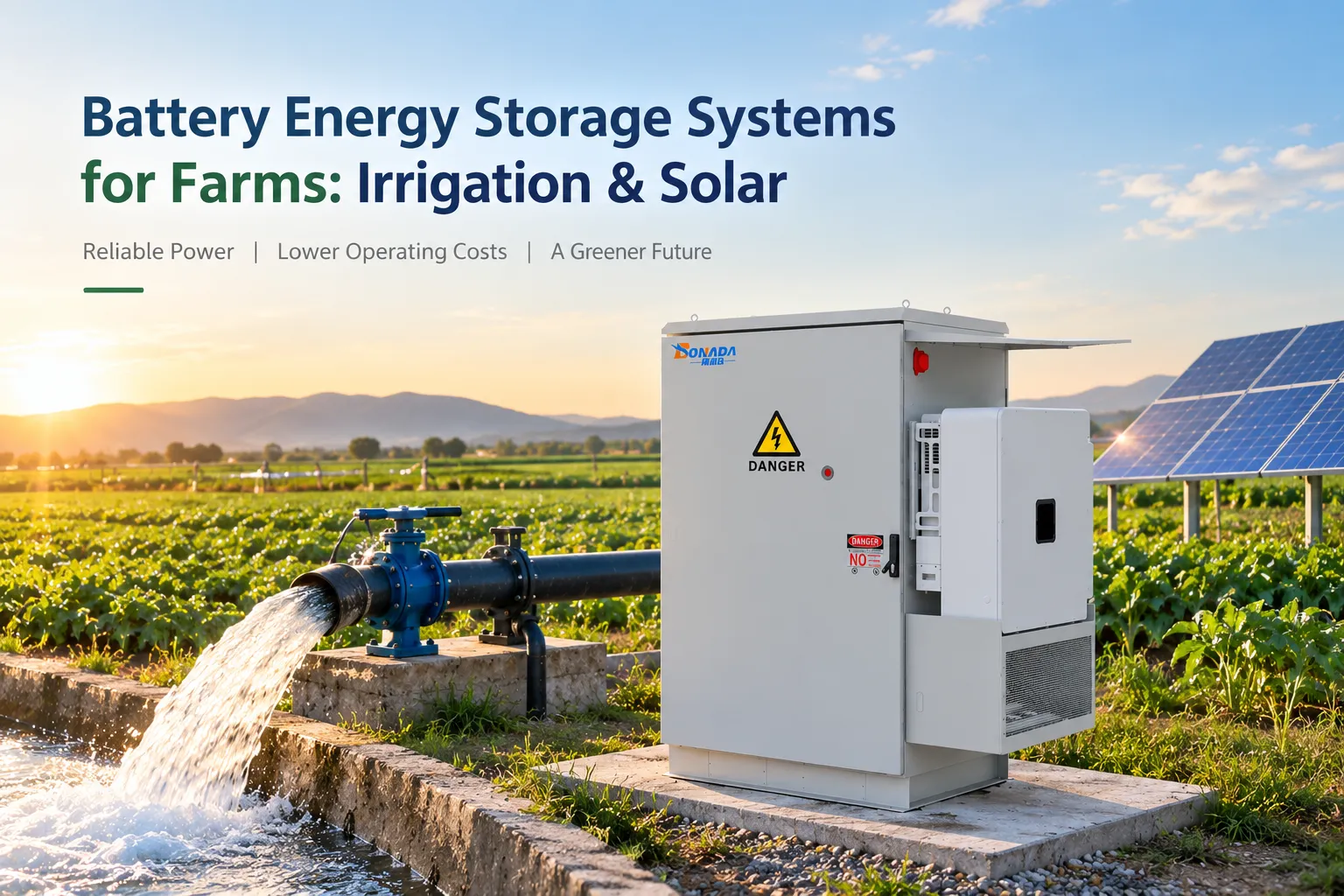
Remote holiday lodges use this storage to supply guest rooms, lighting, water systems, fridges and some climate control gear. Farm operators draw on stored energy for irrigation pumps, ventilation fans, cold storage and harvest processing tools.
When designing these industrial builds, every component has to work well together: batteries, inverters, safety gear and the site’s existing wiring. If motors or heavy machines are part of the setup, designers must plan for startup power spikes, steady power quality, the order loads switch on, and space to expand the system later.
For EPC teams and project developers, working with a supplier that provides matching battery layouts, practical technical materials and targeted support makes integration and onsite testing much less troublesome.
Telecommunications and Critical Infrastructure
Lots of vital infrastructure out in the wild — cell towers, sensor stations, navigation gear and similar gear — has to stay online, even when there’s no utility grid nearby.
Batteries keep these services running through supply dips, so site teams don’t have to fire up generators nonstop. Solar is a common pick here; it produces power right on location, and the battery bank takes over whenever sunshine drops off.
Anyone designing these setups needs to check the steady baseline power draw, what the comms hardware needs, how sunlight shifts through different seasons, and what happens if power cuts out. Remote tracking tools let operators catch issues early — things like overheating cells, dropping charge levels or broken parts, before they knock the whole service offline.
For the most high-stakes sites, adding extra backup units or a generator can make sense. The final layout all comes down to how reliably the system must run, and how expensive it would be if the service went down.
Emergency and Disaster Relief Support
Communities can lose power for days when storms, natural disasters or breakdowns hit the local power grid. Lightweight, stackable battery storage units offer quick temporary power. They support medical gear, radio links, lights, water purification systems and teams handling emergency response work.
These battery packs can pair with foldable solar panels, or hook up to temporary power generators. Unlike a small diesel unit that runs nonstop, batteries run quietly for critical loads. If solar is available to top them up, you also burn far less fuel overall.
Emergency power jobs demand thoughtful preparation. You need to think about moving the gear, setting it up safely, electrical risks and where you can recharge the batteries. Don’t just pick a big battery. Match your hardware to real power usage and how long the blackout is likely to last.
Key Considerations and Maintenance Best Practices
Installation and System Integration in Remote Areas
You can’t skip proper installation work if you want the battery system to run safely and last. Many remote spots come with tricky hurdles: cramped space, tough access roads, hot air, or old wiring that needs upgrades before you hook up the new storage gear.
Any pre-install check needs to cover these points:
- How to get the gear to site, transport plans and what gear you need for lifting.
- Whether the ground can support the weight, how you mount the units and where to put the enclosures.
- Fuses, earth connections, cable gauge selection and isolation switches.
- Rules from the maker for airflow or temperature control around batteries.
- How the batteries link up with solar inverters, generators and the existing powered devices.
- Fire alarms, emergency shut-off steps and all local electrical safety rules.
Only trained technicians should carry out this setup and startup work. They need to follow the supplier’s guide and stick to local electrical and fire rules. The layout should leave enough room to work on the system later when maintenance is needed.
Before handing the system over, installers test the signal link between BMS and inverter, double-check all safety trigger points, run each operating mode, and write down the final setup details for future reference.
Battery Management Systems (BMS) and Routine Maintenance
Every lithium-based battery bank relies heavily on its BMS. It keeps track of individual cells and modules, stopping them from running past safe voltage, current and temperature boundaries.
What this controller can do varies by build. It shows how much charge remains, tracks heat levels, balances cells, flags errors, and exchanges data with inverters or energy control units.
Stick to the supplier’s advice for regular upkeep. Typical check items are listed below:
- Go through warning logs, temperature readings and charge history.
- Look over wires, connectors and cabinets, watching for rust or physical damage.
- Make sure cooling gear and air pathways work properly, and the surrounding environment stays acceptable.
- Test tracking tools, backup power and alert systems whenever they are part of the setup.
- Keep an eye on performance trends and look into any unexpected drop in available capacity.
These lithium setups need far fewer service visits than older lead-acid options, but they still aren’t something you can ignore entirely. Never turn off safety locks or open battery casings unless you have the right training and approval.
If a site only has limited skilled staff on hand, remote tracking plus a clear process for reporting issues helps catch faults early. This cuts down unnecessary trips for service crews.
Legal, Regulatory, and Logistics Planning
Every off-grid power build has to stick to the rules enforced in that country. Codes for wiring, construction, fire prevention and environmental protection all apply here. What you need to follow varies — it depends on how large the battery bank is, what cell chemistry you select, and which local body reviews the installation.
It’s smart for site owners and EPC teams to sort out certification requirements before placing orders. Different projects need different paperwork. This can cover electrical safety approvals, shipping test records for batteries, material safety sheets, and compliance documents for inverters.
You will often see UN 38.3 listed for lithium products. This test only validates safe transport conditions. It cannot stand in for full product safety certificates or local installation approvals. Double-check what your shipping company and local regulators ask for before shipment.
Getting hardware delivered to remote areas brings unique hurdles. Islands, mine sites and rural settlements often have rough roads. You need to think about package size, total weight, unloading tools, spare part supply and lead times. All of these factors shift your budget and project schedule.
Figuring out these rules early keeps you from unexpected delays, extra compliance fees, and problems once you start setting everything up on site.
What are the specific electrical safety approvals required for off-grid storage projects? How can I obtain the necessary compliance documents for my energy storage project? Are there any international standards for lithium battery storage systems?Frequently Asked Questions About Off-Grid Battery Storage
1. How much battery storage does a remote off-grid site need?
The required battery capacity depends on daily energy consumption, the number of backup days needed, usable battery capacity, and system efficiency. Start by calculating the daily energy demand of all essential equipment, then determine how long the system must operate without solar generation.
For example, a site using 20 kWh per day with one day of battery autonomy may need approximately 27 kWh of nominal battery capacity, assuming 80% depth of discharge and 92% discharge efficiency. Actual sizing should also account for battery aging, temperature, peak loads, and local weather conditions.
2. Can an off-grid solar battery system provide reliable power during several cloudy or rainy days?
Yes, but reliability depends on the balance between solar generation, battery capacity, and electricity demand. During cloudy weather, solar panels may produce less energy, forcing the battery to supply more power for longer periods.
To improve reliability, project designers can increase solar capacity, provide sufficient battery reserves, prioritize essential loads, or integrate a backup generator. Remote industrial and commercial projects should consider the location's worst solar conditions rather than relying only on annual average sunlight.
3. Is a solar battery storage system more cost-effective than a diesel generator for remote areas?
There’s no single answer here. Everything comes down to local fuel rates, how much it costs to haul supplies out, service schedules, how much sunlight the site gets, and its power draw. Diesel units often don’t cost much upfront, but constant fuel purchases and regular repairs rack up big bills over time — this hits extra hard for places that are hard to reach.
Many teams go with solar paired with batteries and a diesel backup. This combo cuts how many hours the generator runs, while still keeping a safety net ready. To pick the best option, you need to weigh startup spending, recurring running costs, future battery swap fees and how long each piece of hardware is expected to last.
4. Can an off-grid battery storage system power factories, water pumps, and other heavy equipment?
Yes, provided the battery, inverter, and power generation system are correctly designed for the equipment's requirements. Battery capacity, measured in kWh, determines how much energy can be stored, while inverter power, measured in kW, determines how much power can be delivered at a given moment.
Factories, irrigation systems, compressors, and cooling equipment may require substantial starting power when motors switch on. Project developers should evaluate daily energy consumption, simultaneous loads, motor startup surges, voltage requirements, and future expansion plans before selecting equipment.
5. How can remote energy storage systems reduce maintenance and operating costs?
Remote energy storage systems can reduce diesel consumption, fuel transportation requirements, and the number of generator maintenance visits. Lithium iron phosphate (LFP) batteries are often considered for stationary storage because of their cycle life and thermal stability.
To keep operating costs under control, choose compatible batteries and inverters, install suitable electrical and environmental protection, and monitor battery temperature, state of charge, and system alarms. For locations where technicians are difficult to access, remote monitoring, readily available spare parts, and a modular system design can also simplify long-term maintenance.
Conclusion: Building a Reliable Off-Grid Energy Storage Solution
A battery bank by itself won’t guarantee stable power for places cut off from the grid. You need to fit every component to the realities on site: what natural energy you can collect, how much energy you store, peak power from the inverter, protective measures and how the whole system runs automatically.
These storage setups help family homes, farms, communication stations and industrial sites cut down diesel use. Solar, small wind or micro-hydro can all work, but only if the local landscape and weather support them. A diesel backup fills the gap when renewables fall short.
The first step is always checking real power consumption and figuring out how long the system must run without fresh generation. You also need to account for site hazards and weather limits. After that, you can compare different battery options, work out the required size, and pick gear that can expand later if power needs go up.
Contractors, dealers and project planners gain a lot when they work with an experienced battery supplier. When the design is built around the site’s actual power draw, the system tends to run reliably and deliver good value long term.
Need a Reliable Off-Grid Energy Storage Solution?
Planning an off-grid power system for a remote home, farm, telecom site, or industrial facility? Bonada helps you find the right battery capacity and system configuration for your energy needs. Get a customized energy storage solution designed around your load requirements, solar integration, and backup power needs.
Contact Bonada for Your Project
Greenhouse Energy Storage: Improve Efficiency with Battery Storage
Related Article