What's Inside a 129kWh BESS Cabinet? A Complete Breakdown of Internal Components
A typical 129kWh BESS cabinet contains much more than battery cells. Inside the enclosure, multiple systems work together, including battery modules, Battery Management System (BMS), high-voltage protection units, Energy Management System (EMS), cooling equipment, fire protection devices, and communication components. Each part has a specific role in maintaining safe and stable energy storage operation.
Understanding What's inside a 129kWh BESS cabinet is important for EPC contractors, system integrators, and commercial energy users who need to evaluate storage solutions before purchasing. The battery capacity is only one part of the system. The internal design, protection architecture, thermal management, and control strategy directly affect project reliability and operating costs.
A 129kWh Battery Energy Storage System is commonly used in commercial and industrial applications, including factories, solar-plus-storage projects, EV charging stations, telecom facilities, and microgrids. This article takes a closer look inside the cabinet and explains the function of each major component.
129kWh BESS Cabinet: A Complete Breakdown of Internal Components
Understanding the 129kWh BESS Cabinet Structure
What Is a 129kWh BESS Cabinet?
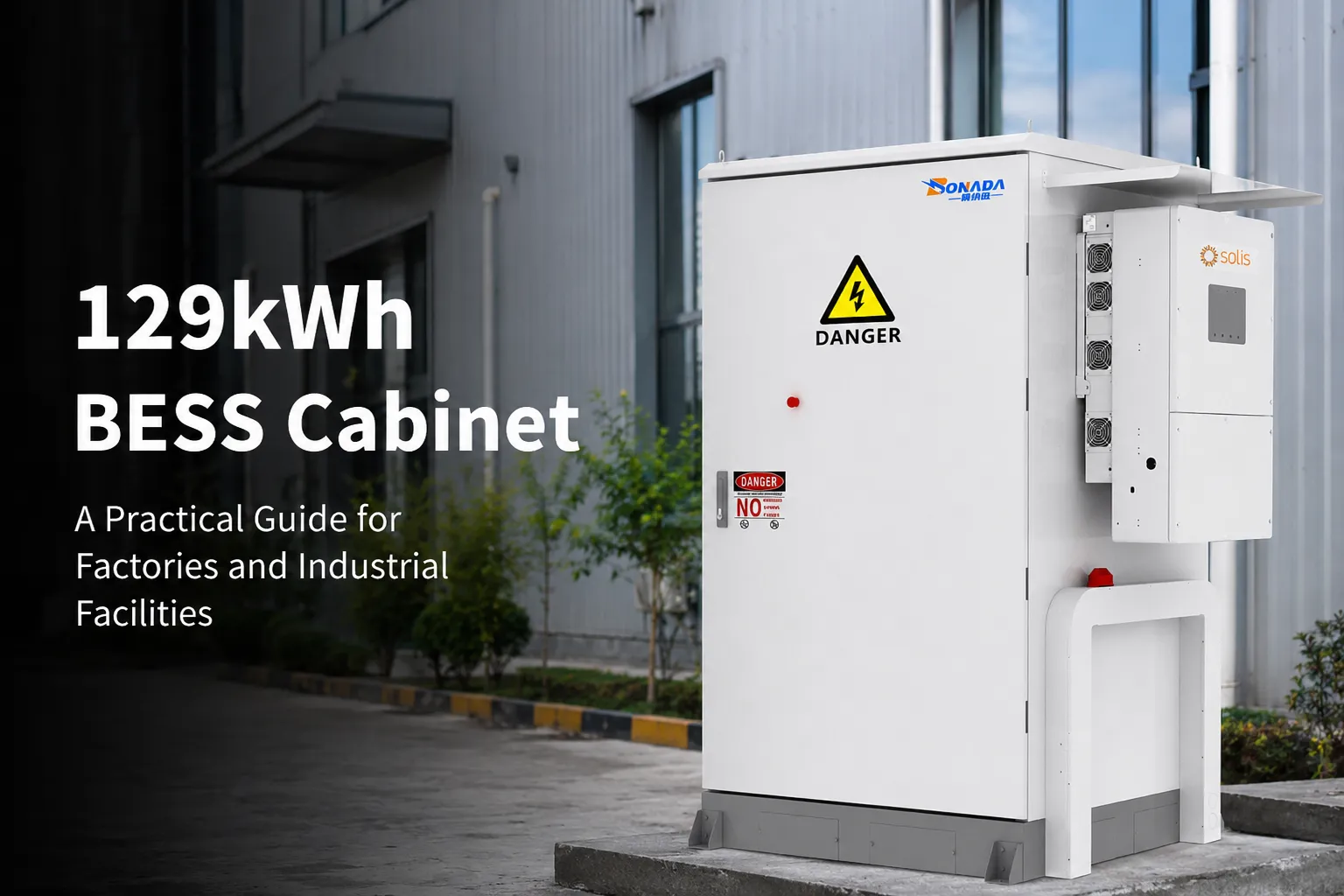
A 129kWh BESS cabinet is an integrated energy storage unit designed to store and deliver electricity when required. It combines battery storage, electrical protection, monitoring systems, and thermal control inside one outdoor-rated enclosure.
Compared with traditional battery installations that require separate battery racks, control cabinets, and cooling systems, an integrated BESS cabinet simplifies transportation, installation, and commissioning.
A typical 129kWh cabinet includes:
- Battery modules and battery racks
- Battery Management System (BMS)
- High Voltage Box (HV Box)
- Energy Management System (EMS)
- DC protection devices
- Cooling system
- Fire suppression system
- Communication gateway
- Outdoor protection enclosure
The All-In-One Cabinet Design
Most commercial BESS manufacturers use an all-in-one cabinet structure. The purpose is to integrate all necessary components into a factory-tested system instead of requiring installers to connect multiple independent devices on-site.
| Component | Function |
|---|---|
| Battery Rack | Stores electrical energy through lithium battery modules |
| BMS | Monitors and protects battery operation |
| HV Box | Controls DC power connection and protection |
| EMS | Manages system operation and communication |
| Cooling System | Maintains suitable battery temperature |
| Fire Protection | Provides additional safety protection |
Core Components Inside a 129kWh BESS Cabinet
1. Lithium Battery Modules and Battery Rack
The battery rack is the main energy storage section inside the cabinet. Most commercial systems use LiFePO₄ battery cells because of their stable chemical characteristics, long cycle life, and strong safety performance.
Inside the cabinet, individual battery cells are assembled into modules. Multiple modules are connected together to form a high-voltage battery cluster.
A typical battery structure is:
- Battery cell → Battery module → Battery rack → Battery system
- Multiple modules connected in series to achieve required voltage
- Parallel connections used to increase available capacity
For a 129kWh system, the battery voltage is usually designed for commercial PCS applications, commonly operating in a high-voltage DC range depending on system configuration.
2. Battery Management System (BMS)
The Battery Management System is one of the most important control systems inside the cabinet. It continuously monitors battery conditions and prevents operation outside safe limits.
A complete BMS normally includes:
- Battery Monitoring Unit (BMU)
- Battery Control Unit (BCU)
- Cell voltage monitoring
- Temperature monitoring
- SOC calculation
- SOH estimation
- Cell balancing control
The BMS communicates with the EMS and PCS to coordinate charging, discharging, and protection actions.
3. High Voltage Box (HV Box)
The High Voltage Box is the electrical protection center between the battery system and the inverter or PCS. It manages DC power distribution and protects the battery from electrical faults.
The HV Box usually contains:
- DC circuit breaker
- High-voltage fuse
- Main contactor
- Pre-charge circuit
- Current sensor
- Insulation monitoring device
Without proper high-voltage protection, battery systems cannot safely connect with commercial power conversion equipment.
4. Energy Management System (EMS)
The EMS controls how the battery system operates according to project requirements. While the BMS focuses on battery safety, the EMS focuses on energy management.
The EMS can manage:
- Charging and discharging schedules
- Peak shaving strategy
- Solar energy utilization
- Remote monitoring
- Power demand control
- System alarms and data analysis
For commercial projects, EMS functionality is especially important because the goal is usually not only backup power but also reducing energy costs.
Thermal Management System Inside the Cabinet
Cooling Fans and Airflow Design
Battery temperature has a direct impact on performance and lifespan. The cooling system inside a 129kWh BESS cabinet keeps battery modules operating within the recommended temperature range.
Common air cooling components include:
- Cooling fans
- Air ducts
- Temperature sensors
- Air filters
- Control circuits
Some higher-density energy storage systems may use liquid cooling to achieve better temperature consistency between battery modules.
Temperature Monitoring Sensors
Multiple sensors are installed throughout the cabinet to monitor operating conditions in real time.
- Battery temperature
- Cabinet temperature
- Cooling system status
- Humidity level
- Smoke detection
Safety Protection Systems Inside a 129kWh BESS Cabinet
Fire Detection and Suppression System
Safety is one of the most important design considerations when developing a commercial energy storage cabinet. A well-designed 129kWh BESS cabinet does not rely on a single protection method. Instead, multiple safety systems work together to detect abnormal conditions and reduce potential risks.
The internal fire protection system may include:
- Smoke detection sensors
- Temperature monitoring devices
- Combustible gas detection
- Automatic fire suppression module
- Emergency shutdown function
If unusual temperature increases or smoke signals are detected, the system can trigger alarms and take protective actions based on preset safety logic.
Different markets may require different safety standards. Depending on the project location, commercial BESS products may need to comply with IEC standards, UL requirements, transportation safety regulations, and local electrical codes.
DC Electrical Protection Components
Besides battery monitoring, electrical protection devices are essential for preventing damage caused by abnormal current or voltage conditions.
Common DC protection components include:
- DC breaker
- Fuse protection
- Surge protection device (SPD)
- Emergency disconnect switch
- Insulation monitoring system
These components protect both the battery system and connected equipment such as PCS units, solar inverters, and distribution systems.
Communication and Monitoring Components
Remote Monitoring Gateway
A modern BESS cabinet is not an isolated battery box. Communication systems allow operators to check operating status, review historical data, and identify problems remotely.
Typical communication interfaces include:
- CAN communication
- RS485 communication
- Ethernet connection
- Modbus protocol
- Cloud monitoring platform
Through remote monitoring, operators can view important information such as:
- Battery SOC (State of Charge)
- Battery temperature
- Charging and discharging power
- System alarms
- Historical operating records
Auxiliary Power Supply
Inside the cabinet, auxiliary power components provide electricity for control systems, communication devices, sensors, and cooling equipment.
The auxiliary system usually supplies power to:
- BMS controller
- EMS controller
- Cooling fans
- Lighting system
- Communication equipment
- Safety monitoring devices
Cabinet Enclosure and Mechanical Structure
Outdoor Protection Design
The external enclosure protects all internal components from environmental conditions. Since many commercial BESS systems are installed outdoors, the cabinet structure must withstand dust, rain, humidity, and temperature changes.
Common enclosure features include:
- IP54 or higher protection rating
- Corrosion-resistant coating
- Weather-resistant design
- Lockable maintenance doors
- Cable entry protection
- Anti-condensation design
A properly designed enclosure improves system reliability and reduces maintenance requirements during long-term operation.
Internal Layout and Maintenance Access
The internal arrangement of components is carefully designed to simplify installation and maintenance. Battery racks, electrical compartments, and control systems are usually separated to improve safety and service efficiency.
A practical cabinet layout normally considers:
- Easy access for maintenance technicians
- Clear separation between high-voltage and control sections
- Optimized airflow path
- Safe cable routing
- Space for inspection and replacement

How Components Work Together Inside a 129kWh BESS Cabinet
A 129kWh BESS cabinet is a complete energy system where every component has a specific function. The battery modules store energy, the BMS protects the batteries, the HV Box controls electrical connection, and the EMS manages overall operation.
The typical energy flow is:
During charging, electricity flows from the grid or renewable energy source through the PCS and HV protection system into the battery modules.
During discharge, stored energy passes through the same electrical pathway and is converted into usable AC power for commercial loads.
Key Specifications to Check Before Selecting a 129kWh BESS Cabinet
When comparing different energy storage solutions, battery capacity should not be the only consideration. The internal architecture determines how safely and efficiently the system will operate over its lifetime.
| Item | What to Check |
|---|---|
| Battery Cell | LiFePO₄ chemistry, cell quality, cycle life |
| BMS | Cell monitoring, balancing, protection functions |
| Cooling | Temperature control method and reliability |
| Safety | Fire protection and electrical protection design |
| Communication | Remote monitoring and protocol support |
| Enclosure | IP rating and outdoor durability |
Applications of a 129kWh BESS Cabinet
Commercial and Industrial Energy Storage
A 129kWh BESS cabinet is widely used in commercial and industrial projects where reducing electricity costs and improving power reliability are important. Factories, warehouses, office buildings, and industrial facilities often experience high electricity demand during peak hours. Energy storage allows these users to store energy when electricity prices are lower and discharge it when demand increases.
Typical C&I applications include:
- Factory peak shaving
- Industrial load management
- Solar energy storage
- Backup power supply
- Energy cost optimization
- Demand charge reduction
For many commercial users, the value of a BESS system is not only providing backup power but also improving daily energy management.
Solar PV Plus Energy Storage Projects
Solar power generation changes throughout the day depending on weather conditions and sunlight availability. Without storage, excess solar electricity may be wasted or exported at a lower value.
By combining photovoltaic systems with a 129kWh BESS cabinet, businesses can:
- Store excess solar energy during daytime
- Use stored energy during evening peak periods
- Increase solar self-consumption
- Reduce dependence on grid electricity
- Improve renewable energy utilization
This configuration is becoming increasingly common in factories, commercial buildings, agricultural facilities, and remote power applications.
EV Charging Infrastructure
Electric vehicle charging stations can create sudden increases in electricity demand. In locations where grid capacity is limited, battery storage can help reduce the impact of high-power charging loads.
A 129kWh BESS cabinet can support EV charging by:
- Reducing peak grid demand
- Providing additional charging capacity
- Supporting fast charging stations
- Improving energy management efficiency
Installation and Maintenance Considerations
Installation Requirements
Although integrated BESS cabinets simplify deployment, proper installation is still essential for safe operation and long-term reliability.
Important installation considerations include:
- Installing the cabinet on a stable foundation
- Providing sufficient ventilation space
- Following electrical connection requirements
- Ensuring correct grounding
- Protecting communication cables
- Following local safety regulations
Before commissioning, technicians should check battery connections, communication signals, insulation resistance, protection functions, and system parameters.
Routine Maintenance Requirements
One advantage of modern integrated BESS cabinets is reduced maintenance compared with traditional battery installations. However, regular inspection is still recommended to maintain performance.
Typical maintenance tasks include:
- Checking system alarms
- Reviewing battery performance data
- Inspecting electrical connections
- Cleaning cooling air filters
- Checking communication status
- Updating system software when required
Friendly Reminder
So, What's inside a 129kWh BESS cabinet? The cabinet contains a complete energy storage system rather than only battery cells. Inside are battery modules, battery racks, BMS controllers, high-voltage protection equipment, EMS controllers, cooling systems, communication devices, fire safety components, and a durable outdoor enclosure.
Each component has a specific responsibility. Battery modules store energy, BMS protects the cells, HV components manage electrical safety, EMS controls operation strategies, and thermal systems maintain stable working conditions.
For EPC companies, distributors, and commercial users, understanding the internal structure of a BESS cabinet helps evaluate product quality more accurately. A reliable energy storage system depends not only on the stated kWh capacity but also on the engineering behind every internal component.
Frequently Asked Questions
1. What's inside a 129kWh BESS cabinet?
A 129kWh BESS cabinet usually contains lithium battery modules, battery racks, BMS, HV Box, EMS controller, cooling system, fire protection devices, communication components, and electrical protection equipment.
2. What type of battery cells are used in a 129kWh BESS cabinet?
Most commercial systems use LiFePO₄ battery cells because they provide good thermal stability, long cycle life, high safety, and reliable performance for industrial applications.
3. What is the function of the BMS inside a BESS cabinet?
The BMS monitors battery voltage, current, temperature, SOC, and SOH. It also performs cell balancing and provides protection against abnormal operating conditions.
4. Why does a BESS cabinet need a cooling system?
Battery performance and lifespan are affected by temperature. The cooling system keeps battery modules within a suitable operating range and prevents excessive heat accumulation.
5. Can a 129kWh BESS cabinet be used with solar panels?
Yes. A 129kWh BESS cabinet can be integrated with solar PV systems to store excess solar energy and provide power during periods of low generation or high electricity demand.
6. What should buyers check before purchasing a BESS cabinet?
Buyers should evaluate battery cell quality, BMS design, safety protection, cooling method, communication capability, certifications, warranty terms, and manufacturer support.
Need Help Choosing the Right BESS Cabinet?
Not sure what components and specifications your energy storage project requires? Talk with Bonada’s BESS engineers to understand battery capacity, system architecture, cooling design, safety protection, and grid integration requirements. We can provide a customized energy storage solution based on your application, load profile, and project goals.
Consult Bonada BESS EngineersHow Many Batteries to Run a Whole House? A Practical Home Battery Sizing Guide
How to Choose an Energy Storage Cabinet: 3 Types You Should Never Buy
Related Article