129kWh BESS Cabinet: Complete Guide to Capacity, Components, Applications and Sizing
Electricity is one of the largest operating expenses for many factories. The problem is not always the total amount of electricity a facility consumes. In many markets, a factory can face significantly higher charges simply because its power demand reaches a high level for a short period.
This is where an industrial energy storage system can make a measurable difference. Instead of buying all the electricity from the grid exactly when it is needed, a factory can charge batteries during lower-cost periods and discharge them when electricity prices or demand charges are higher.
In practical terms, industrial energy storage system projects can help manufacturers reduce peak demand, shift energy consumption, increase solar self-consumption, and provide backup power for selected loads. The actual savings depend on the local electricity tariff, factory load profile, battery size, and operating strategy.
For factories considering battery storage, the important question is therefore not simply how many kilowatt-hours the battery can store. The real question is whether the system is correctly sized and controlled around the way the factory actually uses electricity.

Understanding the 129kWh BESS Cabinet Architecture
What is a 129kWh Battery Energy Storage System (BESS)?
A 129kWh Battery Energy Storage System is a cabinet-based energy storage solution designed for commercial and industrial applications. It stores electrical energy in lithium battery modules and releases that energy when the facility needs additional power.
The 129kWh figure refers to the nominal energy capacity of the battery. It does not, by itself, tell you how much power the system can deliver at any given moment. That depends on the inverter and the overall system configuration.
This distinction matters when planning a factory installation. A facility with short, sharp demand peaks may need a relatively high power rating even if the required energy capacity is moderate. Another factory with several hours of high consumption may place greater emphasis on battery capacity.
A typical 129kWh cabinet can support applications such as:
- Peak demand reduction
- Time-of-use energy shifting
- Solar energy storage
- Backup power for selected loads
- Microgrid operation
- Renewable energy integration
Several cabinets can also be combined when a project requires more storage capacity or higher output power.
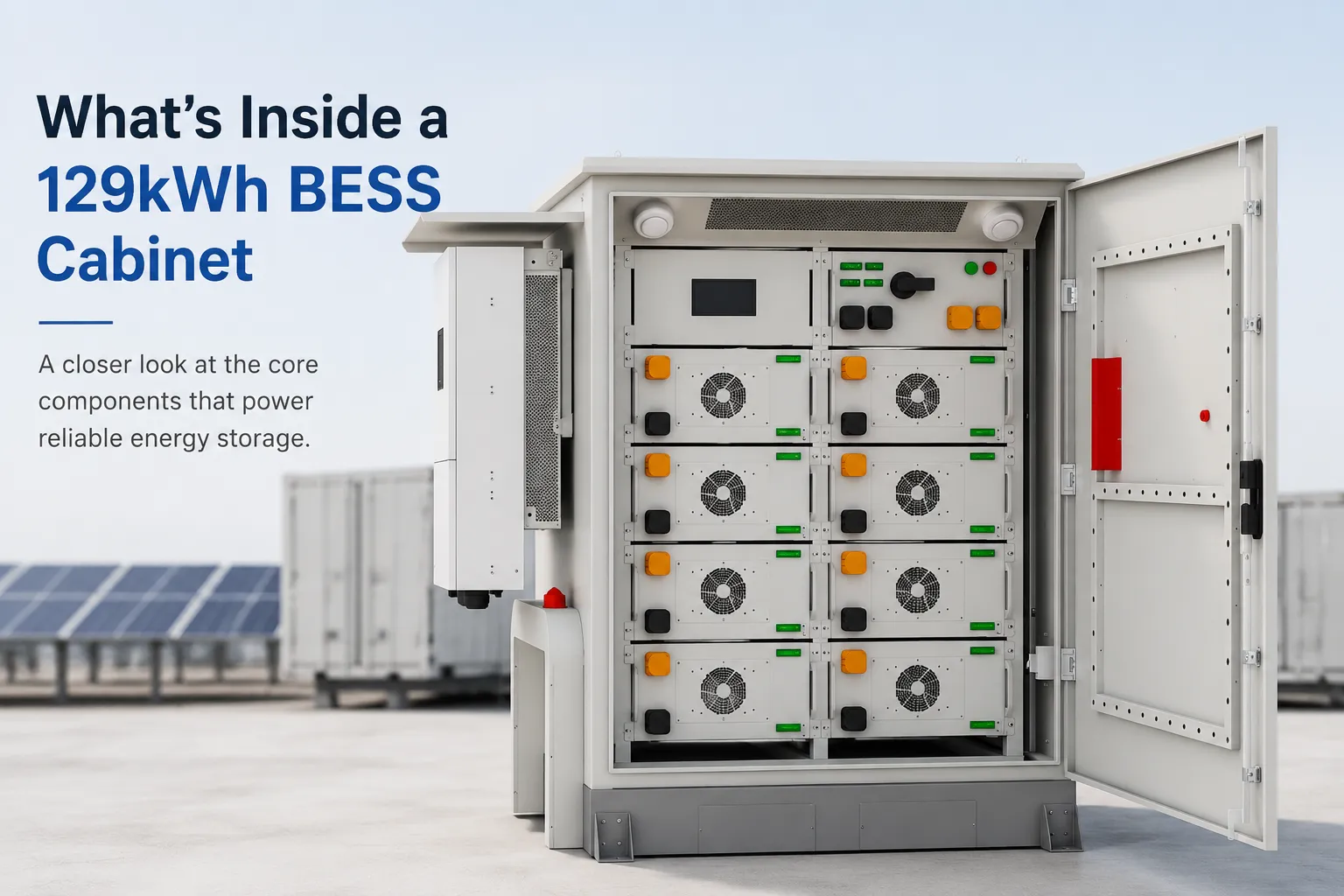
The All-In-One Modular Cabinet Design
One advantage of an all-in-one BESS cabinet is that the major electrical and control components are integrated into a single enclosure. This can simplify transportation, installation, commissioning, and maintenance compared with building a storage system from completely separate components.
A typical cabinet may contain battery modules, a battery management system, power conversion equipment, an energy management interface, thermal management equipment, protection devices, and monitoring hardware.
| Design Feature | Practical Benefit |
|---|---|
| Integrated components | Less system integration work at the project site |
| Modular construction | Easier capacity expansion when energy demand grows |
| Factory assembly | More consistent quality control before delivery |
| Compact enclosure | More flexible use of available installation space |
| Centralized monitoring | Easier day-to-day system management |
For manufacturers planning factory battery storage, modularity can be particularly useful. Production requirements often change over time, so a system that can be expanded is usually more practical than one designed only for today's load.
Core Components Inside the 129kWh BESS Cabinet
High-Voltage Lithium Battery Clusters
The battery modules are the energy reservoir of the system. Modern commercial storage cabinets commonly use lithium-ion batteries, with lithium iron phosphate (LFP) being a popular choice for stationary applications.
LFP batteries are widely used because they offer a combination of thermal stability, long service life, and predictable operating characteristics. The actual performance of a battery, however, depends on more than its chemistry.
Factors such as depth of discharge, operating temperature, charging rate, discharge rate, and the quality of the battery management system all influence long-term performance.
This is why two batteries with the same nominal capacity can produce very different results in real-world operation.
Integrated Battery Management System (BMS)
The Battery Management System, commonly called the BMS, constantly monitors the battery pack. It provides information about cell voltage, temperature, state of charge, and other operating conditions.
The BMS also provides protection when the battery operates outside predefined limits. Depending on the system design, it can restrict charging or discharging when temperature, voltage, or other parameters reach abnormal levels.
For an industrial energy storage system, the BMS is particularly important because industrial batteries may be cycled frequently. Poor battery control can result in unnecessary degradation and reduced usable capacity over time.
Energy Management System (EMS) Controls
The Energy Management System is responsible for deciding how the stored energy should be used.
Imagine a factory that starts production at 8:00 a.m. and reaches its highest electrical load between 10:00 a.m. and 2:00 p.m. If electricity is cheaper overnight, the EMS can charge the battery during the low-cost period. During the afternoon peak, the battery can discharge to reduce the amount of power drawn from the grid.
This is the basic principle behind peak shaving energy storage.
A more advanced EMS can also coordinate battery operation with rooftop solar, factory loads, electricity prices, and predefined demand limits. The goal is not to discharge the battery whenever possible. It is to discharge it when doing so creates the greatest operational or financial benefit.
Thermal Management and Cooling Systems
Advanced Air Cooling vs. Immersion Cooling
Temperature management is an important part of battery system design. Excessive heat can accelerate battery aging, while very low temperatures can affect charging and discharge performance.
For many medium-sized BESS cabinets, air cooling remains a practical option. Fans and controlled airflow remove heat generated during battery operation and help maintain an appropriate operating temperature.
Liquid cooling provides more precise thermal control and can become attractive for larger systems or applications with high cycling intensity. Immersion cooling takes the concept further by placing battery components in a specialized dielectric fluid.
| Cooling Approach | Typical Advantage | Consideration |
|---|---|---|
| Air cooling | Simple design and comparatively low complexity | Thermal performance depends on airflow and ambient conditions |
| Liquid cooling | More consistent temperature control | More components and maintenance requirements |
| Immersion cooling | Very effective heat transfer | Higher system complexity and specialized design |
For a 129kWh cabinet, the appropriate cooling method should be determined by the battery configuration, climate, expected cycling frequency, enclosure design, and project budget rather than by capacity alone.
Active Thermal Management Sensors
A modern BESS does not simply turn its cooling equipment on and leave it running continuously. Temperature sensors placed throughout the system provide the control platform with information about battery and ambient conditions.
Depending on the cabinet design, monitoring may cover individual battery modules, cabinet temperature, cooling equipment status, and other thermal parameters.
This information allows the system to respond when temperatures begin to rise instead of waiting until a serious thermal problem develops.
Safety Features and Protective Systems
Fire Suppression and Safety Standards
Battery safety deserves particular attention in industrial installations. A commercial BESS should use several layers of protection rather than relying on a single safety mechanism.
Common protection features can include:
- Battery voltage and temperature monitoring
- Over-current protection
- Electrical isolation
- Emergency shutdown functions
- Smoke detection
- Gas detection where applicable
- Fire suppression equipment
- Thermal event monitoring
The exact requirements vary by country and project. Local electrical codes, fire regulations, building requirements, and energy storage standards should all be reviewed before installation.
Factories should also consider how the battery cabinet will be positioned relative to production areas, electrical rooms, emergency access routes, and other critical infrastructure.
Smart Alarms and Enclosure Durability
Remote monitoring has become a normal feature of modern commercial storage systems. Operators can view battery state of charge, power output, temperatures, alarms, and historical operating data from a centralized platform.
This can be especially useful for factories where the energy system is not directly supervised throughout the day.
The cabinet enclosure itself also needs to match the installation environment. Outdoor projects may require appropriate IP protection, corrosion resistance, dust protection, and temperature management.
Factories located in coastal areas, humid climates, or regions with high ambient temperatures should pay particular attention to environmental protection when comparing different BESS solutions.
Technical Specifications and Performance Metrics
Power Output and Capacity Ratings
One of the most common mistakes when evaluating battery storage is treating kWh and kW as the same thing.
They are not.
Kilowatt-hours describe how much energy the battery stores. Kilowatts describe how quickly the system can deliver or absorb that energy.
For example, a 129kWh system could be configured with different inverter ratings depending on the application. A factory trying to control a brief 300kW demand spike will have different requirements from a facility that needs 100kW of support for several hours.
| Application | Important Specification |
|---|---|
| Peak shaving | Discharge power and response time |
| Load shifting | Usable battery capacity and discharge duration |
| Solar storage | Battery capacity and PV generation profile |
| Backup power | Critical load and required backup duration |
| Microgrid operation | Power capacity, controls, and grid-forming capability where required |
For factory battery storage, the inverter rating should therefore be selected according to the actual load profile instead of simply matching the battery's nominal energy capacity.
Efficiency and Cycle Life Expectations
No battery storage system is 100% efficient. Energy is lost during charging, battery storage, power conversion, cooling, and discharging.
Round-trip efficiency is therefore an important number when comparing systems, but it should not be viewed in isolation.
Battery life is similarly influenced by operating conditions. Frequent deep cycling, high temperatures, and aggressive charge or discharge rates can affect degradation.
A factory that cycles its battery every day should evaluate expected performance over the actual operating profile rather than relying solely on a headline cycle-life figure supplied in a product brochure.
Key Applications for 129kWh Storage Systems
Commercial & Industrial (C&I) Energy Storage
Factories are a natural application for C&I battery storage because their electricity consumption is often concentrated into predictable operating periods.
For example, a manufacturing plant may have relatively low consumption overnight and a significant increase after production lines start. If the facility is subject to demand charges, that short period of high consumption can have an outsized impact on the monthly electricity bill.
With peak shaving energy storage, the battery can supply part of the load when demand approaches a predefined threshold.
The system can also support other strategies, including:
- Reducing demand charges
- Moving electricity consumption to lower-cost periods
- Increasing solar self-consumption
- Supporting additional production capacity
- Reducing short-duration grid disturbances
- Providing backup power to selected equipment
The financial benefit should always be calculated using the factory's actual electricity tariff and historical load data.
Data Centers and Telecom Base Stations
Data centers and telecommunications facilities place a high value on power reliability. Even a short interruption can cause operational problems, equipment shutdowns, or service disruption.
Battery systems can provide short-duration backup power, support transitions between power sources, and work alongside generators or renewable energy systems.
For these applications, system reliability and redundancy may be more important than simply maximizing battery capacity.
Microgrids and Renewable Energy Integration
Solar generation and factory electricity demand rarely follow exactly the same schedule.
A factory may produce a large amount of solar power around midday while its highest electricity consumption occurs later in the afternoon. Without storage, some of that solar generation may have limited value to the facility.
A battery can store excess solar generation and release it later. This makes the battery particularly useful for factories with large rooftop PV systems.
When solar PV, BESS, and intelligent energy controls operate together, the factory can build a more flexible microgrid and reduce its dependence on grid electricity during selected periods.
Choosing the Right 129kWh BESS Solution
Key Features and Selection Criteria
Price is obviously important when purchasing battery storage, but it should not be the first and only comparison point.
A better evaluation starts with the factory's electricity data.
Start with the load profile. Look at maximum demand, average load, peak duration, production schedules, and seasonal changes.
Then review the tariff. Find out whether the utility charges for demand, peak-period consumption, capacity, or time-of-use electricity.
Next, define the battery's job. A system designed primarily for peak shaving may require a different power-to-energy ratio from a system intended to store solar energy for evening use.
Other factors worth checking include:
- Battery chemistry
- Usable capacity
- Inverter power rating
- Round-trip efficiency
- Expected cycle life
- Cooling method
- Fire protection
- Monitoring and EMS functions
- Warranty conditions
- Local service capability
- Expansion options
For a factory planning long-term industrial energy storage system deployment, after-sales support and system integration capability can be just as important as the initial equipment price.
Installation and Maintenance Requirements
A cabinet-style BESS is relatively straightforward to deploy, but it still requires proper site engineering.
Before installation, the project team should review:
- Available floor or outdoor space
- Foundation and cabinet placement
- Grid connection point
- Transformer capacity
- Electrical cable routing
- Ventilation and cooling requirements
- Fire safety arrangements
- Communication network availability
- Local permitting requirements
Maintenance requirements depend on the system design and operating environment. Regular inspections, software checks, cooling-system maintenance, electrical inspections, and performance monitoring can help maintain reliable operation.
Remote monitoring is also useful because engineers can identify unusual temperature changes, repeated alarms, abnormal battery behavior, or declining performance without physically visiting the cabinet every day.
Friendly Reminder
A 129kWh BESS cabinet is more than a large battery pack. It is an integrated energy management platform that combines lithium battery modules, BMS controls, power conversion equipment, thermal management, safety protection, and EMS functionality.
For factories, the main value lies in using stored electricity at the right time. Demand reduction, tariff-based load shifting, solar self-consumption, and backup power can all be achieved with the appropriate system configuration.
The most suitable system will depend on the factory's actual load profile, electricity tariff, operating schedule, available space, and future energy requirements.
FAQ stands for Frequently Asked Questions
1. Can a battery energy storage system really reduce a factory's electricity bill?
Yes, but the amount of savings depends heavily on the factory's electricity tariff and load profile. A battery does not automatically make electricity cheaper. Its value comes from changing when the factory draws power from the grid.
For example, if a factory is charged a high demand fee when its electricity demand reaches a monthly peak, a BESS can discharge during that peak and reduce the amount of power coming from the grid. The factory may also charge the battery during lower-cost periods and use that stored energy when electricity prices are higher.
For facilities with predictable demand peaks, peak shaving energy storage can be one of the most practical ways to reduce electricity costs. The first step is to review the factory's electricity bills and interval load data rather than choosing a battery based only on its advertised capacity.
2. How do I know what size battery storage system my factory needs?
There is no universal battery size for factories. Two facilities with similar monthly electricity consumption can require completely different BESS configurations because their peak demand, operating hours, tariffs, and production schedules may be very different.
The most useful starting point is the factory's historical load data. Engineers normally look at the highest demand, how long the peak lasts, the desired demand limit, and how often those peaks occur.
For example, if a factory regularly experiences a 200 kW demand spike that lasts for 30 minutes, its requirements will be very different from a facility with a 200 kW peak lasting four hours.
This is also why kW and kWh should not be confused. kW determines how much power the battery can provide at one time, while kWh determines how much energy it can store.
3. Is a 129kWh BESS cabinet large enough for a factory?
It can be, depending on what the system is expected to do. A 129kWh cabinet is not necessarily intended to supply an entire factory for several hours. In many projects, its role is more specific—for example, reducing short-duration demand peaks, storing excess solar generation, or supporting selected loads.
For factory battery storage, the required capacity should be calculated from the actual application. A factory with a short but high power spike may need a relatively powerful inverter and moderate battery capacity. A facility trying to move several hours of solar energy into the evening may need substantially more kWh.
Multiple cabinets can also be connected when a single 129kWh unit does not provide enough capacity or power for the project.
4. Can battery storage work together with a factory's rooftop solar system?
Yes. Solar and battery storage can complement each other particularly well in factories where electricity consumption does not perfectly match solar production.
For instance, a factory may generate more solar power around midday than it can use immediately, while its electricity demand remains high later in the afternoon. Instead of exporting or wasting part of that excess generation, the BESS can store it and discharge the energy later.
The combination can also help reduce grid demand during expensive periods. An Energy Management System can coordinate solar generation, factory loads, battery charging, and battery discharge according to the site's operating conditions.
For manufacturers with significant rooftop PV capacity, an industrial energy storage system can therefore improve solar self-consumption while providing additional flexibility for electricity cost management.
5. What information should I prepare before buying a BESS for my factory?
The best BESS design starts with the factory's electricity data rather than a standard product recommendation. Ideally, the project team should review at least several months of electricity bills and detailed interval load data.
Useful information includes:
- Monthly electricity consumption in kWh
- Maximum demand in kW
- Peak demand duration and frequency
- Peak and off-peak electricity rates
- Existing solar PV capacity
- Factory operating hours
- Critical loads that require backup power
- Available installation space
- Transformer and grid connection capacity
With this information, an engineer can determine whether the project should prioritize peak shaving, load shifting, solar energy storage, backup power, or a combination of several functions. This approach is much more reliable than selecting a battery simply because it has a certain number of kilowatt-hours.
Looking for a 129kWh BESS Solution for Your Project?
Share your load profile, required power, solar capacity and application requirements with our BESS engineers. We can help evaluate the appropriate 129kWh configuration or a scalable multi-cabinet solution.
Talk to a BESS EngineerHow BESS Reduces Electricity Costs for Factories
Why Cold Storage Facilities Need Battery Energy Storage Systems
Related Article