BESS for Telecom Towers: Improving Power Reliability in Weak Grid Areas
Cell sites cannot function without steady power. Mobile carriers count on these towers to keep calls and data flowing around the clock. Where the local grid is shaky though, sudden cuts and voltage shifts happen often, making site maintenance a constant hassle.
This trouble is widespread in emerging economies and off-grid villages. Old setups mostly run on diesel generators and lead-acid batteries. Fuel keeps getting pricier, these parts need frequent servicing, and they wear out fast — all of which eats into tower operators’ profit margins.
LFP-based battery storage changes how site power works. It works alongside rectifiers, solar panels and diesel machines. The combo helps sites stay online longer, burn less fuel, and bring down ongoing running costs year after year.
If your telecom business runs many sites with unreliable grid supply, picking the right storage pack is about much more than emergency backup. It is a practical way to build power infrastructure that you can afford and trust long term.
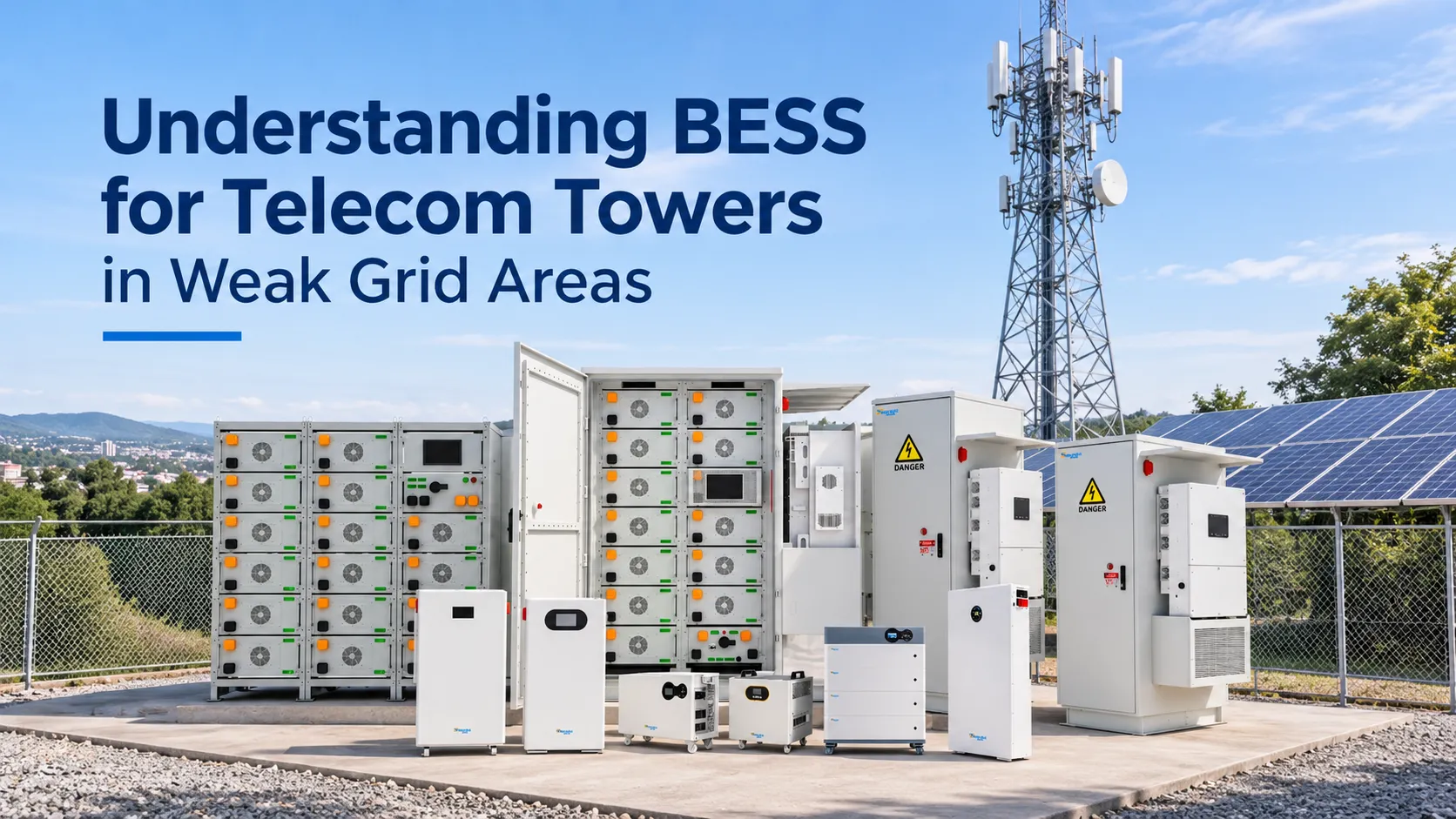
Understanding BESS for Telecom Towers in Weak Grid Areas
The Impact of Grid Instability on Remote Telecom Infrastructure
Cell sites need steady power to keep radios, links and cooling running. Even a short power hit breaks service for users.
Towers on unstable grids run into these common issues:
- Constant blackouts: Random cuts keep backups and generators running nonstop.
- Wobbly voltage: It hurts power converters and makes faults more likely.
- Little grid access: Some far-off sites only get mains power for a couple hours each day.
- Expensive power: High utility bills eat into regular operational budgets.
- Hard to get help: Rural towers wait longer for repairs when something fails.
All this makes life harder for telecom teams. If batteries cannot hold the load long enough, diesel machines have to pick up the slack. More fuel runs, extra maintenance, and more risk of the site going down follow right after.
For anyone running lots of these scattered towers, small energy tweaks add up and cut total network costs noticeably.
What Is a Telecom Tower Battery Energy Storage System (BESS)?
This storage pack built for cell towers works as an all‑in‑one power setup. It keeps sites running when grid power drops, balances energy use and makes power supply far more dependable.
It is not just a simple set of standby batteries. This newer storage unit packs battery blocks, a BMS, charging and power conversion hardware,To understand how these components work together, read our guide to the internal components of a 129kWh BESS cabinet.
safety cutouts plus real‑time tracking. If needed, it can link up and talk to the tower’s original power gear and other energy supplies already on site.LFP cells are the go‑to choice for these tower storage units. They hold up well through repeated charge and discharge cycles, run cool and carry low fire risk.
For more information about battery safety requirements, see our guide to UL certifications for battery energy storage systems.
The core parts you will find inside this tower storage system are listed below:
| Component | Main Function |
|---|---|
| LFP Battery Modules | Save power and feed the load once mains supply cuts out. |
| Battery Management System (BMS) | Tracks voltage, current and temperature, and triggers safeguards. |
| Rectifier & Charger | Turn grid AC into stable DC to run tower hardware and top up batteries. |
| Power Conversion Gear | Handles power shifting and routing to match the site’s power layout. |
| Energy Management System (EMS) | Switches between power inputs, arranges charging and sets load priorities. |
| Monitor & Protection Units | Send live status alerts and shield the whole system against electrical faults. |
How you hook this storage unit up depends on the tower’s native DC power layout. It can tie straight into a matching DC bus or use extra conversion hardware. Getting the voltage right and ensuring smooth signal exchange matters a lot when fitting everything together.
Telecom Power System Architecture: LiFePO4 Batteries, Rectifiers, Solar PV, and Diesel Generators
Good power setups for cell towers draw from different energy feeds, keeping sites running even with unstable grid supply.
With this popular hybrid layout, mains power runs things whenever it is there. Rectifiers flip AC into stable DC, feeding tower hardware and topping batteries. If the grid cuts out, batteries take over the DC load right away. Solar adds extra power, and diesel gensets kick in once stored battery energy runs thin.
It works in these four core states:
- Grid active: Mains power runs site loads and keeps batteries topped up.
- Grid lost: LFP batteries send DC power to keep telecom gear working.
- Solar feed: Solar power serves live loads and refills batteries through matching controllers or converters.
- Prolonged outage: Diesel units supply extra power when solar and stored energy fall short.
This hybrid setup helps tower owners make the most out of every energy option, instead of relying only on grid power or diesel.
Why BESS Is Critical for Weak Grid Telecom Sites
Transitioning from Lead-Acid to LiFePO4 Battery Systems
For years, lead‑acid batteries were the default backup choice for cell towers. They are easy to source and cheap to buy at first. Still, their weaknesses show quickly where blackouts happen often and last a long time.
If you drain them deeply over and over, these batteries wear out fast. They also need regular checks, and you cannot pull as much usable power out of them compared with well‑set‑up LFP packs.
LFP cells fit tower storage far better for many practical reasons:
- Longer runtime across cycles: A good LFP unit can go through thousands of charge‑discharge rounds, based on how you run it and the maker’s design.
- More usable power: You can safely draw much more energy from an LFP bank than from standard lead‑acid types.
- Quicker recharge: Suitable setups take higher charging current, so power reserves bounce back faster between outages.
- Less upkeep: Unlike flooded lead‑acid types, lithium packs need no regular topping up of liquid electrolyte.
- Smaller footprint: Higher energy density means you get the same usable power without taking up as much room on site.
The table below lays out this side‑by‑side contrast. Real results will shift based on cell specs, working temperature, discharge speed, charging habits and how well you maintain the whole unit.
| Performance Factor | Lead-Acid | LiFePO4 |
|---|---|---|
| Usable Depth of Discharge | Generally lower | Generally higher |
| Cycle Life | Generally shorter | Generally longer |
| Charging Speed | Relatively slower | Can support faster charging |
| Maintenance | Higher for flooded types | Generally lower |
| Energy Density | Lower | Higher |
| Initial Investment | Usually lower | Usually higher |
For telecom operators, the decision should not be based solely on battery purchase price. Battery replacement frequency, maintenance costs, usable energy, and generator fuel consumption should all be included in the evaluation.
Reducing Diesel Generator Reliance and Fuel Logistics Costs
Most cell towers still rely on diesel gensets if the grid is unstable. The hardware price is just the start; running it keeps costing you.
There’s fuel, delivery to faraway sites, engine checks, oil and filter swaps, spares, and surprise repairs.
Get the right battery storage, and it cuts how much you run the genset. It takes over brief outages so you skip firing up diesel.
Say a tower draws a steady 2 kW DC load, and power stays out for eight hours:
Energy use = 2 kW × 8 h = 16 kWh
If the battery has enough usable power, it holds the site without turning on the generator.
But you cannot simply buy a 16 kWh pack. You have to account for discharge limits, power loss, temperature changes, battery wear and safety reserve.
Roll this out across many towers, and less genset run time makes fuel and maintenance much easier to manage.
Enhancing Network Uptime and Power Quality Conditioning
For mobile carriers and tower firms, uptime is everything. One tower losing power can knock out local coverage, calls and data.
BESS keeps power flowing, holding stored energy to kick in the moment mains power cuts out.
It also smooths the switch between different power feeds. Even so, batteries alone cannot fix every spike or frequency shift. You still need matching rectifiers, inverters and protection gear built around the site’s wiring setup.
A well-built battery setup for these key tower sites does several things:
- Cuts service drops triggered by grid failures.
- Feeds steady DC power to all tower hardware.
- Holds the load while generators spin up and take over.
- Makes the site tougher against frequent grid blips.
- Lets operators plan energy use across many sites with more confidence.
All this adds up to sturdier power infrastructure and fewer outages traced back to power trouble.
Reducing Operating Expenses (OPEX) for Telecom Tower Operators
Power costs eat up a big chunk of running a cell tower, more so where grids are shaky and diesel engines run nonstop.
A battery storage pack helps trim these bills in a few ways:
- Less diesel burned, by running generators only when truly needed.
- Fewer battery swaps than older battery types, depending on real working conditions.
- Minimal regular upkeep for the battery bank.
- Make better use of solar power captured on site.
- Remote tracking cuts down on unnecessary site trips.
These perks really add up for operators running towers spread far apart. Small monthly savings on each site turn into a large total gain once you have hundreds of towers online.
That said, how much you save hinges on local diesel rates, how often the grid stays on, sunlight levels, the upfront cost of the battery system and each tower’s power draw. It pays to run a full lifecycle cost check before picking any storage setup.
Telecom BESS Sizing and Engineering Design Considerations
Calculating Daily Power Consumption and Autonomy Hours
Picking the right battery size is critical for tower storage. Too small, and it fails during long outages. Too big, and you waste money with no extra benefit.
First, figure out the site’s total power draw.
Count every key AC and DC load:
- Base radios and transceivers
- Transmission and network hardware
- Fans and cooling gear
- Monitoring and security devices
- Other necessary auxiliary loads
For DC setups, read the DC bus directly, do not just use nameplate figures.
Use this simple formula:
Battery size (kWh) = Avg load (kW) × Backup hours ÷ (Usable DoD × System efficiency)
Example: a tower pulls 2 kW, needing 12 hours backup. Its LFP bank allows 90% discharge, at 95% efficiency.
Required battery capacity = 2 × 12 ÷ (0.90 × 0.95)
Nominal size needed ≈ 28.1 kWh
This is just a starting number. Remember battery wear, temperature losses, safety buffer, varying loads and possible future expansions.
The table further down shows how power needs change with load and backup runtime.
| Average Load | Backup Time | Energy Required |
|---|---|---|
| 1 kW | 8 hours | 8 kWh |
| 2 kW | 8 hours | 16 kWh |
| 2 kW | 12 hours | 24 kWh |
| 3 kW | 12 hours | 36 kWh |
| 3 kW | 24 hours | 72 kWh |
Note: The table shows energy consumption during the backup period, not the final nominal battery capacity. Additional capacity is required to account for battery operating limits and system losses.
Fast Charging Capabilities and Cycle Life Optimization under Frequent Outages
Many tower sites with poor grids get hit by repeated blackouts daily. So how fast the battery recharges counts just as much as its storage size.
Grid power may only return briefly. The battery has to pick up enough charge in that short window; otherwise, your backup reserve keeps dwindling.
LFP batteries can charge quickly, yet the actual speed is bounded by cell specs, BMS settings, temperature and charger capacity.
When assessing charging capability, watch these items:
- The maximum safe continuous charging current
- Power output of the rectifier or charger unit
- The available grid window between outages
- How much charge remains before recharge starts
- Temperature limits and charging protection triggers
Suppose a 30 kWh battery needs to recover 15 kWh within three hours. It will need around 5 kW charging power, not counting energy losses and running site loads.
During operation, the charger feeds tower devices while charging batteries. The rectifier must be sized to handle both tasks.
Do not keep pushing excessive charging current, which heats the battery and speeds up wear. A mild, stable charging scheme keeps the battery in good shape longer.
Typical Telecom Tower BESS Configurations and Battery Capacity Selection
Power draw, backup needs, space and grid quality vary a lot from one tower to another. A tiny rural BTS will not need the same storage as a busy city macro tower running extra cooling gear.
Here are typical battery setups for reference:
| Site Type | Illustrative Battery Capacity | Typical Application |
|---|---|---|
| Small Telecom Site | 5–15 kWh | Light‑load BTS and small remote stations. |
| Standard Telecom Tower | 15–30 kWh | Regular mobile network backup. |
| High-Load Telecom Site | 30–60 kWh | Multiple radio units and longer backup runtime. |
| Remote Hybrid Telecom Site | 60–100+ kWh | Prolonged blackouts, solar and diesel hybrid runs. |
These figures are just rough guides, not fixed industry specs. The real battery size comes from actual load readings, required backup hours, charging access and hardware matching.
Modular LFP packs work great for tower owners. You can start with what you need right now, then slot in extra modules later as the network grows.Explore Bonada's LiFePO4 battery energy storage products for different energy storage applications and project requirements.
Integrating Solar PV and Existing Diesel Generators
For sunny places with shaky grids, adding solar panels to cell towers makes a lot of sense.
If laid out well, solar covers a share of the site’s daily power use and cuts how much fuel the diesel generator burns.
This kind of hybrid power setup usually has these parts:
- Solar panels
- MPPT charge controllers or matching hybrid power hardware
- LFP battery storage
- Grid‑tied rectifiers
- Existing diesel generators
- Energy management and monitoring gear
When sunshine is strong, solar runs the tower load and tops up the batteries. After dark or in bad weather, stored power keeps everything going. Once battery levels drop past the set limit, the controller can fire up the diesel automatically, if the system supports it.
Rather than tearing out the whole power setup, you can fit a BESS into sites already running on diesel. It works alongside compatible old rectifiers and generator controls, so you avoid swapping out gear you do not need to replace.
Still, you need to plan carefully around DC bus voltage, charging current, generator size, control rules and communication protocols.
Thermal Management for High-Temperature and Extreme Environments
Many towers sit in hot tropical, desert or remote spots, with high temperatures lasting most of the time.
Heat affects battery output, charging and lifespan. It speeds up wear. Charging lithium cells outside the allowed temperature window also brings safety hazards.
So telecom battery storage needs proper thermal control and weather protection.
Key design points:
- Choose cells matching local temperature conditions
- Add vents or active cooling as needed
- Place temperature sensors on battery packs
- Use a BMS that limits charge and discharge based on temperature
- Select cabinets with suitable IP ratings
- Shade the unit from direct sunlight and extra heat
For extremely hot sites, dedicated outdoor cabinets with thermal management beat ordinary indoor placements.
Thermal design should follow local climate, sun exposure, cabinet layout and heat generated while batteries operate.
Deployment Challenges in Weak Grid and Remote Regions
Managing Ambient Temperature and Environmental Hardening
Most cell towers sit in tough outdoor spots. Coastal sites deal with damp air and salt, while desert ones battle sand, dust and sharp heat swings.
Such elements eat away at cabinets, plugs, cooling parts and signal ports over time.
To keep storage systems running reliably long term, the BESS needs built‑in safeguards against these harsh conditions.
Here are practical steps:
- Cabinet material and surface coating that fights rust
- Cabinets with correct IP rating against dust and moisture
- Sealed cables and shielded connectors
- Temperature regulation inside battery chambers if needed
- Solid earthing and lightning defense
- Routine checks for vents and cooling parts
Do not use one standard cabinet for all jobs. Match the protection level to where the tower actually stands.
Anti-Theft Protection and Grid Surge/Voltage Fluctuation Resilience
Isolated tower sites run risks of theft, damage and electrical faults. Battery packs, solar panels and power cables are easy targets, especially when nobody can keep an eye on them.
That means you need solid physical security when rolling out BESS units.
Good safeguards to put in place:
- Locked, tamper-proof battery cabinets
- Restricted entry for battery and power distribution areas
- Site alarms plus remote live monitoring
- Firm battery mounts and shielded cable runs
- Surge suppressors and reliable earthing
The power side also has to handle erratic grid supply. Quick voltage jumps, lightning surges and switching spikes can fry delicate hardware without proper guards.
Surge modules, breakers and fuses work together to lower these hazards. All protection layouts must follow local electrical rules and the carrier’s internal specs.
Preventing BMS Communication and Integration Failures
If you swap in lithium batteries for old telecom power setups, communication matching is a big deal.
Most rectifiers and monitoring tools talk back and forth to get battery data: SOC, SOH, voltage, current, temperature and fault alerts.
If the battery’s BMS fails to communicate properly, readings will be wrong. Charging and safety controls will not work the way they should.
Before installation, check these items:
- Battery voltage fit for the current DC bus
- CAN, RS485 or other needed ports
- Supported protocols and data mapping
- Voltage and current caps for charging
- Alarm triggers and protection actions
- Compatibility with the existing rectifier and site monitor
Always run integration trials before mass rollout. Catch communication and control bugs at the factory, instead of fixing them out at distant tower sites.
Remote Monitoring and Intelligent Operations Maintenance (O&M)
Looking after power gear spread over dozens of tower sites costs plenty of time and money. Manual check‑ups get pricey, particularly for towers tucked away in hard‑to‑reach rural zones.
Remote monitoring lets teams track battery performance without driving out to every single site.
A modern BESS monitoring tool shows useful data like:
- Battery SOC and SOH
- Voltage for each cell or module, if available
- Charge and discharge current
- Battery working temperature
- Past energy usage logs
- System alerts and protection triggers
- Charge and discharge cycle history
Using one central dashboard, maintenance crews spot odd battery behaviour, sort out link failures and arrange service only when real issues pop up.
For big telecom networks, this cuts wasted trips and makes maintenance far more efficient.
Even so, remote tracking cannot take the place of hands‑on inspections. Terminals, cabinet condition, cooling parts and electrical safeguards still need regular on‑site checks.
Selecting and Evaluating the Right Telecom BESS Supplier
Battery Cell Quality (Grade A LiFePO4) and Customization Options
Cell quality decides how reliably and how long your tower storage runs.
Carriers and EPCs should not just compare quoted capacity and price. It pays to check traceability, consistent production, datasheets and quality controls.
Make sure to ask these questions:
- Who makes the raw cells, and can they be traced?
- Can the supplier hand over cell specs and test records?
- What cycle life is promised, and under what test setup?
- What are the safe charge and discharge boundaries?
- Does the BMS watch and protect every single cell?
- Can voltage and capacity be adjusted for this project?
Grade‑A LFP cells are the usual pick for storage jobs. Still, that label alone means little; ask for proof and inspect the whole packed unit.
Tower projects often need tweaks. Different carriers want custom voltage, capacity, cabinet size, communication rules and mounting styles.
A good maker will tailor the battery to fit your specs, instead of pushing only off‑the‑shelf stock.
System Integration, Testing, and Warranty Support
A telecom BESS is not just a stack of cells. How well it works hinges on system integration, circuit safeguards, BMS tuning, and whether it plays nicely with the site’s existing power gear.
Run through these points before locking in a supplier:
- Production capacity: Do they have solid assembly and inspection workflows?
- System design: Can they adjust voltage, capacity, cabinet layout and communication setups to your needs?
- Pre‑shipment tests: Do they verify performance, safety triggers and data links before shipping?
- Certification papers: Can they supply valid product and transport docs, like UN38.3 reports if required?
- Warranty rules: Is coverage length, operating limits, exceptions and after‑sales duty spelled out clearly?
- Tech help: Will they walk you through installation, fix faults and sort out integration headaches?
These checks matter a lot for EPCs and telecom firms buying batteries for many sites or long‑run projects.
Suppliers who build the units themselves usually have more room to tweak designs, shift production timelines and coordinate technical support.
Calculating Total Cost of Ownership (TCO) and ROI
The upfront price is not everything when you buy battery storage for cell towers. You need to look at total ownership cost across its whole service life.
TCO covers these items:
- Battery hardware and installation fees
- Conversion gear and integration parts
- Freight and commissioning charges
- Diesel fuel use
- Service and future battery swap costs
- Power drawn by cooling and aux devices
- Remote monitoring and routine upkeep
To judge if it pays off, compare running costs of your old power setup against the new battery solution.
Here is an easy ROI way to work it out:
Yearly net saving = Cut in energy and service bills − Extra yearly running costs
Simple payback time = Total initial outlay ÷ Yearly net saving
For instance, spending $20,000 on a BESS that saves $5,000 each year means you get your money back in four years.
This is just a rough example. A proper financial model has to factor in battery wear, replacement plans, loan fees, power and diesel rates, plus the full project lifespan.
If you run many tower sites, comparing TCO across locations helps pick which ones will bring the best returns once the storage goes in.
Frequently Asked Questions About Telecom BESS
How Long Can a BESS Keep a Telecom Tower Operational During Grid Outages?
Backup runtime is tied to battery size, real load, safe discharge limit, power loss and battery health.
If a tower draws 2 kW, it takes 16 kWh usable energy for eight hours of run time. The battery’s rated capacity has to be bigger, to cover discharge constraints and energy waste.
Get the sizing right with real load measurements, and set your backup hours according to local grid reliability.
Can BESS Be Retrofitted into Existing Diesel-Powered Telecom Towers?
Absolutely. Usually you can add an LFP storage system to telecom sites running diesel, no need to rip out the whole power setup.
The battery works with your existing rectifiers, DC distribution, solar controllers and diesel gensets, as long as voltages, charge settings, communication rules and control logic match up.
Before fitting it in, technicians need to check the original power layout and make sure the new BESS runs safely alongside all the on-site hardware.
Why Is LiFePO4 Preferred Over Lead-Acid for Weak Grid Telecom Applications?
LFP batteries are the go-to option. They handle more charge cycles, let you draw more power safely, recharge quicker, and need far less regular care than old lead‑acid types.
That makes them perfect for poor-grid areas, where batteries cycle back and forth all the time.
They cost more up front. But with the right design, their longer lifespan and better energy use bring down running costs over time.
Building More Reliable Telecom Power Infrastructure with the Right BESS Solution
Unstable grids keep causing headaches for tower operators. Frequent blackouts, costly diesel and hard‑to‑reach sites all hurt network uptime.
A well‑built battery storage setup offers a solid fix. Pair LFP packs with matching rectifiers, solar panels, diesel gensets and smart monitoring, and you get steadier power while keeping energy bills in check.
Looking for Reliable BESS Solutions for Telecom Towers?
Power outages and unstable grids shouldn't compromise telecom network reliability. Talk directly with Bonada's energy storage team about customized LiFePO4 battery solutions for telecom towers, including battery capacity selection, hybrid solar-diesel integration, and backup power configurations. We support telecom EPC contractors, tower operators, and project developers with factory-direct supply and technical assistance.
Discuss Your Telecom BESS Project
How to Choose a Reliable BESS Manufacturer for Commercial Solar Projects
Related Article