
20 calculation formulas related to photovoltaics
2025-06-18
1. Conversion efficiency
- η= Pm (peak power of the cell)/A (cell area)×Pin (incident light power per unit area)
- Where: Pin=1KW/㎡=100mW/cm²
2. Charging voltage
- Vmax=Vrated×1.43 times
3. Battery modules in series and parallel
- 3.1 Number of battery modules in parallel=average daily power consumption of load (Ah)/average daily power generation of modules (Ah)
- 3.2 Number of battery modules in series=system operating voltage (V)×coefficient 1.43/peak operating voltage of modules (V)
4. Battery capacity
- Battery capacity = average daily power consumption of load (Ah) × number of consecutive rainy days / maximum discharge depth
5. Average discharge rate
- Average discharge rate (h) = number of consecutive rainy days × load working time / maximum discharge depth
6. Load working time
- Load working time (h) = ∑ load power × load working time / ∑ load power

7. Battery
- 7.1 Battery capacity = average daily power consumption of load (Ah) × number of consecutive rainy days × discharge correction factor / maximum discharge depth × Low temperature correction factor
- 7.2 Number of batteries in series = system operating voltage / battery nominal voltage
- 7.3 Number of batteries in parallel = total battery capacity / battery nominal capacity
8. Simple calculation based on peak sunshine hours
- 8.1 Component power = (electrical power × power usage time / local peak sunshine hours) × loss coefficient
- Loss coefficient: 1.6~2.0 based on local pollution level, line length, installation angle, etc.
- 8.2 Battery capacity = (electrical power × power usage time / system voltage) × continuous rainy days × system safety factor
- System safety factor: 1.6~2.0, according to battery discharge depth, winter temperature, inverter conversion efficiency, etc.
9. Calculation method based on annual radiation total
- Component (square array) = K × (electrical appliance working voltage × electrical appliance working current × power consumption time) / local annual radiation total
- When there is maintenance + general use, K is 230; when there is no maintenance + reliable use, K is 251; when there is no maintenance + harsh environment + very reliable requirements, K is 276.
10. Calculation based on annual radiation total and slope correction coefficient
- 10.1 Array power = coefficient 5618 × safety factor × total load power consumption / slope correction coefficient × annual average radiation on the horizontal plane
- Coefficient 5618: According to the charge and discharge efficiency coefficient, component attenuation coefficient, etc.: Safety factor: According to the use environment, whether there is a backup power supply, whether there is someone on duty, etc., take 1.1~1.3.
- 10.2 Battery capacity = 10 × total load power consumption / system operating voltage; 10 is the no sunshine coefficient (applicable for continuous rainy days not exceeding 5 days).
11. Multi-channel load calculation based on peak sunshine hours
- 11.1 Current
- Component current = load daily power consumption (Wh) / system DC voltage (V) × peak sunshine hours (h) × system efficiency coefficient
- System efficiency coefficient: including battery charging efficiency 0.9, inverter conversion efficiency 0.85, component power attenuation + line loss + dust, etc. 0.9, which will be adjusted according to actual conditions.
- 11.2 Power
- Total component power = component power generation current × system DC voltage × coefficient 1.43
- Coefficient 1.43: the ratio of component peak operating voltage to system operating voltage.
- 11.3 Battery Pack Capacity
- Battery Pack Capacity = [Daily Power Consumption of Load Wh/System DC Voltage V] × [Number of Continuous Rainy Days/Inverter Efficiency × Battery Discharge Depth]
- Inverter Efficiency: Approximately 80% to 93% depending on equipment selection: Battery Discharge Depth: Select between 50% and 75% based on performance parameters and reliability requirements, etc.
12. Calculation method based on peak sunshine hours and the number of days between two rainy days
- 12.1 Calculation of system battery pack capacity
- Battery pack capacity (Ah) = safety times × average daily load power consumption (Ah) × maximum number of continuous rainy days × low temperature correction factor / maximum battery discharge depth factor
- Safety factor: between 1.1-1.4: Low temperature correction factor: 1.0 above 0℃, 1.1 above -10℃, 1.2 above -20℃: Maximum battery discharge depth factor: 0.5 for shallow cycle, 0.75 for deep cycle, 0.85 for alkaline nickel-cadmium battery
- 12.2 Number of components in series
- Number of components in series = system operating voltage (V) × coefficient 1.43 / selected component peak operating voltage (V)
- 12.3 Calculation of average daily power generation of components
- Daily average power generation of components = (Ah) = selected component peak operating current (A) × peak sunshine hours (h) × slope correction coefficient × component attenuation loss coefficient
- Peak sunshine hours and slope correction coefficient are actual data of the system installation site: Component attenuation loss correction coefficient mainly refers to the loss due to component combination, component power attenuation, component dust cover, charging efficiency, etc., generally taken as 0.8.
- 12.4 Calculation of the battery capacity required to be replenished for the shortest interval between two consecutive rainy days
- Replenished battery capacity (Ah) = safety factor × average daily power consumption of load (Ah) × maximum number of consecutive rainy days
- Calculation of the number of parallel modules:
- Number of parallel modules = [replenished battery capacity + average daily power consumption of load × shortest interval days] / average daily power generation of modules × shortest interval days
- Daily average power consumption of load = load power / load working voltage × number of working hours per day
13. Calculation of photovoltaic array power generation
- Annual power generation = (kWh) = local annual total radiation energy (KWH/㎡) × photovoltaic array area (㎡) × module conversion efficiency × correction factor. P=H·A·η·K
- Correction coefficient K=K1·K2·K3·K4·K5
- K1 is the attenuation coefficient of the long-term operation of the component, which is taken as 0.8; K2 is the correction for the power reduction caused by dust blocking the component and the temperature rise, which is taken as 0.82; K3 is the line correction, which is taken as 0.95; K4 is the inverter efficiency, which is taken as 0.85 or according to the manufacturer's data; K5 is the correction coefficient for the orientation and tilt angle of the photovoltaic array, which is taken as about 0.9.
14. Calculate the area of the photovoltaic array based on load power consumption
- The area of the photovoltaic array = annual power consumption/local annual total radiation energy × component conversion efficiency × correction factor A = P/H·η·K
15. Conversion of solar radiation energy
- 1 cal = 4.1868 joules (J) = 1.16278 milliwatt-hours (mWh)
- 1 kilowatt-hour (kWh) = 3.6 megajoules (MJ)
- 1 kilowatt-hour/㎡ (KWh/㎡) = 3.6 megajoules/㎡ (MJ/㎡) = 0.36 kilojoules/cm (KJ/cm)
- 100 milliwatt-hours/cm mWh/cm2 = 85.98 cal/cm2
- 1 MJ/m2 = 23.889 cal/cm2 = 27.8 mWh/cm2
- When the radiation unit is cal/cm2: Annual peak sunshine hours = radiation × 0.0116 (conversion factor)
- When the radiation unit is megajoule/m2: Annual peak sunshine hours = radiation ÷ 3.6 (conversion factor)
- When the radiation unit is kilowatt-hour/m2: Peak sunshine hours = radiation ÷ 365 days
- When the radiation unit is kWh/m2: Peak sunshine hours = radiation ÷ 365 days = kJ/cm, peak sunshine hours = radiation ÷ 0.36 (conversion coefficient)
16. Battery selection
- Battery capacity ≥ 5h × inverter power / battery pack rated voltage
17. Electricity price calculation formula
- Power generation cost price = total cost ÷ total power generation
- Power station profit = (power purchase price - power generation cost price) × working time within the power station life
- Power generation cost price = (total cost - total subsidy) ÷ total power generation
- Power station profit = (power purchase price - power generation cost price 2) × working time within the power station life
- Power station profit = (power purchase price - power generation cost price 2) × working time within the power station life Price - Power generation cost price 2) × working time within the life of the power station + non-market factor income
18. Calculation of return on investment
- Without subsidy: annual power generation × electricity price ÷ total investment cost × 100% = annual return rate
- With power station subsidy: annual power generation × electricity price ÷ (total investment cost - total subsidy) × 100% = annual return rate
- With electricity price subsidy and power station subsidy: annual power generation × (electricity price + subsidized electricity price) ÷ (total investment cost - total subsidy) × 100% = annual return rate
19. Photovoltaic array inclination angle and azimuth angle
- 19.1 Tilt angle
- Latitude Module horizontal tilt
- 0°-25° tilt = latitude
- 26°-40° tilt = latitude + 5°-10° (+7° in most parts of my country)
- 41°-55° tilt = latitude + 10°-15°
- Latitude>55° tilt = latitude + 15°-20°
- 19.2 Azimuth
- Azimuth = [peak load time of the day (24h system) - 12] × 15 + (longitude - 116)
20. Spacing between front and rear rows of photovoltaic array:
- D = 0.707H /tan [acrsin (0.648cosΦ-0.399sinΦ) ]
- D: The distance between the front and rear of the module array
- Φ: The latitude of the photovoltaic system (positive in the northern hemisphere, negative in the southern hemisphere)
- H: The vertical height from the bottom edge of the rear photovoltaic module to the top of the front shielding
What is a floor-standing lithium battery? How does it work and what are its advantages?
How to Install Solar Panels on the Roof: A Step-by-Step Guide for Different Roof Types
Related Article
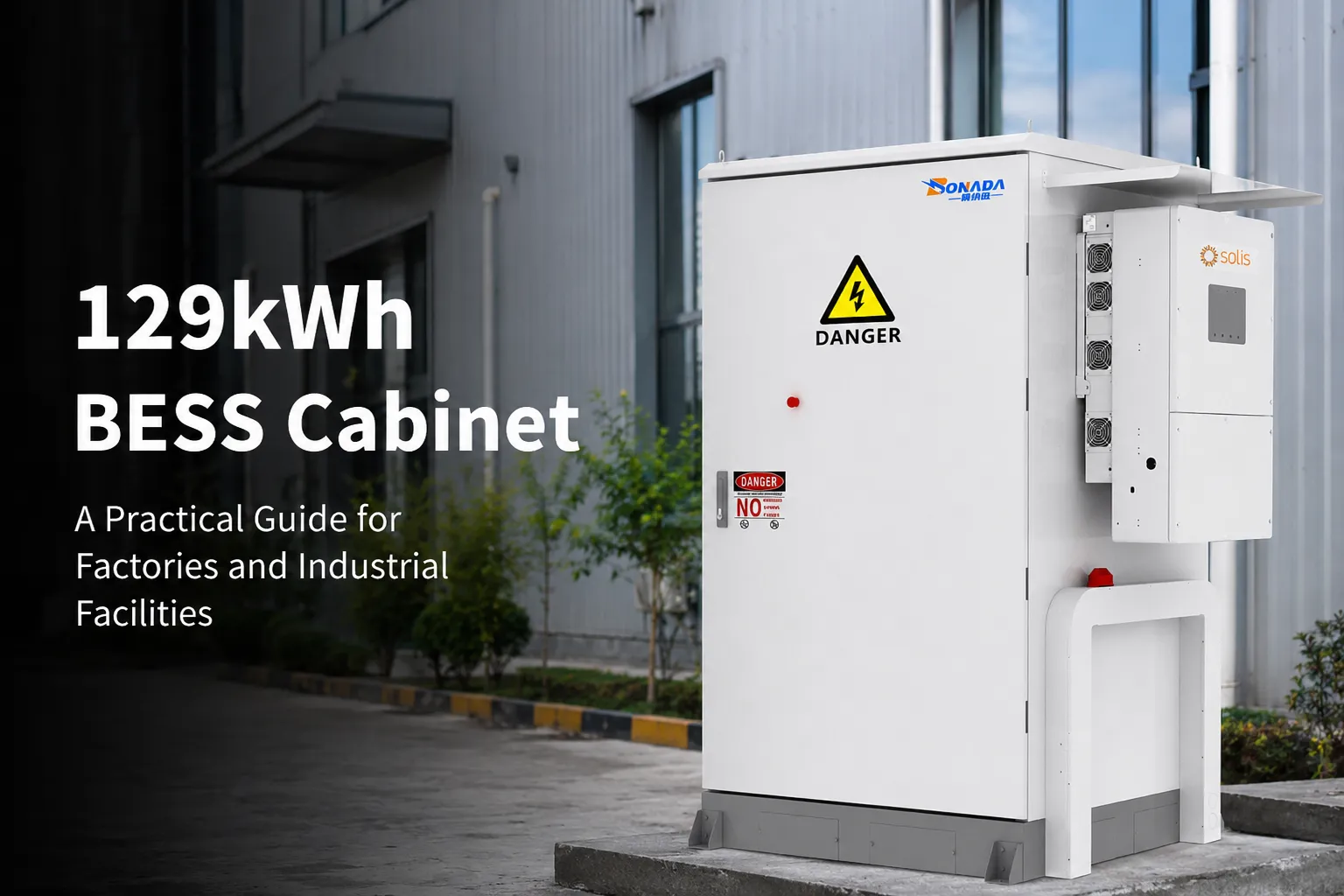
Electricity is one of the largest operating expenses for many factories. The problem is not always the total amount of electricity a facility consumes. In many markets, a factory can face significantly higher charges simply because its power demand reaches a high level for a short period.
129kWh BESS Cabinet: Complete Guide to Capacity, Components, Applications and Sizing

One of the first questions homeowners ask when considering solar storage or backup power is: How many batteries to run a whole house? It sounds like a simple question, but the answer is different for every home. A battery system that works well for a small house with basic backup needs may not be enough for a larger property running air conditioning, electric heating, or an EV charger.
How Many Batteries to Run a Whole House? A Practical Home Battery Sizing Guide
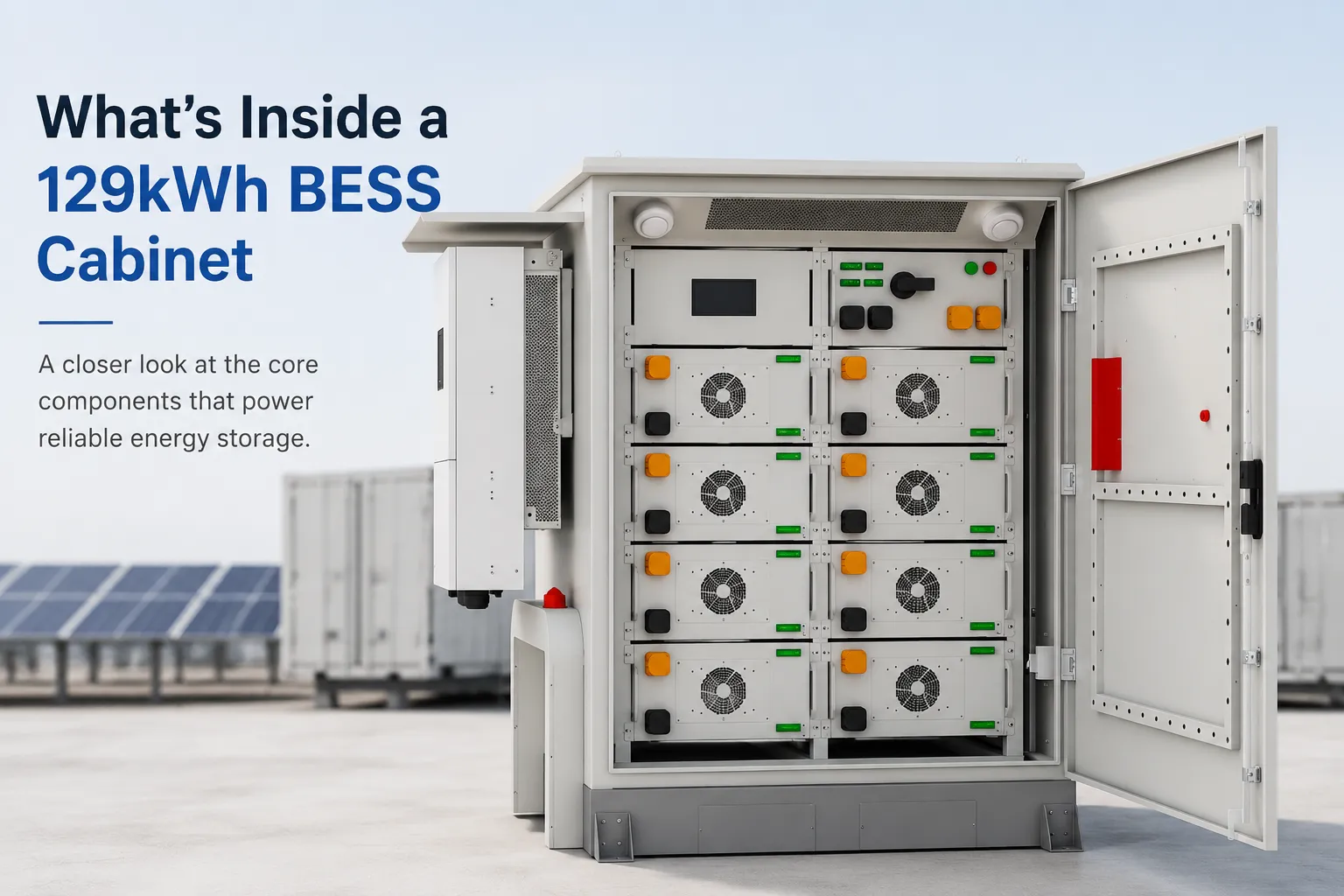
A typical 129kWh BESS cabinet contains much more than battery cells. Inside the enclosure, multiple systems work together, including battery modules, Battery Management System (BMS), high-voltage protection units, Energy Management System (EMS), cooling equipment, fire protection devices, and communication components. Each part has a specific role in maintaining safe and stable energy storage operation.
What's Inside a 129kWh BESS Cabinet? A Complete Breakdown of Internal Components
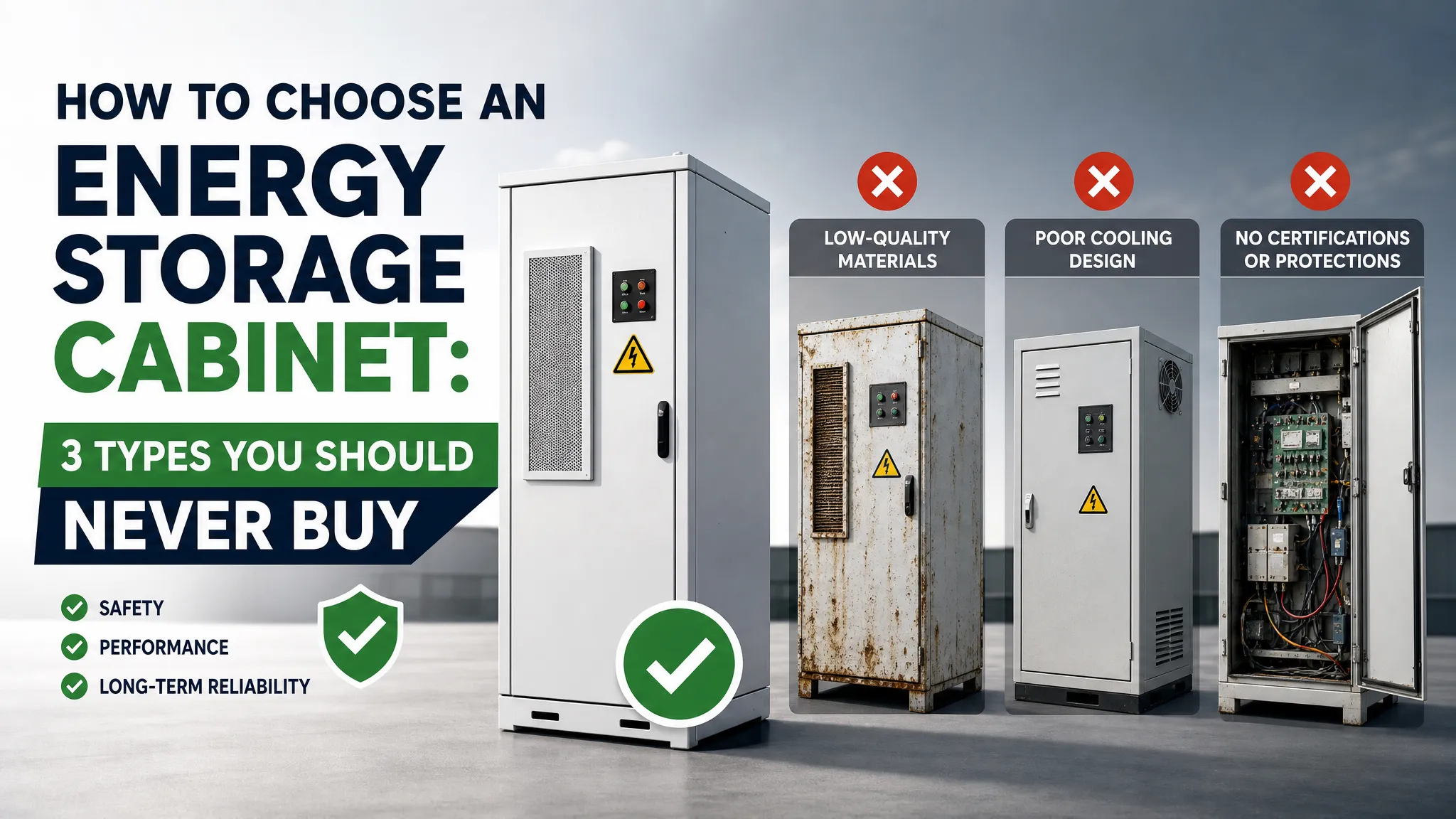
When sourcing a Battery Energy Storage System (BESS), most buyers obsess over cell capacity, inverter brands, and price per kilowatt-hour. The enclosure? It’s usually an afterthought—treated as a simple metal box. That is a massive financial and operational mistake.
How to Choose an Energy Storage Cabinet: 3 Types You Should Never Buy